A Season Without Major Trophies: Why Real Madrid Failed in 2025–26
 After90
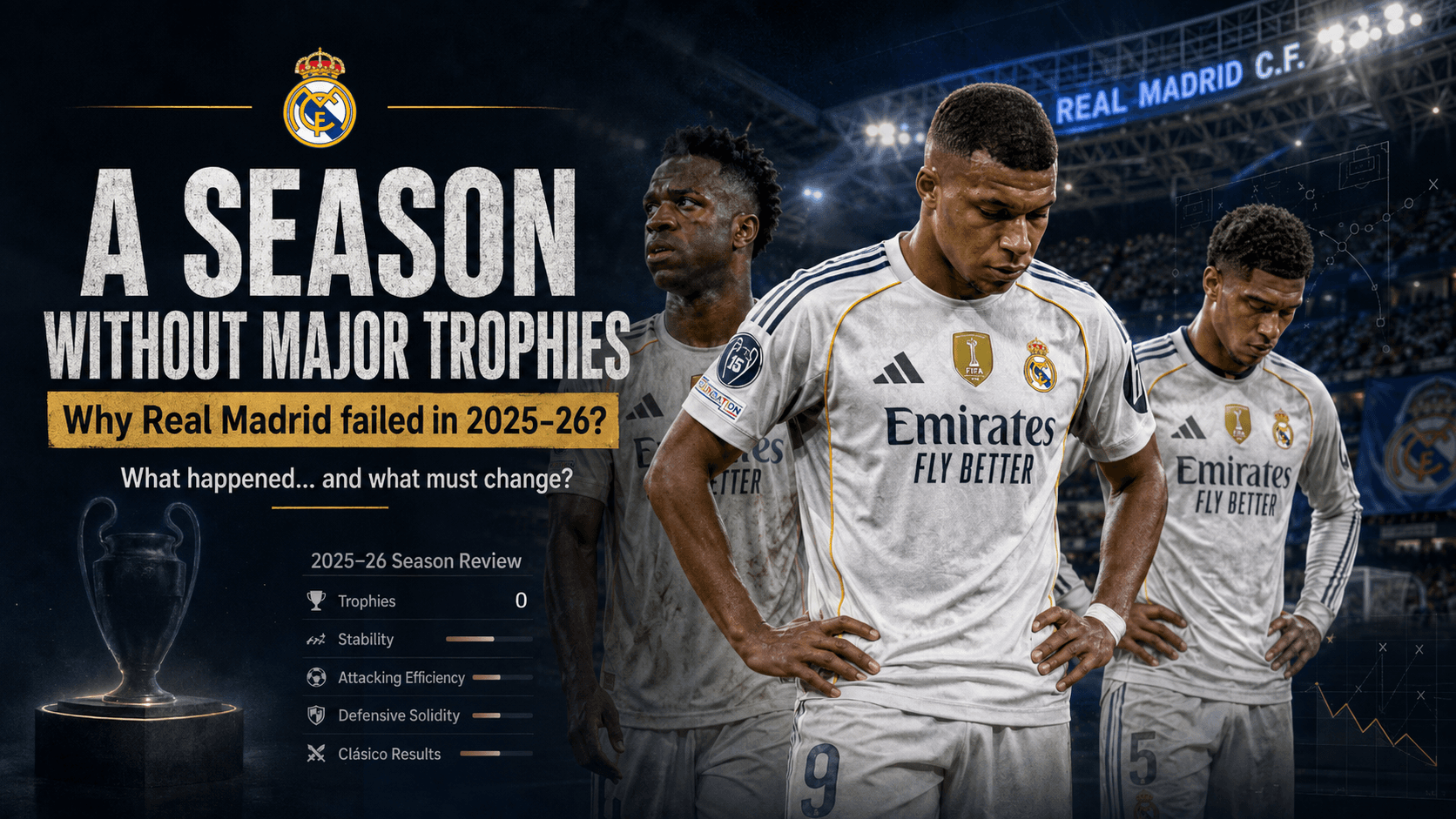
Plenty of Stars, but No Real Team
Real Madrid ended the 2025–26 season in a way that did not reflect the quality of the squad or the scale of the club’s ambitions.
The team had players capable of deciding any match and produced several strong performances against elite opponents, but it failed to turn that individual quality into a stable collective identity across the season.
The result was another campaign without a major trophy, after:
- Losing LaLiga to Barcelona.
- Being eliminated from the Champions League by Bayern Munich.
- Suffering an early and surprising Copa del Rey exit.
- Losing the Spanish Super Cup final.
The problem was not that Real Madrid were a weak team. The problem was that they were a strong team without a clear identity.
LaLiga: The Problem Was Not Only Defensive
Real Madrid finished second in LaLiga with 86 points, eight behind Barcelona.
| Metric | Real Madrid | Barcelona |
|---|---|---|
| Points | 86 | 94 |
| Wins | 27 | 31 |
| Draws | 5 | 1 |
| Defeats | 6 | 6 |
| Goals scored | 77 | 95 |
| Goals conceded | 35 | 36 |
| Goal difference | +42 | +59 |
These numbers reveal an important point: the main difference between the two teams was not the number of goals conceded, but their ability to score and turn control into victories.
Real Madrid and Barcelona lost the same number of matches, while Madrid actually conceded one fewer goal.
However, Barcelona recorded four more victories, and that was enough to create the decisive gap in the title race.
Real Madrid’s 2–0 defeat to Barcelona during the final stage of the season was one of the key moments, as Barcelona extended their advantage and confirmed their superiority in the title race.
Madrid were not incapable of competing with Barcelona in direct meetings, but they could not reproduce the same performance level week after week.
An Attack Full of Talent, but Unstable as a System
Real Madrid had several high-level attacking options, including:
- Kylian Mbappé.
- Vinícius Júnior.
- Jude Bellingham.
- Rodrygo.
- Arda Güler.
- Franco Mastantuono.
However, having so many talented players was not enough to create a balanced attacking system.
The main problem appeared in the team’s occupation of the final third.
Vinícius naturally starts on the left before moving inside, while Mbappé frequently drifts toward the same area.
Bellingham also prefers to attack the inside-left channel, while Rodrygo sometimes moves centrally rather than maintaining width on the right.
This occasionally resulted in three or four players gathering in similar areas, while the opposite side of the pitch lacked a genuine attacking presence.
Real Madrid had players capable of dribbling and scoring, but the team often lacked:
- Attacking width.
- Proper occupation of the penalty area.
- Coordinated rotations.
- Repeatable attacking patterns.
- Connections between both flanks.
- A striker capable of pinning the centre-backs.
As a result, Madrid were more dangerous when matches became open, but less convincing against opponents who defended deep with large numbers behind the ball.
Too Much Dependence on Individual Quality
At their best, Real Madrid could decide matches through:
- A Vinícius run.
- An Mbappé movement behind the defence.
- A late Bellingham arrival.
- A line-breaking pass from Güler.
- A shot or individual action from Rodrygo.
However, when those individual moments did not appear, the team did not always have a collective structure capable of producing chances consistently.
In some matches, the attacking plan became dependent on waiting for something exceptional, rather than building attacks through clear and repeatable mechanisms.
That approach may succeed in a single match, but it is not enough to win a league title or progress deep into the Champions League.
Elite teams need individual brilliance, but they also need a system that can create chances even when their stars are not performing at their highest level.
Champions League: Attacking Quality Could Not Prevent the Collapse
Real Madrid produced several strong Champions League performances, including their success against Manchester City.
However, their campaign ended against Bayern Munich in the quarter-finals, with Madrid losing 6–4 on aggregate.
The team scored three goals away from home in the second leg and once again demonstrated its attacking threat, but it could not manage the game when it became fast and open.
The problem was not only conceding goals. It was the team’s inability to control the rhythm of the match.
Real Madrid needed to:
- Slow the game after periods of dominance.
- Keep possession for longer spells.
- Protect the space in front of the centre-backs.
- Prevent Bayern from launching repeated attacks.
- Reduce the chaos after losing the ball.
- Avoid entering a constant end-to-end exchange.
Instead, the match became an open attacking contest, which gave Bayern the space they needed to reach the semi-finals.
Poor Protection After Losing Possession
One of Real Madrid’s most important weaknesses was the organisation behind their attacks.
When both full-backs pushed forward and several midfielders and attackers moved ahead of the ball, the team often left large spaces in front of the defence.
After losing possession, the centre-backs were forced to:
- Defend in open spaces.
- Move out toward the flanks.
- Face quick attackers in one-against-one situations.
- Deal with numerical disadvantages.
- Cover much larger areas than normal.
This does not mean that Real Madrid conceded an unusually high number of league goals, but they lost control of many matches because of this problem.
Good protection behind the attack does more than prevent goals. It also allows a team to recover the ball quickly and maintain pressure on the opponent.
High Pressing Without Enough Coordination
Real Madrid attempted to press high in many matches, but the pressure was not always collective.
The forwards would move toward the player in possession, while the midfield remained deeper or too far behind them.
Once the opponent escaped the first line of pressure, large spaces became available to attack the defensive line.
Effective pressing is not based on running alone. It requires:
- Compact distances between the lines.
- Closing passing angles.
- The defensive line stepping forward.
- Clear pressing triggers.
- Every player following the same structure.
- Protection behind the first player applying pressure.
Uncoordinated individual pressing consumed energy without giving Madrid the control they needed.
Copa del Rey Elimination: More Than Just an Upset
Real Madrid were eliminated from the Copa del Rey after a 3–2 defeat to Albacete, in Álvaro Arbeloa’s first match in charge of the first team.
The defeat was not simply a surprising result against a lower-division opponent. It reflected the instability surrounding the project.
Madrid entered the match under a new coach, without enough time to build clear tactical ideas or address the problems that had appeared during the first half of the season.
In knockout football, a lack of concentration or organisation can be enough to end an entire competition.
Managerial Changes Destroyed Continuity
Real Madrid moved between several coaches in a short period:
- Xabi Alonso started the season.
- Álvaro Arbeloa took charge during the campaign.
- José Mourinho was appointed to lead the new project.
Changing the coach does not only mean replacing the person on the touchline.
Every manager has different ideas regarding:
- Building from the back.
- Full-back positioning.
- The roles of Bellingham and Güler.
- How Vinícius and Mbappé should be used.
- The height of the defensive line.
- Pressing timing.
- Managing the closing stages of matches.
- The team’s shape in and out of possession.
With every change, the players have to relearn their roles and relationships on the pitch.
Throughout the season, Real Madrid looked like a team searching for an identity, rather than a team developing an existing one.
What Worked Despite the Disappointing Season?
The campaign was not completely without positives.
Mbappé Maintained His Goal Threat
The French forward remained the team’s main threat in front of goal, and his movement into space helped Madrid in open matches.
Mbappé can finish chances and make the difference from limited opportunities, but the team did not always provide the ideal tactical environment for him.
Vinícius Remained One of the Main Sources of Danger
Vinícius maintained his ability to:
- Dribble past opponents.
- Create chances.
- Accelerate into space.
- Attract multiple defenders.
- Threaten opponents in transition.
However, the team did not always organise the relationship between his movements and Mbappé’s positioning effectively.
Arda Güler Continued to Develop
Güler became more involved in the creative phase and offered solutions through:
- Passing between the lines.
- Shooting from distance.
- Set pieces.
- Playing in tight spaces.
- Linking midfield and attack.
The Team Proved It Could Beat Elite Opponents
In certain matches, Real Madrid showed that their technical ceiling remained extremely high.
They demonstrated that they could compete with Europe’s strongest teams when the press, midfield and attack operated as one unit.
The problem was their inability to maintain that level consistently.
What Needs to Change?
Real Madrid need changes that go deeper than simply adding more players.
1. Define the Roles of Mbappé, Vinícius and Bellingham
The three players cannot continue moving into the same areas.
The team needs a clear distribution of space:
- Who maintains width on the left?
- Who starts as the central striker?
- Who plays between the lines?
- Who attacks the penalty area?
- Who stays outside the box to recover second balls?
2. Maintain a Genuine Attacking Presence on the Right
Real Madrid need a player who consistently provides width on the right, whether that is a winger or an advanced full-back.
Without that presence, the team becomes too heavily focused on the left, making its attacks easier to predict and defend.
3. Improve the Structure Behind Attacks
Enough players must remain behind the ball to prevent the team from becoming exposed after every turnover.
Madrid need a structure that allows them to attack aggressively without leaving the centre-backs isolated against counterattacks.
4. Develop Better Solutions Against Deep Defences
The team cannot depend only on dribbling and hopeful crosses.
It needs organised patterns such as:
- Third-man combinations.
- Overlaps between the winger and full-back.
- Cut-backs.
- Movement between the lines.
- Late midfield runs.
- Low crosses into the penalty area.
- Fast switches from one side to the other.
5. Control the Rhythm of Matches
Real Madrid need a player, or a group of players, capable of deciding when the game should be accelerated and when it should be slowed down.
The team cannot play every minute at maximum speed, because that turns matches into open contests and increases the risk of losing control.
6. Achieve Managerial Stability
The players need a coach who has enough time to build a consistent system and develop it, rather than restarting the project every few months.
7. Restore Dressing-Room Discipline
Success requires clarity regarding:
- Player roles.
- Selection criteria.
- Leadership responsibilities.
- Reactions to substitutions.
- Managing internal disagreements.
- Commitment to tactical instructions.
Conclusion
Real Madrid did not fail because of a lack of quality.
They failed because they could not turn that quality into a stable and organised team.
The squad had excellent players, but it lacked:
- Balance.
- Role clarity.
- Control of matches.
- Organisation after losing possession.
- Consistency.
- Managerial stability.
Real Madrid were capable of producing a major performance against a strong opponent, then looking far less convincing against a deep and organised defensive block.
That gap between the team’s highest level and its average level is what the new coaching staff must address.
The new season does not simply require a more attacking Real Madrid, nor does it only require a more defensive Real Madrid.
It requires a team that understands:
- When to attack.
- How to attack.
- How to protect its attacks.
- When to press.
- When to slow the game down.
That is the real starting point for the new project.