







Bradley Barcola to Liverpool: A £120m Luxury Signing or the Missing Piece in Iraola’s Attack?
 After90
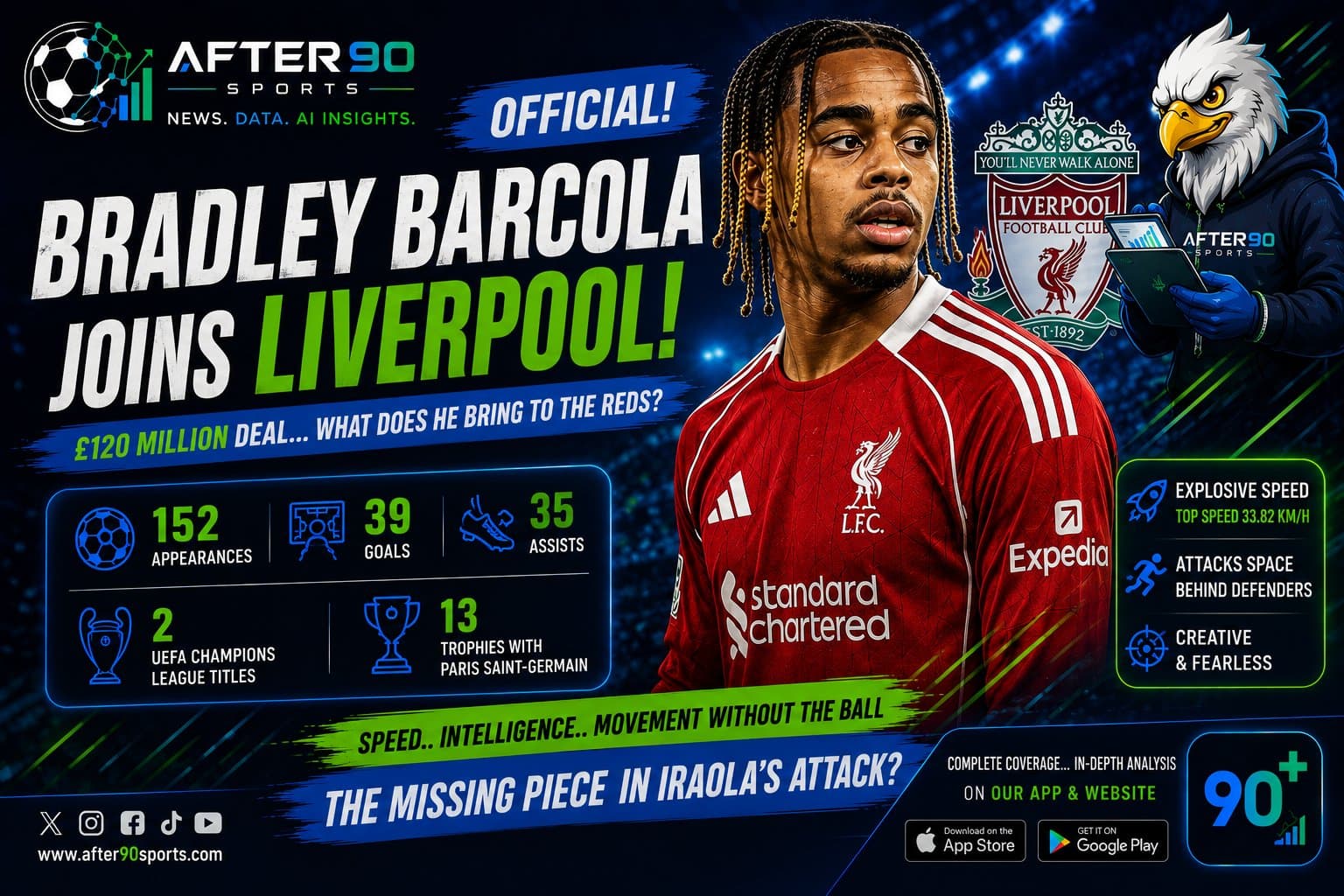
Explosive pace, intelligent movement and a constant threat behind defenders. We analyse how Bradley Barcola could transform Liverpool's attack alongside Isak and Wirtz.
Liverpool have not simply added another player to their attack.
The English club have officially completed the signing of Bradley Barcola from Paris Saint-Germain on a long-term contract, completing one of the biggest transfers of the summer window.
Reuters reports that the deal is worth around £120 million, while other reports put the potential total package at approximately £123 million including add-ons.
It is an enormous investment.
But the most important question is not:
Did Liverpool pay too much?
It is:
What exactly are Liverpool buying for that money?
The answer goes beyond goals and assists.
It is about pace, movement without the ball, attacking space behind defensive lines and potentially restoring an attacking dynamic Liverpool were missing last season.
That is why Barcola could represent much more than another expensive forward.
He could become a central piece in the redesign of Liverpool's attack under Andoni Iraola.
Official: Bradley Barcola Is a Liverpool Player
Liverpool completed the transfer following three highly successful seasons for Barcola at Paris Saint-Germain.
The French international arrives after being part of a PSG side that won consecutive Champions League titles alongside multiple domestic trophies.
During his time in Paris, Barcola recorded:
| Metric | Total |
|---|---|
| Appearances | 152 |
| Goals | 39 |
| Assists | 35 |
| Trophies with PSG | 13 |
| Champions League titles | 2 |
Barcola therefore does not arrive at Anfield simply as a talented young player looking to prove himself at the highest level.
He has already played and won within a European championship-level team.
Yet he is still only 23 years old.
That combination of experience and age is one of the factors behind Liverpool's enormous investment.
Why Did Liverpool Need a Player Like Barcola?
Before the deal was completed, Iraola had been clear about Liverpool's need for additional options in wide areas.
The club entered the new season following major changes to its attacking unit.
But Liverpool did not simply need another winger capable of receiving the ball and dribbling.
They needed something more specific:
Movement without the ball.
That distinction is important.
Liverpool already have players capable of receiving possession and creating.
But even the best playmaker becomes less effective when there is insufficient movement ahead of him.
This is where Barcola becomes particularly interesting.
His natural instinct is often to run to receive the ball in space rather than wait for it to arrive at his feet.
That characteristic could be particularly important alongside a player such as Florian Wirtz.
If Wirtz can find passing lanes between and behind defensive lines, he needs forwards constantly threatening those spaces.
Barcola does exactly that.
Barcola Is a Winger Who Thinks Like a Striker
This may be the most important tactical aspect of the transfer.
Barcola has predominantly operated from the left wing at PSG.
But his development was not that of a traditional touchline winger.
During his academy years at Lyon, he played as a striker until around the age of 17.
You can still see that background in his movement.
Barcola does not simply remain wide and wait for possession.
He constantly looks to:
- Run behind the full-back.
- Move into the half-space.
- Attack the channel between full-back and centre-back.
- Enter the penalty area from wide positions.
- Receive passes behind the opposition's final defensive line.
His instincts frequently resemble those of a forward more than a conventional winger.
That gives Iraola significantly more possibilities than simply placing Barcola on the left side of a 4-3-3.
Pace Is Not Just a Strength — It Is Fundamental to the Transfer
Barcola is among the quickest attacking players at the elite European level.
He ranked among the 10 fastest players in last season's Champions League, while UEFA data has recorded a top speed of 33.82 km/h with France.
But raw speed is not what makes him particularly valuable.
It is how he uses it.
Some wingers become dangerous once the ball reaches their feet.
Barcola can become dangerous before receiving the ball at all.
His runs behind the defensive line force defenders to retreat.
And when the defensive line drops, space opens elsewhere.
That means Barcola can influence Liverpool's attack even in situations where he never receives the final pass.
Where Will Barcola Play?
This is perhaps the most complicated question surrounding the transfer.
Barcola's natural position is on the left.
But Liverpool already have several players capable of operating from that side.
Cody Gakpo can play from the left.
Rio Ngumoha is another option.
Victor Muñoz can operate across different attacking positions.
That is why questions have already been raised about the balance of Liverpool's recruitment.
Jamie Carragher, for example, has argued that while Barcola is an outstanding player, Liverpool's more obvious requirement was on the right wing following Mohamed Salah's departure.
That is an important distinction.
Barcola should not automatically be presented as a direct "Salah replacement."
He is a different type of player.
His preferred starting position is different.
And the way he arrives in scoring positions is different.
So Why Spend £120 Million?
Because Liverpool may not be trying to replace one player with another.
They may be building a completely different attacking structure.
Liverpool's attacking options now include players such as:
- Alexander Isak.
- Bradley Barcola.
- Cody Gakpo.
- Hugo Ekitike.
- Rio Ngumoha.
- Victor Muñoz.
This is not an attempt to recreate an old Liverpool attack.
It is a new collection of forwards with different characteristics.
And the success of the project will depend on how Iraola distributes the roles between them.
Barcola + Isak Could Become the Key Partnership
Having Alexander Isak at centre-forward makes Barcola's arrival particularly interesting.
Isak is not simply a striker who remains inside the penalty area.
He can move away from the last defensive line, receive possession and connect attacks.
When a striker drops away from the defensive line, someone else needs to attack the space he has created.
That player could be Barcola.
Imagine the sequence:
Isak drops to receive possession.
A centre-back follows him.
Barcola immediately attacks the space from the left.
Wirtz has possession between the lines.
Suddenly Liverpool have a vertical passing lane directly towards goal.
Those are precisely the types of movements that could give Iraola's attack greater depth and unpredictability.
Wirtz May Be Another Major Reason Behind the Transfer
Florian Wirtz is a player who wants runners ahead of him.
His ability to find spaces and play vertical passes becomes considerably more dangerous when forwards continuously attack the defensive line.
That was one of the attacking characteristics Liverpool lacked at times last season.
Barcola can restore some of that dynamic.
Not because he is a direct replacement for any previous Liverpool forward.
But because he gives Wirtz a constant target behind the opposition defence.
This relationship could ultimately become one of the most important tactical consequences of the transfer.
What About the Right Wing?
This remains the biggest question mark.
Barcola has played on the right before.
His pace can still make him dangerous there, particularly when attacking the outside channel.
But most of his strongest football has come from the left.
Using him on the right changes his attacking profile.
Instead of naturally moving inside onto his stronger foot, he may become more dependent on maintaining width and making outside runs.
Can he succeed there?
Yes.
Is that the best way to maximise a £120 million player?
That is much less certain.
How Iraola distributes minutes and roles between Barcola, Gakpo and Liverpool's other wide players could therefore become one of the defining tactical stories of the season.
Pressing Is Another Reason the Transfer Makes Sense
Iraola does not want Liverpool to become a passive team without possession.
His football demands intensity and aggressive attempts to recover the ball.
This is another area where Barcola's physical profile becomes useful.
He has the athletic capacity to repeatedly sprint, press from wide positions and immediately transition into attack when possession is recovered.
Liverpool finished last season in fifth place, despite significant investment in the squad.
Iraola has also spoken about the need for greater intensity without the ball following Liverpool's winless opening to the new league campaign.
Adding a fast forward capable of pressing and then immediately attacking space fits naturally within that idea.
But There Is a £120 Million Question
All of those characteristics explain why Liverpool wanted Barcola.
They do not completely answer the more difficult question:
Is he worth around £120 million?
That price changes expectations.
Liverpool are not buying a player who can quietly develop for several years without pressure.
At this price, Barcola will be expected to become decisive.
He will be expected to influence major matches.
And he will ultimately be judged against the most expensive attacking transfers in football.
Where Does Barcola Still Need to Improve?
For all his qualities, Barcola is not yet a complete forward.
One area where further improvement remains possible is finishing.
Luis Enrique worked with him on becoming more clinical in front of goal during his time at PSG.
Barcola can create high-quality situations through his movement and acceleration, but there are still occasions when the final action does not match the quality of everything that came before it.
That becomes particularly important in the Premier League.
Against deeper defensive blocks, Liverpool may encounter less space than Barcola enjoyed in some Ligue 1 matches.
When opportunities become less frequent, decision-making and finishing become even more important.
It will not be enough for Barcola to consistently reach dangerous positions.
At this price, Liverpool will expect him to convert those situations more regularly.
39 Goals and 35 Assists — Is That Enough?
Barcola's PSG numbers are strong:
39 goals and 35 assists across 152 appearances.
That represents consistent attacking production while competing for minutes in one of Europe's deepest forward lines.
But the context is important.
Barcola was not always an automatic starter.
Last season, he appeared 49 times across all competitions, including 29 Ligue 1 matches, but started only 21 league games.
Competition with players such as Khvicha Kvaratskhelia, Desire Doue and Ousmane Dembele made securing a permanent starting role extremely difficult.
Liverpool can potentially offer him something different.
The opportunity to become one of the central figures of an attacking project.
Why Did He Leave PSG?
Paris Saint-Germain were not simply disposing of an unwanted player.
Barcola was part of a squad that won consecutive Champions League titles.
But PSG's attacking competition had become extraordinary.
Dembele.
Kvaratskhelia.
Doue.
And several other options.
Barcola was competing for minutes within perhaps the deepest attacking group in European football.
Liverpool can offer him something PSG increasingly could not guarantee:
The opportunity to become a central player rather than one of several elite options.
Liverpool Are Also Betting on the Future
Barcola is still only 23.
That matters when evaluating the transfer fee.
Liverpool are not paying solely for the player he is today.
They are paying for what they believe he can become during his prime years.
They are acquiring a player who already possesses:
- Champions League experience.
- Two Champions League titles.
- International experience with France.
- Elite pace.
- Positional versatility.
- Strong attacking production.
And yet there is still obvious room for improvement.
If his finishing and decision-making in the final third develop, the transfer fee could look considerably less extraordinary several years from now.
What Could Liverpool's Attack Look Like?
One particularly intriguing possibility would be:
Barcola — Isak — Right Winger
With:
Wirtz
operating behind them.
That structure would give Liverpool:
- Barcola attacking space from the left.
- Isak moving between the lines and into the penalty area.
- Wirtz searching for vertical passing lanes.
- A right-sided forward providing width or moving centrally depending on the tactical setup.
But there is another possibility.
Barcola could begin on the left and effectively become a second striker when Liverpool have possession.
In that scenario, Liverpool could defend in something resembling a:
4-2-3-1
before attacking in a:
3-2-5 or 2-3-5
depending on the positioning of the full-backs.
Barcola would then no longer operate as a conventional winger.
He would become one of five players occupying Liverpool's highest attacking line.
That could be where his striker instincts become particularly valuable.
Does Barcola Solve All of Liverpool's Problems?
No.
And that distinction matters.
Barcola can improve Liverpool's:
Pace.
Movement without the ball.
Threat behind defensive lines.
One-v-one ability.
Attacking transitions.
But he cannot individually solve every structural issue.
Liverpool have started the Premier League season with two draws, while Iraola has acknowledged periods in which his team lacked the necessary intensity without possession.
The success of this transfer therefore cannot be judged simply by counting Barcola's goals.
The more important question is whether his presence makes Liverpool's entire attacking structure better.
What Should We Monitor in Barcola's First Weeks?
This is where the After90Sports analysis begins.
Rather than looking only at goals and assists, several indicators could tell us much more about whether the transfer is working.
1. Runs Behind the Defensive Line
How often does Barcola attack the space behind the opposition's last line?
And more importantly:
How often do Liverpool's midfielders find those runs?
2. Penalty-Area Touches
If he starts on the left, does he remain outside the box?
Or does he consistently become an additional penalty-area attacker?
This will tell us a great deal about the role Iraola actually wants him to play.
3. Receiving Between Full-Back and Centre-Back
This could become Barcola's most dangerous zone.
If Liverpool can consistently find him in that channel, he can immediately threaten with a shot, final pass or carry towards goal.
4. His Relationship With Wirtz
How often does Wirtz find Barcola with progressive passes?
How many chances emerge from their combinations?
This could become one of Liverpool's most important new attacking partnerships.
5. His Relationship With Isak
Who attacks the penalty area?
Who drops?
Who creates space for the other?
If Isak and Barcola successfully exchange those responsibilities, Liverpool's attack could become significantly less predictable.
6. Pressing After Possession Is Lost
Barcola's reaction immediately after Liverpool lose possession will be an essential part of whether he fits Iraola's system.
The £120 million investment is not only about what he does with the ball.
It is also about whether he helps Liverpool become more aggressive without it.
The After90Sports Angle
The main question surrounding Barcola should not simply be:
How many goals will he score?
It should be:
Does Bradley Barcola change the way Liverpool attack?
At After90Sports, the key indicators to track are:
Runs behind the defensive line + penalty-area touches + half-space receptions + progressive carries + combinations with Wirtz and Isak + pressing after possession is lost.
Because the true value of a transfer this expensive will not appear only in the goalscoring table.
It will appear in Liverpool's ability to attack opponents in ways they could not do as effectively before.
£120 Million: Luxury Signing or the Missing Piece?
There are two legitimate ways to view this transfer.
On one side, Liverpool have spent an enormous amount on a player whose preferred position is the left wing — an area where the squad already contains several options.
Questions about squad balance are therefore entirely reasonable.
But on the other side, Barcola possesses a combination of qualities Liverpool clearly needed:
Pace.
Runs into space.
Movement without the ball.
The ability to attack goal from wide positions.
The flexibility to perform several attacking roles.
If Iraola can create the right environment around him, Barcola may become much more than another expensive signing.
He could become the player connecting Wirtz's vision, Isak's movement and Iraola's attacking philosophy.
And if that happens, the question may eventually stop being:
Why did Liverpool spend £120 million on Bradley Barcola?
It could become:
How would this Liverpool attack work without him?
Sources
- Liverpool FC — Official announcement and Bradley Barcola player profile.
- Paris Saint-Germain — Official confirmation of Barcola's departure and record with PSG.
- Reuters — Reported transfer value and background to the Liverpool move.
- Sky Sports — Tactical analysis of Barcola's pace, movement, preferred position and fit at Liverpool.
- Ligue 1 — Barcola's PSG appearances and attacking competition.
- UEFA — Official speed and international performance data.