Champions Again — But What Still Went Wrong? Barcelona’s 2025–26 Season Under the Microscope
 After90
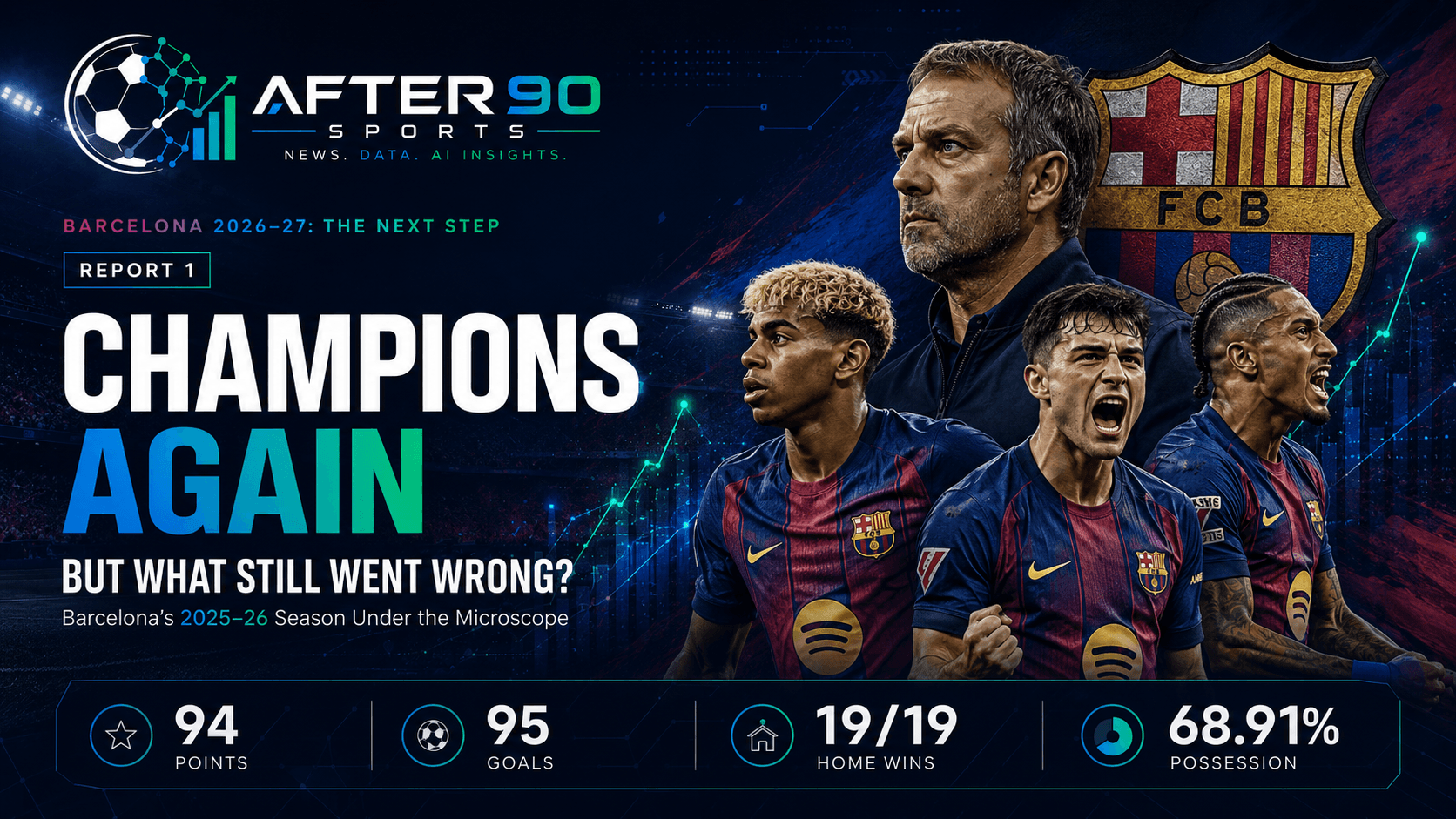
Report 1 — Barcelona 2026–27: The Next Step
Barcelona ended the 2025–26 season as champions of Spain.
Again.
They collected 94 points, scored 95 league goals, dominated possession, won every single home league match, and finished eight points ahead of Real Madrid.
They also defeated Real Madrid 3–2 to retain the Spanish Super Cup.
On the surface, this looks like an outstanding season.
And domestically, it was.
But Barcelona’s season also contained an uncomfortable contradiction.
The team that dominated LaLiga was eliminated from both the Champions League and Copa del Rey by Atlético Madrid.
The team capable of controlling the ball for long periods could still become vulnerable when matches became chaotic.
The team that scored freely in Europe failed to keep a single Champions League clean sheet.
Barcelona proved they were the best team in Spain.
What they did not prove was that they were the best team in Europe.
That is why the biggest question entering 2026–27 is not:
Can Barcelona win again?
They already can.
The real question is:
What must change for Barcelona to take the next step?
1. LaLiga: Domestic Dominance Was Real
Barcelona’s league season was not simply successful.
By most important attacking measures, it was dominant.
The final numbers were remarkable:
| Metric | Barcelona |
|---|---|
| Points | 94 |
| Goals scored | 95 |
| Goals per match | 2.5 |
| Average possession | 68.91% |
| Total shots | 692 |
| Shots on target | 257 |
| Points won from losing positions | 21 |
| Different league goalscorers | 16 |
Barcelona finished with 18 more league goals than Real Madrid, who were the second-highest scoring side with 77.
That difference matters.
It shows that Barcelona were not simply controlling matches through possession.
They were converting that possession into attacking production.
The team could create chances from several different sources.
Lamine Yamal.
Raphinha.
Ferran Torres.
Robert Lewandowski.
Dani Olmo.
Fermín López.
Pedri.
And even defenders and deeper midfielders contributed.
Having 16 different league goalscorers made Barcelona much harder to defend than a team dependent on only two or three attacking stars.
2. The Perfect Home Season
Perhaps the most extraordinary statistic from Barcelona’s league campaign was this:
19 home matches. 19 victories.
Barcelona collected all 57 possible home points.
Across those 19 matches they scored:
57 goals
and conceded only:
10.
That means Barcelona averaged exactly three goals per home league match while conceding barely more than half a goal per game.
They also kept 10 clean sheets at home.
This is what championship-level home dominance looks like.
The significance goes beyond the numbers.
Opponents arriving to face Barcelona increasingly knew that they would need an almost perfect performance simply to survive.
Barcelona could:
- Control possession.
- Press high.
- Recover the ball quickly.
- Attack with width.
- Create overloads.
- Score from multiple positions.
- Respond when falling behind.
That combination turned their home matches into one of the foundations of the title.
3. Barça Became the League’s Most Complete Attacking Team
Hansi Flick’s Barcelona are sometimes described simply as an attacking team.
That description is incomplete.
The more important characteristic is the volume of pressure they create.
Barcelona led LaLiga in shots.
They led the league in possession.
They scored more than anyone else.
They won more corners than any other team.
And they repeatedly caught opponents offside through their aggressive defensive line.
The intention was clear:
Push the entire match toward the opponent’s goal.
When the system worked, Barcelona could trap opponents inside their own half.
The ball would circulate quickly.
The full-backs and wingers would stretch the pitch.
The midfield would constantly provide passing angles.
And when possession was lost, Barcelona attempted to recover it almost immediately.
This created waves of pressure rather than isolated attacks.
That is one of the biggest achievements of Flick’s project.
Barcelona became a team that could impose its preferred game on most domestic opponents.
4. Lamine Yamal Became the Centre of the Project
If one player symbolised Barcelona’s season, it was Lamine Yamal.
He finished the league campaign with:
16 goals and 11 assists.
He was named LaLiga Player of the Season.
And perhaps most importantly, he continued evolving from an extraordinary young talent into one of Barcelona’s primary attacking references.
His influence extends beyond goals and assists.
When Lamine receives the ball on the right, opponents face several problems at once.
If the left-back stays alone against him, Lamine can attack one-on-one.
If a midfielder comes across to help, space opens centrally.
If a centre-back moves outward, the defensive line becomes stretched.
That creates opportunities for Barcelona’s midfielders and forwards.
The threat therefore exists before Lamine even beats his defender.
His presence changes defensive positioning.
That is the mark of an elite attacking player.
5. The Danger: Barcelona Must Not Become Lamine-Dependent
There is another side to his importance.
The better Lamine becomes, the greater the temptation to give him the ball and wait for him to solve the problem.
Barcelona must resist that.
Their strongest football comes when Lamine is the final piece of an organised attacking structure.
Not when the structure disappears and he becomes the structure.
Against the strongest European teams, one player — even a brilliant one — cannot solve everything repeatedly.
Barcelona need the movements around him to remain strong:
- The right-back providing the correct support.
- Midfielders creating passing triangles.
- The striker occupying the centre-backs.
- The opposite winger attacking the far side.
- Pedri and the deeper midfielders controlling the second ball.
Lamine should be Barcelona’s greatest weapon.
He should not become Barcelona’s only answer.
6. Joan García Changed the Goalkeeping Conversation
One of the most successful decisions of the previous summer was the arrival of Joan García.
In his first league season with Barcelona, he won the Zamora Trophy.
His numbers were excellent:
- 30 league appearances.
- 21 goals conceded.
- 0.7 goals conceded per match.
- Several decisive interventions in important games.
This was significant because Barcelona’s defensive system naturally exposes the goalkeeper to unusual situations.
Flick wants his defensive line high.
That means the goalkeeper must be comfortable:
- Defending space behind the centre-backs.
- Making decisions outside the six-yard box.
- Facing transition situations.
- Participating in build-up.
- Remaining concentrated despite long periods without action.
Joan García gave Barcelona security behind an aggressive defensive structure.
And in a team that takes risks, an elite goalkeeper is not a luxury.
He is part of the tactical system.
7. Pedri Remained the Brain of the Team
Lamine may provide the spectacular moments.
But Barcelona’s football still depends heavily on what happens in midfield.
And Pedri remains central to that.
His importance is not measured only in goals or assists.
Pedri determines:
- Where Barcelona circulate the ball.
- When the attack accelerates.
- When possession needs to be recycled.
- Which side receives the next overload.
- How Barcelona escape pressure.
- When the final pass should be attempted.
This is especially important in Flick’s system because Barcelona often play at a very high tempo.
Without a player capable of controlling that tempo, aggressive football can quickly become chaotic football.
Pedri gives Barcelona the ability to attack quickly without always playing hurriedly.
That distinction is vital.
8. The Midfield Was Strong — but Still Carried Enormous Responsibility
Barcelona’s midfield had to perform several functions simultaneously.
It had to:
- Build attacks.
- Support the press.
- Cover behind advanced players.
- Protect the high defensive line.
- Create between the lines.
- Arrive inside the penalty area.
- Recover second balls.
When the midfield controlled those responsibilities, Barcelona looked overwhelming.
When those distances became stretched, the defensive line became much more vulnerable.
This is one of the central tactical lessons from the season.
Barcelona’s high line is not simply a defensive tactic.
It depends on what happens 20 or 30 metres ahead of the defenders.
If the midfield press works:
the defensive line looks aggressive.
If the midfield press fails:
the same defensive line can suddenly look reckless.
9. Raphinha Continued to Give Barcelona Something Different
Raphinha’s importance goes beyond conventional wing play.
He brings a different kind of aggression to Barcelona’s attack.
His game contains:
- Direct running.
- Pressure without the ball.
- Movement into scoring positions.
- Vertical passes.
- Attacks toward the far post.
- Intensity in transitions.
His two goals against Real Madrid in the Spanish Super Cup final were another reminder of his ability to influence major matches.
Barcelona need technical players.
But they also need players who attack situations aggressively.
Raphinha gives Flick that quality.
He helps prevent Barcelona from becoming a team that circulates possession beautifully without attacking the goal decisively.
10. The Super Cup Showed Barcelona’s Best Personality
The 3–2 victory over Real Madrid in the Spanish Super Cup final represented many of Barcelona’s strongest qualities.
They controlled possession for long periods.
They pressed aggressively.
They created chances.
They responded emotionally to Madrid’s goals.
And when the match became difficult late on, Joan García produced important saves.
Raphinha scored twice.
Lewandowski also scored.
Barcelona retained the trophy.
It demonstrated that Flick’s team were capable of combining technical football with competitive personality.
That matters because possession alone does not win finals.
Teams also need:
- Mental strength.
- Efficiency.
- Defensive concentration.
- The ability to survive difficult periods.
Barcelona showed all of those qualities that night.
The question is why they could not reproduce the same balance in their biggest knockout disappointments.
11. The Champions League Revealed the Main Weakness
Barcelona’s Champions League attack was not the problem.
They scored:
32 goals in 12 matches.
That is an average of:
2.67 goals per game.
Those are elite attacking numbers.
But at the other end:
Barcelona conceded 20 goals.
Even more concerning:
They did not keep a single clean sheet in 12 Champions League matches.
This is the statistic that should concern Flick most.
A team can survive this level of defensive volatility in many league matches because superior attacking quality eventually wins.
Champions League knockout football is different.
One defensive mistake can change an entire tie.
One transition can become an away goal.
One red card can destroy a tactical plan.
One bad 20-minute period can end the season.
Barcelona experienced all of those risks.
12. Atlético Madrid Exposed the Difference Between Control and Security
The Champions League quarter-final against Atlético Madrid should become one of the most important case studies for Flick’s coaching staff.
Barcelona lost the first leg at home:
0–2.
They then went to Madrid and won:
2–1.
But Atlético advanced:
3–2 on aggregate.
The numbers show that Barcelona were capable of competing.
They were capable of scoring.
They were capable of winning at the Metropolitano.
But the damage had already been done.
The first leg demonstrated a major problem:
possession does not automatically mean control.
A team can dominate the ball and still fail to control the most dangerous moments of the match.
Atlético did not need to dominate every minute.
They needed to exploit specific moments more efficiently than Barcelona.
And they did.
13. Discipline Made the European Problem Worse
Barcelona also suffered from avoidable disciplinary problems in Europe.
They received three red cards during the Champions League campaign.
Two arrived in the quarter-final tie against Atlético.
Pau Cubarsí was dismissed in the first leg.
Eric García was sent off in the second.
This matters because Flick’s football already operates with relatively small margins defensively.
Barcelona defend high.
They commit players forward.
They ask defenders to cover large spaces.
Losing a player in that structure makes an already aggressive system significantly more difficult to protect.
The lesson is simple:
Barcelona cannot give elite European opponents additional advantages.
At Champions League level, tactical courage must be accompanied by emotional control.
14. Barcelona’s European Problem Was Defensive — but Not Simply About the Defenders
It would be too easy to look at 20 Champions League goals conceded and say:
Barcelona need better centre-backs.
The problem is more complicated.
Defending is collective.
The high line is only safe when:
- The forwards press correctly.
- The midfield closes passing lanes.
- The ball carrier is placed under pressure.
- The defensive line moves together.
- The goalkeeper reads the space behind.
- Players react immediately after losing possession.
If one part fails, the centre-backs become exposed.
That means Barcelona’s European improvement cannot come only through recruitment.
It must also come through:
better collective protection.
15. The High Defensive Line Remains Both a Weapon and a Risk
Flick should not abandon the high line.
It is one of the reasons Barcelona can dominate matches.
It compresses the pitch.
It keeps opponents far from Barcelona’s goal.
It supports counter-pressing.
It allows Barcelona to recover possession quickly.
And the league numbers show how effective it can be.
Barcelona caught opponents offside 164 times in LaLiga.
But there is a difference between using a high line intelligently and using it automatically.
Against elite opponents with:
- Fast forwards.
- Strong ball carriers.
- Midfielders capable of passing through pressure.
the distances must be adjusted.
The next step for Flick should not be abandoning his philosophy.
It should be creating:
more than one version of it.
16. Barcelona Need Better Control of Defensive Transitions
This may be the single most important tactical improvement for 2026–27.
When Barcelona lose possession, what happens during the next three seconds?
That moment determines whether the high line is aggressive or vulnerable.
The first reaction should be:
Pressure the ball.
Then:
Close the central passing lanes.
Then:
Protect the space behind the press.
If Barcelona allow the opponent to receive the ball comfortably and look forward, the defence immediately becomes exposed.
Against most domestic opponents, Barcelona can survive these situations.
Against Champions League-quality attackers, they may not.
The objective therefore should be:
reduce the number of clean counterattacking situations opponents receive.
Not necessarily defend deeper.
Defend earlier.
17. Copa del Rey: The 4–0 That Barcelona Could Not Completely Repair
The Copa del Rey semi-final told a similar story in a much more dramatic way.
Barcelona travelled to Atlético Madrid and lost the first leg:
4–0.
That result effectively placed the entire tie on the edge of elimination.
The response in the second leg was extraordinary.
Barcelona won:
3–0.
They came within one goal of completing a remarkable comeback.
But the damage from the first match was simply too large.
Atlético advanced 4–3 on aggregate.
There are two very different lessons here.
The Positive Lesson: Barcelona Never Stopped Believing
Winning the return leg 3–0 demonstrated:
- Personality.
- Attacking quality.
- Emotional strength.
- Ability to dominate an opponent under pressure.
Barcelona did almost everything required to produce a historic comeback.
That deserves recognition.
The Negative Lesson: Elite Competitions Punish Catastrophic Matches
A team trying to win the Champions League or Copa del Rey cannot produce a 4–0 first-leg collapse and expect to repair it later.
The next step for Barcelona is therefore not simply increasing their maximum level.
Their maximum level is already extremely high.
They need to raise their:
minimum level.
The worst version of Barcelona must become better.
That is how elite teams survive knockout competitions.
18. Barcelona Were Better at Chasing Games Than Preventing Chaos
One of the most interesting statistics from the league campaign was the 21 points gained from losing positions.
This demonstrates mentality.
Barcelona repeatedly responded after going behind.
That is a major strength.
But there is another interpretation.
The ideal team does not always need a comeback.
Barcelona should keep their ability to respond while reducing the situations that force them to respond.
This means:
- Better opening control.
- Fewer unnecessary turnovers.
- Stronger defensive transitions.
- Greater concentration after scoring.
- Better game management when leading.
Coming back from behind is exciting.
Avoiding the need for the comeback is often more efficient.
19. Barcelona’s Biggest Strength Is Also a Potential Weakness: Youth
The team’s youth is one of the most exciting parts of the project.
Lamine Yamal.
Pau Cubarsí.
Gavi.
Marc Bernal.
Marc Casadó.
Fermín López.
And other players developing around them.
Barcelona even fielded the youngest starting XI in the club’s Champions League knockout history during the second leg against Atlético.
That represents enormous potential.
But young teams also learn through painful moments.
Knockout football requires more than talent.
It requires:
- Patience.
- Match management.
- Emotional discipline.
- Knowing when not to attack.
- Recognising danger.
- Understanding when the opponent is trying to change the rhythm.
Barcelona’s young core will become better through experience.
But Flick must accelerate that learning process.
20. What Did Barcelona Do Better Than Almost Everyone Else?
Despite the disappointment in Europe, it is important not to lose perspective.
Barcelona did many things exceptionally well.
They dominated possession
An average of almost 69% across an entire league season is extraordinary.
They created enormous attacking volume
692 league shots demonstrates how consistently they reached attacking positions.
They produced goals from across the squad
Sixteen different league scorers made the attack difficult to predict.
They dominated at home
57 points from 57 is an exceptional achievement.
They could recover from difficult situations
Twenty-one points from losing positions reflects strong mentality.
They developed elite young talent while winning
This may be one of Flick’s greatest achievements.
Barcelona did not choose between development and trophies.
They achieved both.
21. What Must Improve?
The next stage of the project is not a complete rebuild.
Barcelona do not need one.
They need refinement.
Several improvements stand above the rest.
1. Reduce Champions League Defensive Volatility
Twenty goals conceded in 12 matches and no clean sheets is too high for a team trying to win the competition.
The objective should not necessarily be deeper defending.
It should be better protection before the opponent reaches the defensive line.
2. Improve Rest Defence
When Barcelona attack, enough players must remain positioned to control the counterattack.
The attacking structure should already contain the defensive solution.
3. Adapt the High Line to the Opponent
Barcelona should remain aggressive.
But there will be moments when the defensive line needs to drop five or ten metres.
That is not abandoning the philosophy.
That is tactical maturity.
4. Improve Match-State Management
When Barcelona lead, they do not always need another immediate attack.
Sometimes the correct action is:
- Keep possession.
- Slow the opponent.
- Force them to run.
- Remove emotional momentum from the match.
The strongest European teams understand how to change the rhythm.
5. Reduce Red Cards and Emotional Mistakes
Three Champions League red cards are too many.
Barcelona cannot repeatedly compete at a numerical disadvantage against elite opposition.
6. Maintain Multiple Sources of Goals
Lamine’s importance will continue growing.
But Barcelona must continue creating goals from several positions.
The arrival or departure of individual forwards should not make the attack dependent on one player.
7. Raise the Minimum Performance Level
This may be the most important improvement of all.
Barcelona already have a championship-level ceiling.
What they need now is a championship-level floor.
Their bad matches cannot become:
0–4.
Their difficult nights need to become:
0–0.
1–1.
Or perhaps:
a difficult 1–0 win.
That is often the difference between an exciting team and a European champion.
22. The Fundamental Question: Were Barcelona Europe’s Best Team?
Based on domestic performance, Barcelona had a strong argument for being one of Europe’s elite sides.
Their attacking numbers were outstanding.
Their possession numbers were exceptional.
Their home dominance was extraordinary.
Lamine Yamal became one of the league’s defining players.
Joan García won the Zamora Trophy.
Flick was named LaLiga Coach of the Season for the second consecutive year.
But the Champions League provides a different standard.
And Barcelona did not pass the final test.
The most accurate conclusion is therefore:
Barcelona proved they could dominate Spain.
They did not yet prove they could dominate Europe.
That distinction defines the next season.
Final Assessment of the 2025–26 Season
| Area | Assessment |
|---|---|
| LaLiga | Excellent |
| Spanish Super Cup | Champions |
| Champions League | Disappointing quarter-final exit |
| Copa del Rey | Painful semi-final elimination |
| Attacking production | Elite |
| Possession control | Elite |
| Home performance | Exceptional |
| Goalkeeping | Excellent |
| Youth development | Excellent |
| Defensive transitions | Needs improvement |
| European defensive record | Major concern |
| Match management | Needs greater maturity |
| Overall season | Very successful domestically, incomplete in Europe |
Conclusion
Barcelona’s 2025–26 season should not be described as a failure.
That would ignore too much.
They won LaLiga with 94 points.
They scored 95 league goals.
They produced a perfect home league season.
They retained the Spanish Super Cup by beating Real Madrid.
Lamine Yamal became LaLiga’s Player of the Season.
Joan García won the Zamora Trophy.
Hansi Flick continued developing one of the most exciting young teams in Europe.
This was a strong season.
But strong seasons are not necessarily complete seasons.
The Champions League exposed the next challenge.
Barcelona scored 32 European goals but conceded 20.
They failed to keep a single clean sheet.
Atlético Madrid eliminated them from Europe and from the Copa del Rey.
And across those ties, Barça learned perhaps the most important lesson of all:
dominating the game is not always the same as controlling the game.
Barcelona already know how to attack.
They already know how to dominate possession.
They already know how to win LaLiga.
The next stage is about learning how to control the moments that decide European knockout football.
How to survive when the press is beaten.
How to defend when the opponent has space.
How to slow a match down.
How to protect a lead.
How to avoid turning one bad period into a catastrophic result.
That is why the story of Barcelona’s new season is different from Real Madrid’s.
Madrid are trying to return.
Barcelona are already winning.
Their challenge is bigger: