How Will the New Real Madrid Play? Mourinho’s Expected Formation and Tactical Plan
 After90
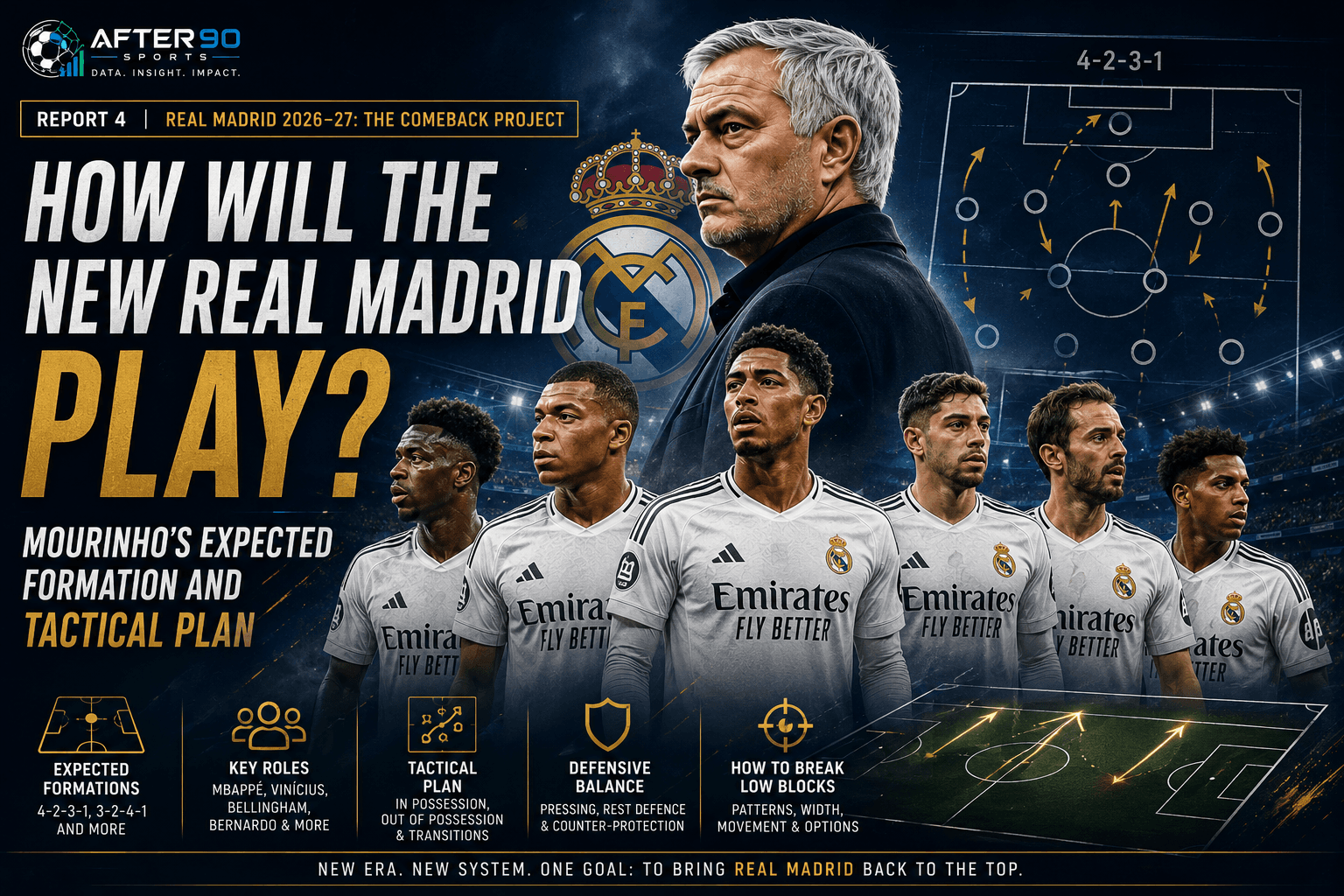
Report 4 — Real Madrid 2026–27: The Comeback Project
After examining why Real Madrid failed last season, Mourinho’s return, and the squad rebuild through the transfer market, we arrive at perhaps the most interesting question of the entire series:
What will this new Real Madrid actually look like on the pitch?
José Mourinho now has a squad with almost every type of profile available to him.
He has pace.
He has physical power.
He has elite one-on-one attackers.
He has midfield runners.
He has technical controllers.
He has attacking full-backs.
He has defenders capable of playing high up the pitch.
And he has several different types of forwards.
The challenge is therefore no longer simply about talent.
It is about structure.
How can Mourinho fit Mbappé, Vinícius, Bellingham, Bernardo Silva, Diomande, Valverde, Trent and the rest into one coherent system?
There may not be one permanent answer.
In fact, the biggest strength of this Real Madrid squad could be its ability to transform from one tactical shape into another without making substitutions.
1. The Starting Point: 4-2-3-1
The most logical base formation for Mourinho appears to be a 4-2-3-1.
Not because Mourinho must use the same system he used earlier in his career, but because this structure fits the current squad extremely well.
Projected Base XI
Goalkeeper
Thibaut Courtois
Defence
Trent Alexander-Arnold / Denzel Dumfries
Ibrahima Konaté
Dean Huijsen
Marc Cucurella
Double Pivot
Aurélien Tchouaméni
Federico Valverde
Attacking Midfield
Yan Diomande
Jude Bellingham
Vinícius Júnior
Striker
Kylian Mbappé
On paper, that looks like a traditional 4-2-3-1.
On the pitch, however, it could become something very different.
2. In Possession: From 4-2-3-1 to 3-2-4-1
One of the most interesting possibilities involves Trent Alexander-Arnold.
Rather than asking Trent to behave like a traditional right-back throughout the match, Mourinho could allow him to move inside during possession.
Madrid could then build in something resembling:
3-2-4-1
The structure might look like this:
Back Three
Konaté — Huijsen — Cucurella
Midfield Base
Tchouaméni — Trent
Attacking Line
Diomande — Bellingham — Valverde/Bernardo — Vinícius
Striker
Mbappé
This shape would solve several problems simultaneously.
It would give Madrid:
- Three players protecting against counterattacks.
- Two players controlling the centre.
- Width on both sides.
- Two players occupying the half-spaces.
- Mbappé permanently threatening the defensive line.
Most importantly, it would give Madrid better occupation of the pitch.
Last season, too many players often moved toward the same spaces.
The new structure should aim for the opposite:
five attacking lanes occupied by different players.
3. The Most Important Rule: Mbappé Must Start Centrally
One of the biggest tactical mistakes Madrid could make would be allowing Mbappé and Vinícius to begin attacks in the same zone.
Both naturally enjoy attacking the left channel.
But if both start there, Madrid immediately become easier to defend.
The solution should be simple:
Mbappé begins centrally.
That does not mean he must remain between the centre-backs for 90 minutes.
He should still have freedom to move.
But his starting reference should be central.
This creates several advantages.
It pins the centre-backs
Opposing defenders cannot constantly move toward Vinícius if Mbappé is threatening the space behind them.
It creates space for Vinícius
If Mbappé occupies the central defenders, Vinícius has more opportunities to isolate the opposing right-back.
It gives Bellingham clearer spaces
Bellingham can attack behind Mbappé rather than arriving into an already overcrowded left side.
It improves Madrid’s penalty-box occupation
Madrid need players inside the box, not five attackers waiting outside it.
4. Vinícius: Freedom, but With One Important Condition
Vinícius should remain one of Madrid’s primary attacking weapons.
But his role needs more structure.
During the early stages of possession, Vinícius should often remain wide.
The purpose is not to limit him.
It is to create the conditions in which he becomes more dangerous.
If Vinícius begins close to the touchline:
- The opposition full-back must follow him.
- The defensive line becomes wider.
- Space opens between the full-back and centre-back.
- Mbappé can attack that channel.
- Bellingham can arrive into the half-space.
Once the ball reaches the final third, Vinícius should then receive much greater freedom to move inside.
The principle should therefore be:
Width first. Freedom later.
That distinction could significantly improve the relationship between Vinícius and Mbappé.
5. Diomande Could Be the Key to Balancing the Attack
Yan Diomande may become tactically important for a reason that goes beyond his individual ability.
He could force opponents to defend the entire width of the pitch.
For several seasons, Madrid’s greatest attacking threat has naturally developed on the left.
Opponents could shift extra defensive numbers toward Vinícius and the left half-space.
Diomande changes that possibility.
If he becomes a genuine one-on-one threat on the right, the opposition faces a difficult decision:
Double-team Vinícius?
Then Diomande receives more space.
Shift toward Diomande?
Then Vinícius receives isolation opportunities.
Protect both wings?
Then Bellingham and Mbappé receive more space centrally.
That is the tactical value of having dangerous players on both sides.
It does not simply create two good wings.
It changes the geometry of the entire defence.
6. Bellingham: No Longer Everywhere — But More Dangerous
Jude Bellingham has often been asked to perform too many roles.
At different moments he has operated as:
- A central midfielder.
- A No. 10.
- A second striker.
- A left-sided midfielder.
- A pressing leader.
- A late runner into the box.
His versatility is exceptional.
But versatility can become a problem if the player never receives a stable reference point.
Under Mourinho, Bellingham could become most effective as the central attacking midfielder in the 4-2-3-1.
His job would not be to control every phase of possession.
It would be to dominate the spaces between midfield and defence.
Bellingham’s ideal responsibilities:
- Receive between the lines.
- Lead the press behind Mbappé.
- Attack the penalty area late.
- Combine with Vinícius.
- Support Mbappé centrally.
- Drop into midfield when additional control is needed.
This could make Bellingham less visible in some phases but more decisive in the important ones.
Instead of being asked to solve everything:
he becomes the player who connects everything.
7. Bernardo Silva: The Tactical Joker
Perhaps no player gives Mourinho more tactical possibilities than Bernardo Silva.
He may not start every match in exactly the same position.
But he could become one of the most important players in the squad.
Bernardo can play:
- Right wing.
- Right half-space.
- Central midfield.
- No. 10.
- Deeper next to Tchouaméni.
- As the player who controls possession late in matches.
This makes him particularly valuable because Mourinho can change the tactical structure without making a substitution.
For example:
Madrid start with a 4-2-3-1.
Bernardo begins on the right.
During possession he moves centrally.
Trent overlaps or moves inside.
The team suddenly resembles a 4-3-3 or 3-2-4-1.
Against opponents who press aggressively, Bernardo could become one of Madrid’s main escape routes.
Against deep blocks, he could operate between the lines.
When Madrid are leading, he could drop deeper and help control possession.
He may therefore become less of a conventional starter and more of a:
Tactical controller.
8. Valverde: The Player Who Makes the System Possible
Some players make tactical diagrams look attractive.
Federico Valverde makes them work.
His value comes from everything he can cover.
If Trent moves forward, Valverde can protect the right side.
If Bellingham attacks the box, Valverde can remain deeper.
If Madrid press high, Valverde can jump forward.
If the opponent breaks the first press, he has the speed to recover.
That makes him extremely important in a team containing so many attacking players.
A midfield containing:
Tchouaméni + Valverde
may not always be the most creative pairing.
But it gives Mourinho the physical platform required to release the attacking players.
Valverde could therefore become the invisible balance behind the stars.
9. Tchouaméni: The Tactical Anchor
Tchouaméni’s role should be relatively simple.
And that is precisely why it is so important.
He must protect the centre.
When Madrid attack, he should constantly ask:
- Where is Mbappé?
- Where is Bellingham?
- Which full-back has advanced?
- Where would the counterattack begin if possession is lost?
His first responsibility is not creating spectacular passes.
It is ensuring Madrid remain structurally stable.
In possession, he can help circulate the ball.
Without possession, he becomes the player protecting the space in front of the centre-backs.
If Mourinho succeeds in defining Tchouaméni’s role clearly, Madrid’s defensive transition could improve dramatically.
10. Trent vs Dumfries Is Not Really a Competition
The arrival of Denzel Dumfries creates the impression that Madrid now have two right-backs competing for one position.
But tactically, this does not need to be the case.
They solve completely different problems.
Trent is the solution when Madrid need:
- Passing.
- Ball progression.
- Creativity.
- Switches of play.
- An additional midfielder.
Dumfries is the solution when Madrid need:
- Width.
- Physical power.
- Runs behind the defence.
- Far-post threat.
- Direct attacking transitions.
There may also be matches where both play.
Trent inside.
Dumfries outside.
That could become one of Mourinho’s most interesting attacking variations.
Against a deep block, Dumfries can almost become a right winger while Trent controls possession from midfield.
Against stronger opposition, Mourinho may prefer one or the other depending on the threat posed by the opponent’s left side.
The key is not deciding:
Who is the better right-back?
The key is deciding:
Which problem are Madrid trying to solve today?
11. Cucurella Could Become the Balancing Full-Back
If Madrid use an adventurous structure on the right, the left-back cannot always behave in the same way.
That is where Cucurella becomes tactically important.
When Trent moves inside and several players attack ahead of the ball, Cucurella can remain deeper.
Madrid would then effectively defend transitions with:
Cucurella — Huijsen — Konaté
This allows the right side to become more aggressive without leaving only two defenders behind.
In other matches, particularly against low blocks, Cucurella can overlap Vinícius and create an additional attacking route.
Again, the key will be asymmetry.
Madrid do not need both full-backs performing identical roles.
Modern tactical balance often comes from doing the opposite:
one side attacks differently from the other.
12. Konaté and Huijsen: A Potentially Ideal Partnership
The Konaté-Huijsen partnership makes sense because their strengths complement each other.
Huijsen
Offers:
- Passing.
- Composure.
- Line-breaking distribution.
- Build-up quality.
Konaté
Offers:
- Recovery pace.
- Physical power.
- Duelling.
- Protection in open space.
If Madrid want to defend higher, this combination could become extremely useful.
Huijsen helps Madrid build attacks.
Konaté helps Madrid survive when attacks break down.
The relationship between the two could become one of the foundations of Mourinho’s team.
13. How Will Madrid Press?
One of the early preseason themes appears to be pressing and possession under pressure.
That is significant.
Mourinho’s Madrid may not simply sit in a deep block and wait.
A possible pressing structure could resemble a 4-4-2.
Mbappé and Bellingham would form the first line.
Vinícius and Diomande would drop into wider midfield positions.
Tchouaméni and Valverde would protect the centre.
The most important element will be pressing triggers.
Madrid should not press aggressively every second.
They should press when the opponent provides the opportunity.
Possible triggers include:
- A backward pass.
- A poor first touch.
- A pass toward the touchline.
- A goalkeeper receiving under pressure.
- A centre-back receiving on his weaker side.
When the trigger appears, the entire team must move forward together.
The distance between the attacking line and defensive line should remain compact.
Because pressing without compactness is not pressing.
It is simply running.
14. Rest Defence: The Improvement Madrid Need Most
One of last season’s biggest weaknesses was what happened immediately after Madrid lost the ball.
This is where Mourinho may make his biggest tactical impact.
When Madrid attack, they cannot leave only two centre-backs behind.
A healthier attacking structure would keep approximately five players responsible for controlling the counterattack.
For example:
Konaté — Huijsen — Cucurella
with:
Tchouaméni — Trent
ahead of them.
That creates a 3+2 security structure.
If possession is lost, Madrid have players positioned immediately around the ball and players protecting the central spaces behind them.
This would allow Madrid to attack aggressively without turning every turnover into an emergency.
Good rest defence also creates better attacking football.
Why?
Because if Madrid recover the ball immediately, the attack continues.
Instead of:
Attack → Lose possession → Run 50 metres backwards.
Madrid can create:
Attack → Lose possession → Recover → Attack again.
That is how elite teams sustain pressure.
15. How Madrid Should Attack Deep Blocks
This may be Mourinho’s greatest challenge in LaLiga.
Most opponents will not give Mbappé and Vinícius large spaces to counterattack.
They will defend deep.
Madrid therefore need repeatable attacking solutions.
Solution 1: Isolate the Wingers
Switch the ball quickly from one side to the other until Vinícius or Diomande receives one-on-one.
Solution 2: Use Bellingham’s Late Runs
Instead of permanently occupying the penalty area, Bellingham should arrive after the defenders are already focused on Mbappé.
Solution 3: Dumfries at the Far Post
When attacks develop from the left, Dumfries can attack the opposite post like an additional forward.
Solution 4: Bernardo Between the Lines
Against compact midfield blocks, Bernardo can receive in tight spaces and create short combinations.
Solution 5: Carlos Espí as Plan B
If the opponent completely closes the centre and Madrid begin producing repeated crosses, Espí provides a genuine penalty-box target.
This gives Mourinho something every elite team needs:
different solutions for different defensive problems.
16. The Big-Match Version: More Control
Against Barcelona, Bayern, Manchester City or other elite possession teams, Mourinho may choose a different balance.
A more conservative midfield could include:
Tchouaméni — Valverde — Bernardo
with Bellingham operating closer to Mbappé.
The shape could become a 4-3-3 or 4-4-2 depending on the phase.
This version sacrifices one pure attacker but increases:
- Midfield control.
- Press resistance.
- Defensive coverage.
- Ability to manage transitions.
Vinícius and Mbappé would then become the primary transition weapons.
In these matches, Madrid may not need five attacking players.
They may need four attackers supported by six players who guarantee control.
17. The Ultra-Attacking Version
When Madrid desperately need a goal, the squad offers another possibility.
Imagine the following attacking group:
Vinícius — Mbappé — Diomande
with:
Bellingham — Bernardo
behind them.
And:
Dumfries
attacking from the right.
That could leave Madrid with six players regularly arriving into or around the penalty area.
Carlos Espí could also enter as a traditional striker, allowing Mbappé to move slightly left or operate around him.
The difference from last season is important.
Madrid now have more ways to change a match.
Not just more players.
More tactical profiles.
18. There May Be No Single Best XI
This is perhaps the most important conclusion when looking at Mourinho’s squad.
The question:
“What is Real Madrid’s strongest eleven?”
may actually be the wrong question.
The better question is:
“What is Real Madrid’s strongest eleven for this opponent?”
Against a deep block:
Bernardo and Trent may become essential.
Against an aggressive high line:
Diomande and Dumfries become extremely dangerous.
Against a physically dominant opponent:
Valverde and Tchouaméni become crucial.
When Madrid need a goal:
Espí gives them a penalty-box striker.
When Madrid need to control the final 20 minutes:
Bernardo becomes invaluable.
This flexibility could become Madrid’s greatest advantage.
But only if Mourinho establishes a clear hierarchy.
Rotation without clarity creates confusion.
Rotation with clearly defined roles creates a squad.
19. My Projected First-Choice XI
If Madrid played an important match tomorrow with the objective of combining balance, speed and defensive security, my projected XI would be:
4-2-3-1
Courtois
Trent — Konaté — Huijsen — Cucurella
Tchouaméni — Valverde
Diomande — Bellingham — Vinícius
Mbappé
But this should not be interpreted as Bernardo Silva being a substitute in the traditional sense.
Against many opponents, Bernardo could start ahead of Diomande, Valverde or even one of the more attacking players depending on the tactical objective.
Similarly, Dumfries could easily replace Trent in matches where Mourinho wants greater verticality.
This squad should not be built around eleven permanent players.
It should be built around:
a permanent structure with interchangeable profiles.
20. What Will Tell Us Whether Mourinho’s System Is Working?
The first months of the season should be judged through several tactical indicators.
1. Are Vinícius and Mbappé occupying different spaces?
If yes, Madrid should become much harder to defend.
2. Is the right side producing consistent attacking threat?
The attack cannot depend almost entirely on the left.
3. Is Bellingham receiving the ball between the lines?
He should not spend the entire match acting as an emergency midfielder.
4. Are Madrid protected when possession is lost?
This may be the most important indicator of all.
5. Can Madrid control matches after taking the lead?
They need to stop turning comfortable situations into end-to-end football.
6. Can the team break down deep blocks without depending on individual brilliance?
This will determine whether Madrid can consistently collect points across a league season.
7. Does Mourinho rotate roles without destroying chemistry?
Squad depth only matters if the structure survives substitutions.
Conclusion
Real Madrid’s biggest problem is no longer a lack of options.
It may actually be the opposite.
José Mourinho now has so many different profiles that his greatest challenge is choosing how they fit together.
The likely starting point is a 4-2-3-1, but the formation itself is almost secondary.
The real identity could come from how the shape transforms.
4-2-3-1 without the ball.
3-2-4-1 during build-up.
3-2-5 when attacking a deep block.
4-4-2 when pressing.
And perhaps a more conservative 4-3-3 against Europe’s strongest teams.
The key relationships will be:
Mbappé central — Vinícius wide-to-inside.
Bellingham between the lines.
Diomande stretching the opposite wing.
Valverde balancing the stars.
Tchouaméni protecting the centre.
Trent creating from inside.
Dumfries providing a completely different right-sided weapon.
Bernardo controlling the rhythm whenever Madrid need intelligence rather than chaos.
If Mourinho succeeds, the most important difference from last season will not simply be that Real Madrid defend better or score more.
It will be that every player finally understands:
where to be, why he is there, and what the team will do next.
That is what turns a collection of elite footballers into an elite team.
And that may ultimately determine whether Real Madrid 2026–27: The Comeback Project becomes a successful rebuild — or another season of extraordinary talent without enough collective control.