Part Three: How Will Michael Carrick Set United Up in 2026/27?
 After90
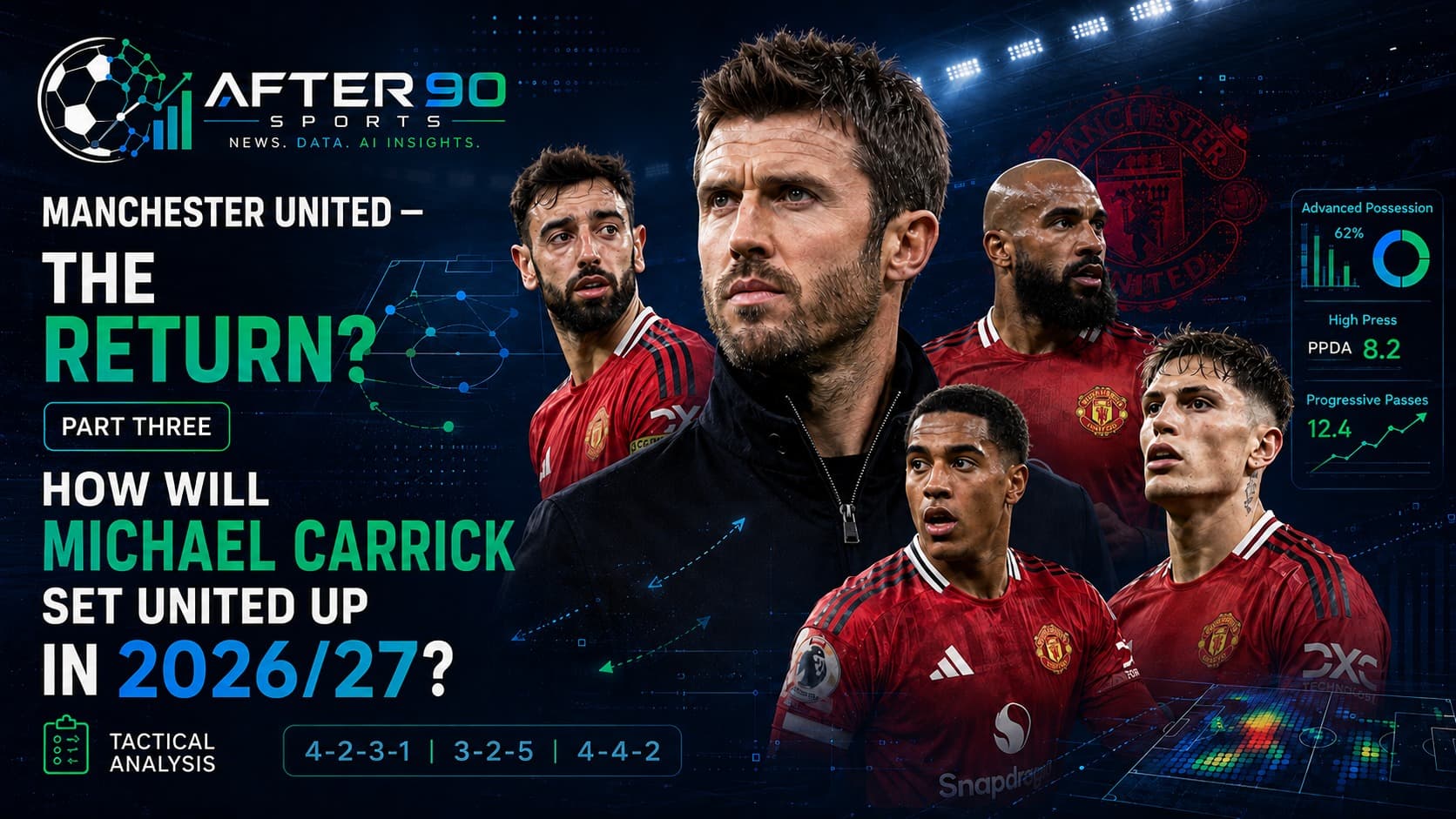
After90Sports 2026/27 Premier League Series — Manchester United, Part Three
After examining last season's revival and Manchester United's summer midfield rebuild, we now reach the most important question of all: how does Michael Carrick actually want United to play? And can a system that worked over 17 matches become a sustainable identity across an entire season?
From Results to Identity
When Michael Carrick took charge of Manchester United last January, his first task was obvious:
Stop the chaos.
United returned to a back four.
The team became more compact without the ball.
Bruno Fernandes moved back into advanced areas.
Transitions became quicker and more direct.
The results followed almost immediately.
But 2026/27 presents a very different challenge.
Carrick is no longer an interim coach trying to rescue a season.
He is now the permanent head coach.
He has had a full pre-season.
He has been given midfielders who appear better suited to his ideas.
And United are preparing for both the Premier League and Champions League.
Manchester United no longer need only results.
They need:
A repeatable identity.
And the evidence from Carrick's first months, the summer transfer business and pre-season suggests that identity is beginning to take shape.
The Base Formation: 4-2-3-1
If one thing appears close to certain, it is that Carrick has little interest in returning to the three-man defensive structure associated with Ruben Amorim.
Since taking charge, 4-2-3-1 has been his basic framework.
It has continued to appear throughout pre-season.
Even when players change positions in possession, the starting structure remains relatively simple:
                     Striker

Left winger          Bruno          Right winger

             Midfielder   Midfielder

Left-back       Centre-back   Centre-back       Right-back

                     Goalkeeper
Premier League analysis has also suggested that new arrivals Youri Tielemans and Andrey Santos could form the central pair behind Bruno Fernandes, potentially becoming the new heartbeat of Carrick's team.
But simply saying "4-2-3-1" does not tell us very much.
Because United's shape should change significantly depending on whether they have the ball.
In Possession: From 4-2-3-1 Towards 3-2-5
This is where Carrick's ideas become more interesting.
Based on his previous coaching work and what United have shown under him, Carrick appears comfortable allowing one full-back to push forward while the other remains deeper or moves inside.
That can transform United's build-up into something resembling:
      Winger      Attacker      Striker      Attacker      Winger

                    Santos      Tielemans

             Defender     Defender     Defender
In other words:
A 3-2-5 attacking structure.
It does not need to look exactly the same in every match.
If the left-back pushes high, the left winger can move inside.
If the right-back advances, Amad or Mbeumo can move into the right half-space.
The key principle is not the formation graphic itself.
It is this:
Put five players across the attacking line while keeping five players behind the ball to control possession and protect against transitions.
That is very different from simply sending bodies forward and hoping the defence can survive what happens next.
Build-Up Play: Carrick Does Not Want United to Simply Clear the Ball
It would be a mistake to describe Carrick's football as nothing more than counter-attacking.
Yes, transitions will remain one of United's biggest weapons.
But Youri Tielemans' comments after joining reveal another important part of the plan.
The Belgian midfielder said Carrick has a clear structure and wants United to keep possession and press in specific ways, while still giving players freedom within that structure.
That suggests United will try to do two things:
Control the ball when the match allows it.
And:
Attack immediately when the opposition leaves space.
This is exactly where the summer midfield recruitment becomes important.
Youri Tielemans: The Player Who Sets the Tempo
Tielemans may be one of the most important players for understanding the new version of Manchester United.
Not because he is necessarily the team's best player.
But because his role could transform how United move through different phases of a match.
Tielemans has explained that Carrick wants him to play with freedom and help organise the team on the pitch.
That is significant.
United have often lacked a midfielder capable of controlling the speed of a game.
Tielemans can receive possession from the defenders and decide:
- Should United play forward immediately?
- Should the ball be switched to the opposite side?
- Is this the moment to slow the game down?
- Can the first line of pressure be broken with one pass?
- Should United draw the press before attacking the space behind it?
Those decisions rarely dominate highlight reels.
But elite teams are built around them.
Andrey Santos: The Legs Beside the Controller
If Tielemans provides organisation, Andrey Santos provides movement.
That creates an interesting balance.
Santos can step forward to press.
He can cover larger spaces.
He can support attacks and recover quickly.
He also gives United additional physical presence following Casemiro's departure.
For that reason, it may be too simplistic to describe:
Tielemans + Santos
as one defensive midfielder plus one attacking midfielder.
The partnership is likely to be more fluid.
Sometimes Tielemans will remain deeper.
Sometimes Santos will drive forward while Tielemans protects the space behind him.
In other phases, their responsibilities could switch.
That flexibility may make United's midfield far less predictable.
Where Does Kobbie Mainoo Fit?
This is where Carrick's midfield becomes particularly interesting.
Kobbie Mainoo was one of the biggest beneficiaries of Carrick's arrival last season.
Now he faces much stronger competition after the additions of Tielemans and Santos.
But that does not automatically make Mainoo a backup.
In fact, greater depth may allow Carrick to use him in situations that suit his strengths.
Against aggressive pressing teams
Mainoo could be especially valuable because of his ability to:
- Receive under pressure
- Turn away from opponents
- Carry the ball forward
- Connect midfield with attack
- Retain possession in tight spaces
Carrick could therefore have several combinations:
| Match Requirement | Possible Midfield Pair |
|---|---|
| Control and organisation | Tielemans + Santos |
| Playing through a high press | Tielemans + Mainoo |
| Greater energy and mobility | Santos + Mainoo |
| Protecting a lead / physical match | More conservative options when available |
The important difference is that United no longer appear to have one midfield partnership.
Carrick has alternatives.
And with Champions League football returning, he will need them.
Bruno Fernandes: Keep Him Away From Deep Midfield
Perhaps the most important rule of Carrick's Manchester United should be:
Keep Bruno close to goal.
In Part One, we saw how dramatically Fernandes' creative output improved when Carrick returned him to the No.10 role.
It would make little sense to undo one of the biggest successes of the previous season.
Tielemans' arrival should help.
If the Belgian becomes responsible for organising the early stages of possession, Bruno should no longer need to repeatedly drop alongside the centre-backs simply to get United moving.
Instead, he can stay between the opposition's midfield and defensive lines.
And that is where Bruno becomes dangerous.
Where Should Bruno Receive the Ball?
Not here:
CB ------ Bruno ------ CB
But here:
     Opposition midfield

             Bruno

     Opposition defence
From that pocket, Fernandes can:
- Release the striker
- Switch play to the winger
- Shoot
- Make runs into the box
- Create overloads
- Lead the counter-press after possession is lost
Carrick must resist using Bruno as the solution to every build-up problem.
Because every metre Fernandes moves away from goal is another metre he has to recover before he can hurt the opposition.
Without the Ball: Bruno Becomes a Second Striker
When Manchester United lose possession, Carrick's team is likely to fall into a structure resembling:
4-4-2
             Striker          Bruno

Winger        Santos        Tielemans        Winger

Full-back    Centre-back    Centre-back     Full-back
Bruno steps alongside the striker.
The wide attackers drop into midfield.
United can then defend central areas rather than chasing the ball individually.
One of the most important changes after Amorim's departure was the move away from a defensive system heavily dependent on repeated individual duels toward a more collective, compact structure.
That principle should remain central to Carrick's approach.
Pressing — But Not All the Time
Carrick does not appear interested in making United press at maximum intensity for 90 minutes.
His approach looks more selective.
Tielemans has spoken about Carrick wanting United to press in specific ways.
That means looking for pressing triggers such as:
- A poor pass toward the full-back
- A player receiving with his back to goal
- A back-pass to the goalkeeper
- A loose second ball
- A player trapped near the touchline
When that trigger appears, United can attack the ball as a unit.
That is different from uncontrolled pressing.
For years, United's problem was not necessarily a lack of running.
It was that one player would press while everyone else remained too far away.
The result?
Huge spaces.
Carrick wants to eliminate those gaps.
The Major Weapon: Fast Transitions
But once United win the ball?
That is when the tempo changes.
The pre-season match against Leeds offered a good example.
Bryan Mbeumo accelerated into space and helped United attack the unsettled Leeds defence before creating a goal for Joshua Zirkzee.
It was exactly the kind of fast, direct attack Carrick and Steve Holland have been working on.
This is an important distinction.
Carrick wants possession.
But he does not want possession for its own sake.
If United recover the ball and the opposition are disorganised, the priority becomes:
Attack immediately.
Why This Suits Bryan Mbeumo
Mbeumo may be the ideal forward for this style.
The Cameroon international can:
- Start from the right
- Move centrally
- Play as a striker
- Attack space behind defenders
- Carry the ball at speed
- Press aggressively
He was also one of United's stronger performers during pre-season.
His flexibility is especially valuable because he does not need to remain permanently on the touchline like a traditional winger.
That allows Carrick to reshape the attack during the match.
Right Wing: Amad or Mbeumo?
This is one of Carrick's most difficult selection decisions.
Option One: Amad
Amad offers:
- Close control in tight spaces
- Combination play between the lines
- The ability to move inside
- Creativity
- A strong understanding with Bruno
Option Two: Mbeumo
Mbeumo offers:
- Greater pace
- More threat running behind
- Stronger goal-scoring potential
- Greater physicality
- Direct pressing
The good news for Carrick is that the presence of both players does not necessarily mean he always has to choose one.
Mbeumo can play as a striker.
Amad can move inside.
Mbeumo can also switch to the left during certain phases.
There are numerous combinations available.
The Real Problem: Left Wing
This remains United's biggest attacking question.
Carrick has several players who naturally prefer:
The right side or central areas.
Amad.
Mbeumo.
Cunha.
Bruno.
Even Mason Mount when he plays further forward.
Premier League analysis has already identified the absence of a natural left winger as a potential problem for the balance of Carrick's 4-2-3-1.
That is why United have explored several different solutions.
Solution One: Matheus Cunha
Cunha can start from the left and move inside.
This gives United another player between the lines.
But it creates another requirement.
If Cunha moves inside, the left-back must provide width.
Otherwise, United risk becoming congested centrally while leaving the touchline completely empty.
That is where Luke Shaw or Patrick Dorgu can become important.
Solution Two: Dorgu Higher Up the Pitch
Pre-season gave us an intriguing clue.
Against Milan, Carrick started with:
Amad — Bruno — Dorgu
behind Matheus Cunha, with Tielemans and Santos in midfield.
Dorgu was therefore used in a more advanced position rather than simply as a full-back.
Why?
Because he offers something United need on the left:
Width and direct running.
He may not be the most naturally creative winger in the squad.
But his presence can force the opposition defence to spread wider.
That, in turn, creates more room for Bruno and Cunha inside.
Solution Three: Marcus Rashford
Then there is Marcus Rashford.
And that makes the situation even more interesting.
Rashford returned to Manchester United training this summer, and Carrick has continued to describe him as part of the group.
If Rashford can recover his best level, he may be the most natural solution of all.
Because he provides:
- A genuine left-sided attacker
- Pace behind the defence
- Goal threat
- A player capable of forcing the opposition full-back deeper
- Elite transition potential
United could then field:
                     Šeško

Rashford             Bruno             Mbeumo

              Santos       Tielemans
On paper?
That is an extremely dangerous attacking unit.
But the question surrounding Rashford is not about theoretical ability.
It is about his future, consistency and relationship with the club.
Benjamin Šeško: The Piece That Can Change the Attack
Šeško gives United a very different type of striker.
His height, physical presence and ability to attack the penalty area offer something that Cunha, Mbeumo and Zirkzee do not provide in exactly the same way.
Last season, Šeško's attacking numbers improved significantly once Carrick arrived and United began delivering the ball to him more quickly and consistently.
This season he could benefit from:
- Mbeumo's crossing
- Bruno's final passes
- Tielemans' early distribution
- Overlapping full-backs
- Cunha moving around him
Šeško returned to training ahead of the league opener after missing parts of pre-season through injury, although his exact involvement will depend on final fitness.
What Happens Without Šeško?
This is another important part of Carrick's tactical flexibility.
Pre-season demonstrated that United have alternatives.
Against Milan, Matheus Cunha played as the centre-forward.
Against Leeds, Carrick also used Cunha centrally after substitutions, while Zirkzee appeared in the forward line at different stages.
Mbeumo can also operate through the middle.
So Carrick has different versions of the attack.
With Šeško
A clear penalty-box striker.
With Mbeumo
More pace and movement behind the defence.
With Cunha
A false-nine profile and increased movement between the lines.
With Zirkzee
Better link play between midfield and attack.
Carrick can therefore change the behaviour of his attack without necessarily abandoning the 4-2-3-1 structure.
Full-Backs: More Important Than They Look
The full-backs become crucial in Carrick's system.
Especially when a player such as Cunha starts wide and moves inside.
Luke Shaw
When fit, he offers:
- Good distribution from deep
- The ability to move inside
- Experience in build-up
- Width when required
Diogo Dalot
He provides:
- Constant movement
- Ability to play on both sides
- Inside positioning
- Attacking support
Noussair Mazraoui
He may be the most tactically flexible of the options.
He can play:
- As a traditional full-back
- Inside midfield
- As part of a back three during build-up
That type of player is extremely useful when Carrick wants to change United's shape without making a substitution.
Defence: The Biggest Test of the Project
The attack is exciting.
But if Manchester United genuinely want to challenge for the title, the biggest issue remains at the other end.
United conceded 50 Premier League goals last season.
That is simply too many for a championship-level defence.
Carrick improved the team significantly after taking over.
But maintaining that defensive improvement over a full season will be much more difficult.
There are also concerns around fitness and consistency among the defensive options.
Harry Maguire performed well under Carrick.
Lisandro Martínez offers elite progression from the back.
Leny Yoro represents the future.
Ayden Heaven has significant potential.
Matthijs de Ligt brings experience and physical presence when available.
But injuries remain a genuine concern, especially with Champions League football returning.
Who Starts at Centre-Back?
If everyone is available, one of the most interesting combinations may be:
Martínez + Yoro
because of their mix of build-up quality and speed.
However:
Maguire + Martínez
offers greater experience and aerial strength.
While:
De Ligt + Martínez
provides another experienced pairing, depending on fitness.
Carrick may not have one fixed centre-back partnership throughout the season.
He may not need one.
But he does need something more important:
Consistent defensive principles regardless of personnel.
The Goalkeeper's Role in Build-Up
A goalkeeper comfortable participating in possession is important to Carrick's approach.
The objective is not to make short passes for the sake of passing.
It is to use the goalkeeper as an extra player to attract pressure.
If the opposition striker jumps toward the goalkeeper, another United player should become free.
That can allow the team to play through the first line.
But it also introduces risk.
Pre-season showed moments where mistakes in build-up created dangerous opportunities for opponents.
Finding the balance between:
Bravery in possession
and:
Avoiding unnecessary risk
will be another major test for Carrick.
What Did Pre-Season Tell Us?
Friendly results are not the most important thing.
Patterns are.
United faced a variety of opponents over the summer, including Atlético Madrid, Paris Saint-Germain, Leeds and Milan.
Against PSG, United earned a 1-1 draw against the European champions, with Mbeumo among the standout performers.
Against Leeds, we saw the direct transition game, with Mbeumo and Zirkzee involved, while the 4-2-3-1 became particularly clear after Bruno, Tielemans and Cunha entered.
The final match against Milan provided a useful warning.
United began with Santos and Tielemans behind Amad, Bruno and Dorgu, but lost 4-2.
That result underlined a key issue:
United's new attacking structure still needs greater protection when possession is lost.
Perhaps that is exactly what pre-season is for.
Find the problems before the matches start counting for points.
The Most Likely XI — If Everyone Is Available
If we select an ideal XI based on the current tactical picture rather than only the opening match, it could look something like:
                     Šeško

Cunha / Rashford      Bruno          Mbeumo / Amad

              Santos       Tielemans

Shaw          Martínez       Yoro        Mazraoui

                     Lammens
But this XI hides significant competition underneath it.
The Biggest Selection Battles
| Position | Competition |
|---|---|
| Centre-back | Martínez / Yoro / Maguire / De Ligt / Heaven |
| Right-back | Mazraoui / Dalot |
| Central midfield | Tielemans / Santos / Mainoo |
| Right wing | Mbeumo / Amad |
| Left wing | Cunha / Rashford / Dorgu |
| Striker | Šeško / Mbeumo / Cunha / Zirkzee |
That depth matters.
Because for the first time under Carrick, United need to manage:
Premier League + Champions League + FA Cup + League Cup.
Plan A: Against a Deep Defensive Block
Against teams that arrive at Old Trafford and defend close to their own penalty area:
                     Šeško

Cunha                Bruno                Amad

              Santos       Tielemans

Shaw          Martínez       Yoro        Mazraoui
Why?
Amad and Cunha are comfortable in tight spaces.
Bruno operates between the lines.
Šeško attacks the penalty area.
Tielemans controls possession from deeper positions.
And the full-backs provide width.
The emphasis becomes:
Control + circulation + overloads around the box.
Plan B: Against Arsenal or Manchester City
Against opponents who will leave space behind their defence:
                     Šeško

Rashford             Bruno               Mbeumo

              Santos       Tielemans

Shaw          Martínez      Maguire       Mazraoui
The idea changes.
United can defend in a more compact block.
Then, after recovering possession:
Bruno → Rashford / Mbeumo
with as few passes as possible.
This version closely resembles the approach Carrick used successfully against some of the strongest opponents last season.
Plan C: Without Šeško
                    Mbeumo

Cunha                Bruno                Amad

              Mainoo       Tielemans

Shaw          Martínez       Yoro        Dalot
This creates a different attack.
There is no fixed penalty-box striker in the same sense as Šeško.
Mbeumo moves constantly.
Cunha comes inside.
Amad combines with Bruno.
United become more fluid and less dependent on crossing.
Tactical Strengths
1. Bruno in His Best Position
United's most important creator is closer to goal.
2. A More Balanced Midfield
Tielemans, Santos and Mainoo give Carrick different profiles.
3. Versatile Attackers
Mbeumo, Cunha, Amad, Rashford, Šeško and Zirkzee can all change positions and roles.
4. Transitions
United possess significant pace when opponents are forced to defend while running toward their own goal.
5. Tactical Flexibility
The same 4-2-3-1 can become:
3-2-5 in possession
and:
4-4-2 without the ball
without requiring substitutions.
Tactical Weaknesses
1. Left-Side Balance
The ideal solution remains unclear.
2. Space Behind the Full-Backs
If both advance at the same time, United could become vulnerable to transitions.
3. Defending Large Spaces
Some centre-back combinations could struggle if the defensive line becomes too aggressive.
4. Dependence on Bruno
If Fernandes is unavailable or successfully marked out of a match, where does the creativity come from?
Tielemans can help.
But the question remains.
5. Fixture Congestion
A system that worked extremely well over 17 matches during a relatively light schedule must now survive an entire European season.
That is the real test.
The Five Most Important Players in Carrick's System
1. Bruno Fernandes
The primary source of creativity and final-third passing.
2. Youri Tielemans
The potential controller of United's tempo.
3. Andrey Santos
The energy that allows the midfield to press and cover space.
4. Bryan Mbeumo
Perhaps United's most dangerous transition weapon.
5. Benjamin Šeško
The striker who gives the team a clear focal point inside the penalty area.
But there may be a sixth name:
Marcus Rashford
If he truly returns to his best.
Because a fast, productive natural left winger could solve one of Carrick's biggest structural problems.
The Real Question Is Not: What Formation Does Carrick Use?
That answer is easy.
4-2-3-1.
But that is not the right question.
The better question is:
How does Carrick want Manchester United to behave during every phase of the game?
The answer appears to be:
During build-up: Stay calm, attract pressure, use Tielemans, and avoid forcing Bruno too deep.
Through midfield: Use Santos' mobility, rotate positions and attack the half-spaces.
In the final third: Bruno between the lines, one winger moving inside, a full-back providing width and Šeško attacking the penalty area.
Immediately after losing possession: A short collective press, then fall into a 4-4-2 if the first counter-press fails.
After winning possession: Attack quickly.
That is the Carrick approach we have seen developing over recent months.
And he now has a squad that appears better suited to executing it.
After90Sports Tactical Rating
Clarity of Idea: 9/10
Carrick's intentions are easy to understand.
Midfield Quality: 8.5/10
The options look significantly stronger after the arrivals of Tielemans and Santos.
Attacking Variety: 9/10
United have numerous forwards with different qualities.
Width and Flank Balance: 7/10
The left side remains an unresolved question.
Defensive Solidity: 7/10
Improved, but still needs to be proven across a full season.
Tactical Flexibility: 8.5/10
United can change shape without necessarily changing personnel.
Title-Challenge Readiness: 8/10
There is a genuine foundation.
But the difference between a good team and a championship team will come down to defensive reliability and consistency.
Final Verdict
Michael Carrick is not trying to recreate Manchester United's past.
That matters.
There is no button that restores "Sir Alex football" simply because the coach once played for the club.
Carrick appears to be building something much more modern.
4-2-3-1 as the starting point.
3-2-5 in possession.
4-4-2 without the ball.
A midfield capable of retaining possession.
Bruno close to goal.
Wide players attacking space.
And a striker providing a clear target inside the box.
But perhaps the most encouraging aspect of the idea is that it does not appear complicated simply for the sake of appearing sophisticated.
The roles make sense.
United's most important players are being used in areas that suit their strengths.
That is exactly what Carrick began doing when he took charge last January.
The difference now?
Opponents know what is coming.
They will study United's patterns.
They will try to isolate Bruno.
They will press Tielemans.
They will attack the space behind the full-backs.
And they will test United's defence over an entire season.
That is why 2026/27 is the real examination.
The revival has already happened.
The rebuild is underway.
Now comes the hardest part:
Building a team capable of imposing its game on others.
Next in the Series
Part Four — Manchester United Squad Audit: Where Are the Strengths and Where Are the Gaps?
Next, we assess every area of Carrick's squad:
- Goalkeepers
- Right-back
- Centre-back
- Left-back
- Defensive midfield
- Central midfield
- Attacking midfield
- Wingers
- Centre-forward
- Starter and backup in every position
- Average age
- Experience
- Squad depth
- Most important players
- Breakout candidates
- Weakest positions
- Whether this squad is strong enough to challenge Arsenal and Manchester City
Sources
- Premier League — How Every Premier League Club Could Line Up in 2026/27
- Premier League — Tactical Analysis: How Will Manchester United Look Under Carrick?
- Reuters — Carrick Seeks to Build on Manchester United Revival
- Reuters — Youri Tielemans on His Role Under Michael Carrick
- The Guardian — Tielemans on Possession, Pressing and Freedom in Carrick's System
- The Guardian — Manchester United vs Leeds: Transitions and the 4-2-3-1
- Manchester United — Match Report: United vs AC Milan
- Manchester United — Match Report: United 1–1 Paris Saint-Germain
- Manchester United — Bryan Mbeumo Named Player of the Match vs PSG
- Manchester United — Benjamin Šeško Training Update Ahead of League Opener
- The Guardian — Analysis of Carrick's Centre-Back Options
- The Guardian — Latest on Marcus Rashford's Manchester United Future
Last updated: 19 August 2026.
This tactical analysis is based on Manchester United's performances under Michael Carrick during the second half of 2025/26, the club's summer 2026 transfer business, pre-season matches and public comments from Carrick and his players up to the date of publication. Some selection possibilities may change depending on player fitness and any further transfer activity before the window closes.