







Messi Says Goodbye to Argentina: 207 Matches, 125 Goals and 21 Years Between Heartbreak and Glory
 After90
After more than two decades in which Argentina’s No. 10 shirt became inseparable from his name, Lionel Messi has brought the curtain down on one of the greatest international careers in football history.
Messi officially announced his retirement from international football on August 31, 2026, ending a journey that began against Hungary on August 17, 2005, and concluded after Argentina reached the 2026 FIFA World Cup final against Spain.
Nearly 21 years separated those two matches.
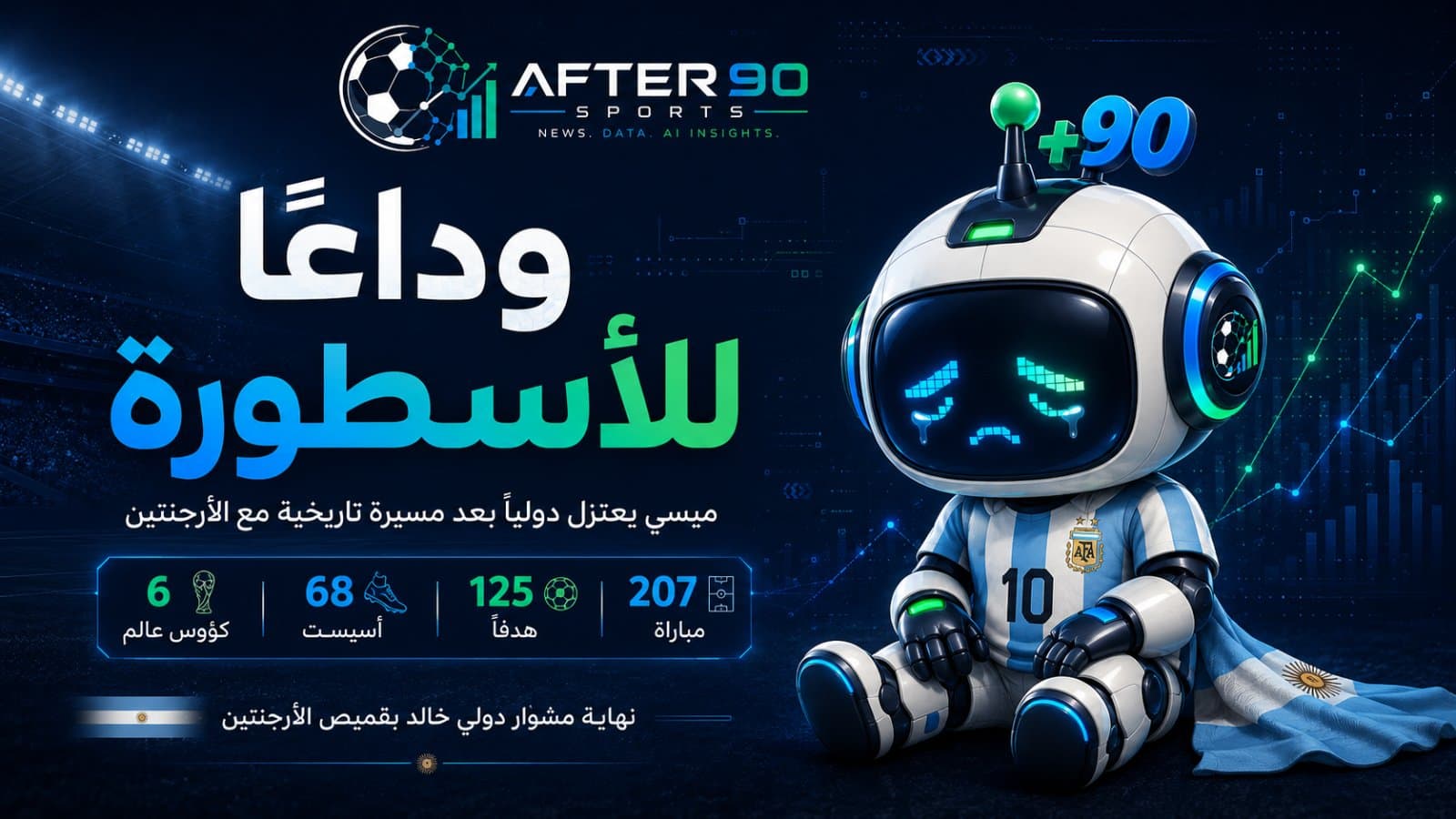
Across that extraordinary journey, Messi played 207 matches for Argentina, scored 125 goals and provided 68 assists, finishing his career as both the national team’s all-time leading scorer and its most-capped player.
But Messi’s Argentina story cannot be explained through goals and appearances alone.
It evolved from a career defined for years by painful defeats and lost finals into one of football’s most complete international stories: two Copa América titles, a FIFA World Cup, the Finalissima, and a collection of records that could stand for generations.
Lionel Messi for Argentina — By the Numbers
| Statistic | Record |
|---|---|
| International appearances | 207 |
| International goals | 125 |
| Assists | 68 |
| Goals per game | 0.60 |
| World Cup editions | 6 |
| World Cup matches | 34 |
| World Cup goals | 21 |
| World Cup wins | 23 |
| Copa América matches | 39 |
| Copa América goals | 14 |
| Copa América editions | 7 |
| CONMEBOL World Cup qualifying matches | 72 |
| World Cup qualifying goals | 36 |
| World Cup finals reached | 3 |
| Major senior international trophies | 4 |
Those numbers leave Messi as Argentina’s all-time leading goalscorer and record appearance holder.
2005: A Beginning That Gave No Hint of What Was to Come
Messi made his senior Argentina debut against Hungary on August 17, 2005.
He was only 18 years old.
He came on as a substitute, but his first international appearance lasted less than a minute before he was shown a red card.
It was an extraordinary beginning for a player who would eventually become Argentina’s record appearance holder and record goalscorer.
His first senior international goal followed on March 1, 2006, against Croatia.
Even before his senior journey properly began, however, Messi had already delivered international success.
In 2005, he helped Argentina win the FIFA U-20 World Cup.
Three years later, he added another major achievement by winning the Olympic gold medal at Beijing 2008.
Six World Cups: From Teenage Talent to Historic Captain
Messi represented Argentina at six FIFA World Cups:
- Germany 2006
- South Africa 2010
- Brazil 2014
- Russia 2018
- Qatar 2022
- United States, Canada and Mexico 2026
By the end of his final tournament, his World Cup record stood at:
34 matches — 21 goals — 23 victories
He finished his career with the record for the most World Cup appearances and victories, while his 21 World Cup goals placed him second on the tournament’s all-time scoring list behind Kylian Mbappé, who reached 22.
2014: The First Time the Dream Came Within Reach
Brazil 2014 marked a major shift in Messi’s international career.
He was no longer simply Argentina’s biggest star.
He was the captain carrying the hopes of an entire nation.
Messi scored four goals during the tournament and led Argentina all the way to the final against Germany.
The dream ended with a 1–0 extra-time defeat, but Messi was awarded the Golden Ball as the tournament’s best player.
It was the first time he had reached a World Cup final.
It would not be the last.
Copa América: Five Finals Between Heartbreak and Redemption
Few competitions tell the story of Messi’s relationship with Argentina better than the Copa América.
He appeared in seven editions, played 39 matches and scored 14 goals.
His 39 appearances established a competition record.
But perhaps the most revealing number is five.
Messi reached five Copa América finals:
| Tournament | Result |
|---|---|
| 2007 | Runner-up |
| 2015 | Runner-up |
| 2016 | Runner-up |
| 2021 | 🏆 Champion |
| 2024 | 🏆 Champion |
Three finals ended in disappointment before the breakthrough finally arrived.
2016: When Messi Said It Was Over
Following Argentina’s defeat to Chile on penalties in the 2016 Copa América final, Messi announced his international retirement for the first time.
By then, he had suffered defeat in:
- the 2014 World Cup final,
- the 2015 Copa América final,
- and the 2016 Copa América final.
Three consecutive major finals.
No trophy.
The frustration became overwhelming.
But the retirement lasted only 66 days.
Messi returned because, ultimately, the story still felt unfinished.
During qualifying for the 2018 World Cup, he scored a hat-trick against Ecuador in Argentina’s decisive final qualifier to help secure their place at the tournament.
At the time, he could not have known that the greatest chapter of his international career had yet to begin.
2021: The Barrier Finally Fell
Messi had to wait 16 years after his senior international debut before lifting his first major trophy with Argentina.
Then came the 2021 Copa América.
Argentina defeated Brazil in the final at the Maracanã and Messi finally became a senior international champion.
The significance went far beyond one trophy.
For years, one question had followed him everywhere:
Could Lionel Messi win a major title with Argentina?
In 2021, that question disappeared.
Messi was named the tournament’s best player after directly contributing to nine of Argentina’s 12 goals during the competition.
And from that moment, everything changed.
2022: From the Finalissima to the Top of the World
After winning the Copa América, Messi led Argentina to victory over Italy in the 2022 Finalissima.
But one dream still remained above all others.
The World Cup.
In Qatar, the story was finally completed.
Messi scored seven goals and provided three assists during the 2022 World Cup.
He scored twice in the final against France before Argentina won the trophy on penalties.
Eight years after losing the 2014 final, Messi returned to football’s biggest match.
This time, he left holding the World Cup.
He also won the Golden Ball as the tournament’s best player, becoming the only player to win the World Cup Golden Ball twice, having previously received the award in 2014.
Messi achieved another unique record in Qatar.
He became the first player to score in every knockout stage of a single World Cup:
Group Stage → Round of 16 → Quarter-final → Semi-final → Final
The international story that had once seemed incomplete was suddenly almost perfect.
2024: Champion of the Americas Again
Messi did not stop after winning the World Cup.
Argentina successfully defended the Copa América title in 2024, giving their captain a second continental championship.
In a relatively short period, years of international frustration turned into four major trophies with the senior national team:
| Competition | Year |
|---|---|
| 🏆 Copa América | 2021 |
| 🏆 Finalissima | 2022 |
| 🏆 FIFA World Cup | 2022 |
| 🏆 Copa América | 2024 |
When his FIFA U-20 World Cup title in 2005 and Olympic gold medal in 2008 are added, Messi’s Argentina career contains major achievements at youth, Olympic and senior level.
2026: The Final Chapter Was a World Cup Chapter Too
Messi entered the 2026 World Cup at the age of 39.
Yet his final tournament was far from a ceremonial farewell.
He scored eight goals and provided four assists, helping Argentina reach another World Cup final.
Reaching the final meant Messi had now appeared in three World Cup finals during his career.
He also became the oldest outfield player to feature in a World Cup final.
But the ending was very different from Qatar.
On July 19, 2026, Argentina were defeated 1–0 after extra time by Spain.
It became Messi’s 207th and final appearance for his country.
Two days later, on July 21, he wrote the words announcing the end of his international career.
He did not publish them immediately.
Following what happened to his father, Messi later explained that he felt more convinced than ever that the time had come to close this chapter.
On August 31, 2026, the decision became official.
Lionel Messi’s Farewell Message to Argentina
In an emotional message reflecting on more than two decades with the national team, Messi wrote:
After all this time that has passed since the final, and after thinking about it a lot, I want to let everyone know that I have decided to retire from international football and end my journey with the national team...
It was a decision that hurt me, and still hurts deep inside, but I understand that the right time has come. I swear that I always gave everything I had, not only during the last few years when I won everything, but before that as well. I always fought and gave everything for this shirt, to bring you joy and make you proud to be Argentine through football.
There is not much left, and stages in life begin to come to an end, and this one in particular hurts me a lot. I love representing the national team, I always have, and I always will. I have given everything inside me and I no longer have anything more to give. Besides, there is a wonderful generation of young players coming through who deserve their opportunity.
Thank you for all the love over these 20 years. I am going to miss hearing you from inside the stadium so much. Now I will become one of you, always cheering and supporting the team from the outside — in the good moments, and even more in the difficult ones.
Thank you to my family for always being there and for accompanying me throughout this beautiful but difficult journey. Thank you to every coach, every teammate and every leader I had the opportunity to share this journey with. I take with me memories and moments that I will never forget.
I leave with peace of mind and pride because, together with my teammates, I was able to give you the moments you dreamed of. It was crazy to experience all of it with you.
I love you!
Thank God for making me Argentine.
Come on Argentina! 🇦🇷
I wrote these words on July 21, two days after the final. Today, after what happened to my dad, I am more convinced than ever.
125 Goals: A Record That Will Be Difficult to Reach
Messi leaves international football as Argentina’s all-time leading scorer with 125 goals.
And that is not his only major scoring record.
He scored 36 goals in South American World Cup qualifying, finishing as the competition’s all-time leading scorer.
He also played 72 CONMEBOL World Cup qualifying matches, matching the record for the most appearances in the competition.
His World Cup legacy alone reads:
34 matches
21 goals
23 victories
6 World Cups
3 World Cup finals
1 World Cup title
From 2016 to 2026: Why This Goodbye Feels Different
Perhaps the best way to understand Messi’s international journey is to compare his first retirement with his final one.
In 2016, Messi walked away devastated after losing another final.
He returned because the story was not finished.
In 2026, he leaves having completed it.
Between those two retirement announcements, Messi won:
- two Copa América titles,
- the Finalissima,
- the FIFA World Cup,
- and reached another World Cup final.
In 2016, the question was:
Will Messi ever truly succeed with Argentina?
By 2026, the question had become something completely different:
Will Argentina ever see another player produce numbers and moments like these?
Messi’s Legacy With Argentina
Records can eventually be broken.
One day, another player may surpass 207 appearances.
Perhaps another goalscorer will begin to approach 125 international goals.
But Messi’s legacy with Argentina cannot be reduced to numbers alone.
He experienced almost every possible emotion in international football.
He lost finals.
He faced criticism.
He retired.
He returned.
He suffered again.
Then he won.
He became champion of South America.
Then champion of the world.
And at 39 years old, he returned to the World Cup final one last time.
That is why 207 appearances, 125 goals, 68 assists, six World Cups and four major senior trophies represent much more than statistics.
They are the numbers behind a story that lasted more than two decades.
A story that began with a red card less than a minute into his debut against Hungary.
And ended with Messi established as one of the greatest players ever to wear Argentina’s shirt — a world champion and the captain of one of the most successful generations in the country’s history.
The journey on the pitch is over.
But Argentina’s No. 10 will forever carry Lionel Messi’s name in football history.
Goodbye, Leo. Thank you for everything. 🇦🇷🐐
Sources
- Argentine Football Association (AFA) — Messi’s official Argentina career record and statistics.
- FIFA — Messi’s World Cup history and international career.
- Reuters — Career milestones and 2026 World Cup statistics.