PSG 2-1 Aston Villa: Paris Retain the UEFA Super Cup — Full Match Report, Tactical Analysis and Historical Statistics
 After90
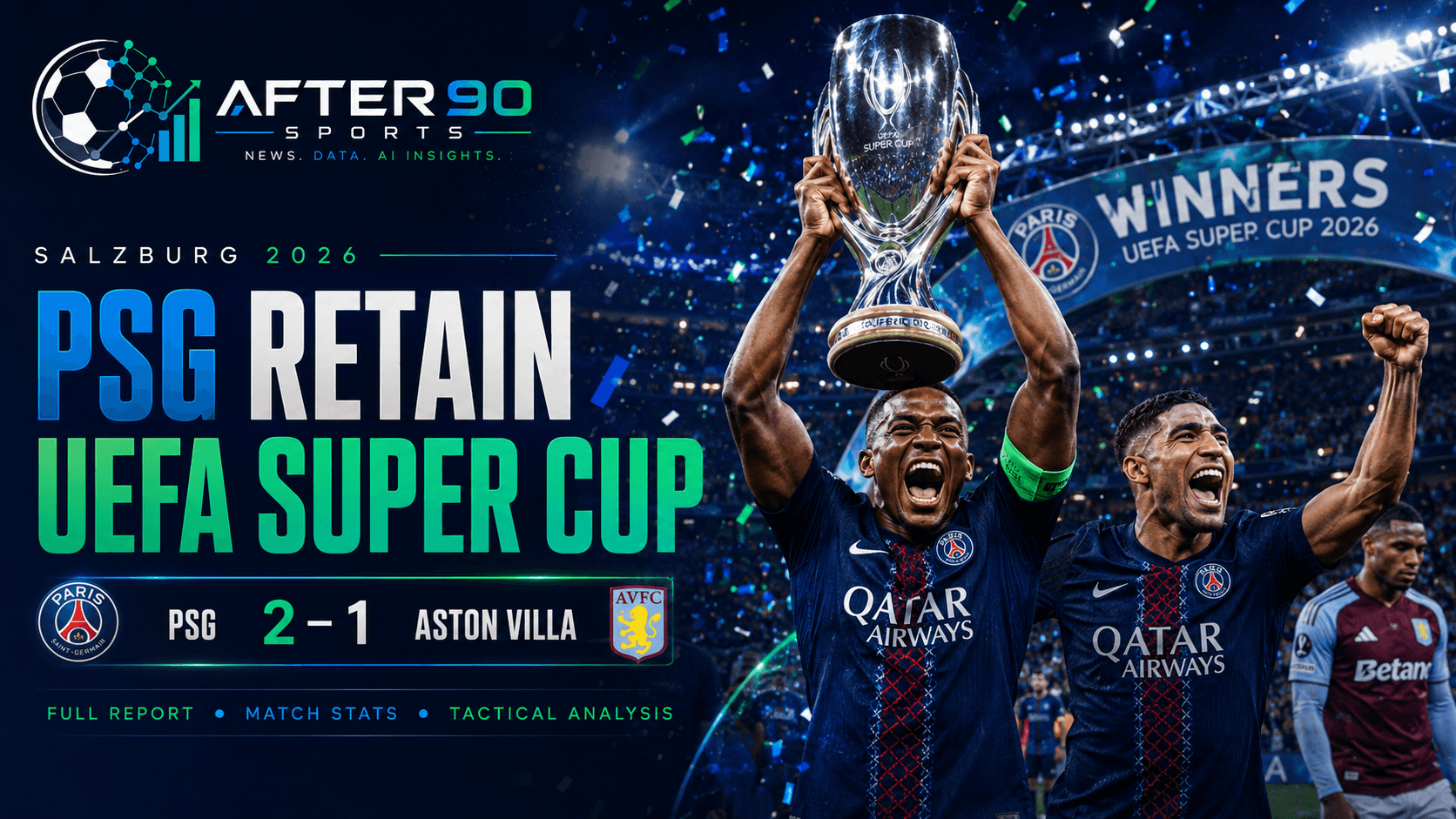
UEFA Super Cup 2026 Paris Saint-Germain 2-1 Aston Villa Date: 12 August 2026 Venue: Stadion Salzburg, Salzburg, Austria Attendance: 27,681 Half-time: 1-1
Goals: Paris Saint-Germain — Khvicha Kvaratskhelia 20', Désiré Doué 61' Aston Villa — Brian Madjo 45'
Paris Saint-Germain's European dominance continued in Salzburg as the Champions League holders defeated Aston Villa 2-1 to retain the UEFA Super Cup.
Khvicha Kvaratskhelia opened the scoring after 20 minutes before 17-year-old Brian Madjo produced a historic equaliser just before half-time. Désiré Doué then decided the final in the 61st minute, finishing Ousmane Dembélé's through ball after VAR overturned an initial offside decision.
The scoreline, however, tells only part of the story.
Aston Villa finished with more attempts, created the better overall expected-goals total according to Opta data and repeatedly caused the European champions problems. PSG ultimately won because of superior finishing, individual quality in decisive moments and their ability to defend the advantage once Doué restored the lead.
Final Score
| Team | Score |
|---|---|
| Paris Saint-Germain | 2 |
| Aston Villa | 1 |
Goals
20' — PSG 1-0 Aston Villa: Khvicha Kvaratskhelia Désiré Doué found Kvaratskhelia inside the area, and the Georgian created enough space against Matty Cash before powering his finish beyond Marco Bizot.
45' — PSG 1-1 Aston Villa: Brian Madjo John McGinn delivered from the flank and Madjo, under pressure from Willian Pacho, managed to steer an excellent volley into the roof of the net.
61' — PSG 2-1 Aston Villa: Désiré Doué Half-time substitute Ousmane Dembélé released Doué behind the defence. Doué curled his finish beyond Bizot. The assistant initially raised the flag for offside, but VAR showed that Matty Cash had kept him onside and the goal was awarded.
Official Match Statistics
UEFA's official full-time report records the following numbers. These should be treated as the primary match statistics.
| Statistic | PSG | Aston Villa |
|---|---|---|
| Goals | 2 | 1 |
| Possession | 56% | 44% |
| Total attempts | 11 | 15 |
| Attempts on target | 5 | 4 |
| Corners | 0 | 2 |
| Offsides | 2 | 0 |
| Fouls committed | 11 | 13 |
| Goalkeeper saves | 3 | 3 |
| Yellow cards | 0 | 3 |
| Red cards | 0 | 0 |
| Ball-in-play possession time | 34:18 | 26:33 |
Total effective ball-in-play time was 60 minutes and 51 seconds. UEFA recorded PSG with 56% possession despite Villa producing four more attempts.
That contrast is one of the most important statistical stories of the final.
PSG controlled more of the ball.
Villa generated more shooting opportunities.
PSG were simply much more efficient with the chances they created.
Advanced Statistics: Villa Actually Won the xG Battle
Advanced event data paints an even more interesting picture.
Opta-powered data gives Aston Villa an expected-goals advantage of approximately:
| Advanced metric | PSG | Aston Villa |
|---|---|---|
| Expected goals | 1.03 | 2.13 |
| Total shots in Opta feed* | 12 | 15 |
| Touches inside opposition box | 29 | 34 |
*Different data providers use slightly different definitions for attempts. UEFA's official report records PSG with 11 attempts and five on target, while the Opta/FotMob feed records 12 attempts and six on target. For the historical record, the UEFA figures above should be considered the official numbers; xG is included as a model-based supplementary statistic.
The xG numbers are significant.
Villa generated roughly twice PSG's expected-goals value, yet PSG won 2-1.
Using those model figures, PSG scored almost one goal more than expected, while Villa finished more than one goal below their expected output.
That is essentially the story of the match in numbers:
Villa created enough to win. PSG finished like European champions.
Brian Madjo: Six Shots, Four Big Chances and a Historic Goal
The biggest individual surprise of the night was Brian Madjo.
The 17-year-old Aston Villa striker finished with:
| Brian Madjo | Total |
|---|---|
| Shots | 6 |
| Big chances | 4 |
| Expected goals | 0.98 |
| Goals | 1 |
| Shots on target | 1 |
No player produced more attempts or big chances in the match.
Madjo alone generated almost one expected goal, but remarkably, only one of his six attempts hit the target.
That one attempt became his historic equaliser.
At 17 years and 212 days, Madjo became the youngest goalscorer in UEFA Super Cup history, breaking a record that had belonged to Patrick Kluivert since 1996.
Kluivert was 19 years and 220 days old when he scored for Ajax.
Madjo therefore lowered the record by more than two years.
He was also the youngest player on record to start a UEFA Super Cup game.
For Villa, defeat may hurt, but the emergence of Madjo could eventually become one of the most important stories to come out of Salzburg.
Désiré Doué: The Player Who Decided the Final
UEFA selected Désiré Doué as the Player of the Match.
The decision was straightforward.
Doué assisted PSG's opening goal and scored the winner himself. UEFA's Technical Observer Group highlighted his goal, assist, key passes and overall attacking contribution.
He also became the first player to both score and assist in the same UEFA Super Cup since Luis Suárez did it for Barcelona against Sevilla in 2015.
Doué's influence can be divided into two decisive moments.
For the opener, he recognised Kvaratskhelia's isolation and released him quickly.
For the winner, he attacked the space behind Villa's defence perfectly after Dembélé received possession centrally.
One assist.
One goal.
One trophy.
Kvaratskhelia Continues His Extraordinary Run
Kvaratskhelia's opening goal was another reminder of why he has become such an important player for PSG.
Across his last 15 matches in all competitions, he has now been involved in 15 goals — 11 goals and four assists.
Against English opposition specifically, he has recorded nine goal involvements across his last eight appearances: five goals and four assists.
His goal against Villa also demonstrated the fundamental difference between the teams.
Villa created several high-quality opportunities.
Kvaratskhelia needed one opening.
That is the efficiency available to Luis Enrique.
How the Match Developed
Opening Phase: PSG Control, Villa Wait
PSG started with their familiar 4-3-3 structure.
Vitinha operated at the centre of midfield with João Neves and Warren Zaïre-Emery around him, while Maghnes Akliouche, Doué and Kvaratskhelia formed the attacking line.
Villa were more compact.
Boubacar Kamara and João Gomes protected the centre, while John McGinn, Emiliano Buendía and George Hemmings worked behind Madjo.
PSG initially controlled possession without creating much.
The first major breakthrough arrived in the 20th minute.
Bizot first stopped Doué, but Villa immediately lost control of the next phase. Doué found Kvaratskhelia, who shifted the ball away from Cash and produced a powerful finish.
Villa's Response Was Excellent
The goal did not damage Villa psychologically.
Instead, Emery's team became more aggressive.
Madjo began repeatedly finding space between PSG's centre-backs and attacking crosses into the box.
He headed one McGinn delivery narrowly wide.
Another opportunity drifted away from goal.
He then hit the post.
Villa were doing something PSG's Champions League opponents often struggled to achieve: bypassing the first pressure and putting the PSG back line under repeated direct pressure.
The eventual equaliser was deserved.
McGinn delivered another dangerous ball and Madjo produced his best finish of the half, guiding a difficult volley into the net immediately before the interval.
Luis Enrique's Half-Time Decision Changed the Final
At half-time, Luis Enrique made the most important tactical change of the match.
Ousmane Dembélé replaced Maghnes Akliouche.
The substitution immediately increased PSG's vertical threat.
Dembélé could receive between Villa's midfield and defensive lines and then attack space directly rather than simply maintaining width.
Villa actually created the first major opportunity of the second half, with McGinn forcing Matvei Safonov into an important save.
But ten minutes later Dembélé provided the decisive pass.
He released Doué behind the Villa defence, and Doué curled his finish across Bizot.
The assistant initially ruled the goal out.
VAR intervened.
Matty Cash had kept Doué onside.
PSG 2-1 Aston Villa.
After Going Ahead, PSG Changed Personality
The final half-hour showed another side of Luis Enrique's team.
PSG did not attempt to win 4-1.
They managed the advantage.
Villa remained dangerous and George Hemmings forced Safonov into another save, but PSG gradually became more conservative.
Luis Enrique replaced Nuno Mendes with Lucas Hernández in the 74th minute.
Fabián Ruiz replaced João Neves a minute later.
Senny Mayulu replaced Doué in the 87th minute.
Lucas Beraldo replaced Kvaratskhelia in the 88th.
By the closing stages, PSG had shifted from attacking dominance toward defensive control.
It was not spectacular.
It was tournament football.
And it worked.
Aston Villa's Changes
Emery responded aggressively.
On 72 minutes Villa introduced Tammy Abraham for Madjo, Alysson for McGinn and Lamare Bogarde for Kamara.
Tyrone Mings replaced Pau Torres and Ross Barkley replaced João Gomes in the 80th minute.
Villa continued to push, but their earlier chances proved more valuable than their late possession.
The final opening fell to Buendía, but PSG survived.
Why Did PSG Win?
The statistics make the answer relatively clear.
Villa produced 15 attempts to PSG's 11 according to UEFA.
Villa's Opta xG was approximately 2.13 compared with PSG's 1.03.
Villa had the only two corners of the game.
They produced five big chances according to Opta.
Yet PSG produced five official shots on target to Villa's four.
More importantly:
PSG converted 18.2% of their official attempts into goals.
Villa converted only 6.7%.
PSG scored with 40% of their shots on target.
Villa converted 25%.
That finishing gap decided the trophy.
Possession Did Not Equal Chance Dominance
PSG's 56% official possession figure suggests territorial control.
But Villa's 15 attempts, higher xG and greater number of big chances show that possession was not the same as attacking superiority.
That is an important tactical lesson from the final.
Villa were comfortable allowing PSG to have the ball in areas that did not immediately threaten goal.
Once Villa recovered possession, they attacked much more directly.
McGinn's crossing, Buendía's positioning and Madjo's movement repeatedly created problems.
PSG had more of the football.
Villa arguably had more of the opportunities.
But PSG had more of the finishing quality.
Full Starting Line-ups
Paris Saint-Germain
Matvei Safonov
Achraf Hakimi — Marquinhos — Willian Pacho — Nuno Mendes
Warren Zaïre-Emery — Vitinha — João Neves
Maghnes Akliouche — Désiré Doué — Khvicha Kvaratskhelia
Aston Villa
Marco Bizot
Matty Cash — Victor Lindelöf — Pau Torres — Ian Maatsen
Boubacar Kamara — João Gomes
John McGinn — Emiliano Buendía — George Hemmings
Brian Madjo
UEFA confirmed both starting XIs and all substitutions in its official final report.
Discipline
Aston Villa received all three yellow cards in the match.
| Player | Minute |
|---|---|
| Pau Torres | 51' |
| João Gomes | 64' |
| John McGinn | 72' |
PSG finished without a booking.
PSG Make UEFA Super Cup History
This victory gave PSG their second UEFA Super Cup title, following their dramatic penalty-shootout victory over Tottenham in 2025.
PSG are now officially only the third club to win consecutive UEFA Super Cups.
| Club | Consecutive titles |
|---|---|
| AC Milan | 1989, 1990 |
| Real Madrid | 2016, 2017 |
| Paris Saint-Germain | 2025, 2026 |
UEFA explicitly lists Milan, Real Madrid and PSG as the three teams to achieve the feat.
A historical note is important here: some third-party databases have occasionally treated Ajax as back-to-back winners in 1973 and 1974. UEFA's official competition history records no 1974 Super Cup, so Ajax are not included by UEFA among the official back-to-back winners.
Champions League Winner vs Europa League Winner: Who Usually Wins?
This is where the 2026 result becomes particularly interesting.
Across all 51 official UEFA Super Cups, the reigning European Cup/Champions League champion has now won:
31 times
and lost:
20 times
That gives the European champion an all-time Super Cup success rate of:
60.8%
The challenger has won 39.2% of editions.
But that overall statistic combines two very different eras.
Era One: European Cup Winner vs Cup Winners' Cup Winner
Before the Cup Winners' Cup disappeared, the Super Cup generally matched the European Cup champion against the Cup Winners' Cup champion.
There were 24 official editions under that structure.
The record was perfectly balanced:
| Competition holder | Super Cup wins | Win rate |
|---|---|---|
| European Cup / Champions League holder | 12 | 50% |
| Cup Winners' Cup holder | 12 | 50% |
The old Super Cup was therefore genuinely close to a 50-50 contest.
That changed dramatically after 1999. UEFA confirms that following the final Cup Winners' Cup, the Champions League holder began facing the UEFA Cup — later Europa League — winner.
Modern Era: Champions League vs UEFA Cup/Europa League
From 2000 through 2026, there have been 27 Super Cups between the Champions League holder and UEFA Cup/Europa League holder.
The record is now:
| Qualification | Titles | Percentage |
|---|---|---|
| Champions League winner | 19 | 70.4% |
| UEFA Cup / Europa League winner | 8 | 29.6% |
PSG's victory therefore pushed the Champions League side's success rate above 70% in the modern format.
The Eight Times the UEFA Cup/Europa League Winner Beat the Champions League Holder
Since the modern matchup began in 2000, it has happened only eight times. UEFA's complete historical results show the following exceptions.
| Year | UEFA Cup/Europa League winner | Champions League holder | Result |
|---|---|---|---|
| 2000 | Galatasaray | Real Madrid | 2-1 aet |
| 2001 | Liverpool | Bayern Munich | 3-2 |
| 2004 | Valencia | Porto | 2-1 |
| 2006 | Sevilla | Barcelona | 3-0 |
| 2008 | Zenit | Manchester United | 2-1 |
| 2010 | Atlético Madrid | Inter | 2-0 |
| 2012 | Atlético Madrid | Chelsea | 4-1 |
| 2018 | Atlético Madrid | Real Madrid | 4-2 aet |
One club therefore accounts for three of the eight victories by the Europa League side:
Atlético Madrid.
That is 37.5% of all modern Super Cup wins by the lower-ranked European competition champion.
The Trend Has Become Increasingly One-Sided
Breaking the modern era into periods shows just how much the balance has changed.
| Period | Champions League winner | UEFA Cup/Europa League winner |
|---|---|---|
| 2000-2008 | 4 | 5 |
| 2009-2018 | 7 | 3 |
| 2019-2026 | 8 | 0 |
During the first nine years of the modern format, UEFA Cup winners actually had the better record.
Five wins to four.
Since then, the balance has completely reversed.
From 2009 through 2026, the Champions League winner has won 15 of 18 Super Cups — 83.3%.
And since Atlético Madrid defeated Real Madrid in 2018:
Champions League winners have won eight consecutive UEFA Super Cups.
UEFA confirms Atlético in 2018 remain the most recent Europa League holders to win the trophy.
Champions League Holders: Eight Straight Titles
The current sequence is:
| Year | Champions League holder | Super Cup result |
|---|---|---|
| 2019 | Liverpool | Won |
| 2020 | Bayern Munich | Won |
| 2021 | Chelsea | Won |
| 2022 | Real Madrid | Won |
| 2023 | Manchester City | Won |
| 2024 | Real Madrid | Won |
| 2025 | PSG | Won |
| 2026 | PSG | Won |
That is an 8-0 run for Champions League winners.
The Super Cup is currently more dominated by Europe's premier competition champion than at any earlier stage of the modern format.
What PSG's Victory Means for the All-Time Rankings
PSG now move from one UEFA Super Cup title to two.
The leading clubs are therefore:
| Club | Super Cup titles |
|---|---|
| Real Madrid | 6 |
| AC Milan | 5 |
| Barcelona | 5 |
| Liverpool | 4 |
| Atlético Madrid | 3 |
| Ajax | 2 |
| Anderlecht | 2 |
| Bayern Munich | 2 |
| Chelsea | 2 |
| Juventus | 2 |
| Paris Saint-Germain | 2 |
| Valencia | 2 |
PSG have now joined the group of multiple winners.
PSG's Super Cup Record
PSG have now appeared in three official UEFA Super Cups.
1996
Juventus defeated PSG 9-2 on aggregate.
2025
PSG drew 2-2 with Tottenham before winning 4-3 on penalties.
2026
PSG defeated Aston Villa 2-1.
Their record now stands at:
| PSG Super Cup record | Total |
|---|---|
| Appearances | 3 |
| Titles | 2 |
| Defeats | 1 |
| Consecutive titles | 2 |
UEFA lists PSG with three appearances and two titles.
Aston Villa's Super Cup Record
Villa's first appearance came after winning the European Cup in 1982.
They defeated Barcelona 3-1 on aggregate to lift the Super Cup.
Forty-four years later they returned as Europa League winners, but PSG prevented them from claiming a second title.
Villa's overall record is now:
| Aston Villa | Total |
|---|---|
| Super Cup appearances | 2 |
| Titles | 1 |
| Defeats | 1 |
The 2026 defeat also ended the possibility of Villa establishing a remarkable 44-year gap between Super Cup victories.
Luis Enrique Moves Closer to Guardiola and Ancelotti
The victory was also historically important for Luis Enrique.
He has now won the UEFA Super Cup three times as a manager:
2015 — Barcelona 2025 — PSG 2026 — PSG
Only two coaches have won more:
| Coach | Titles |
|---|---|
| Carlo Ancelotti | 5 |
| Pep Guardiola | 4 |
| Luis Enrique | 3 |
UEFA confirms Luis Enrique is now alone on three coaching victories.
Unai Emery's Remarkable Super Cup Curse
At the opposite end of the record book stands Unai Emery.
One of the greatest Europa League managers in history has still never won the UEFA Super Cup.
His record is now:
| Year | Club | Result |
|---|---|---|
| 2014 | Sevilla | Lost to Real Madrid |
| 2015 | Sevilla | Lost to Barcelona |
| 2021 | Villarreal | Lost to Chelsea |
| 2026 | Aston Villa | Lost to PSG |
Four appearances. Four defeats.
UEFA confirms Emery has lost every Super Cup he has contested as a head coach.
It is an extraordinary contrast with his record in the Europa League.
A Final Full of Historical Milestones
PSG's victory produced several significant competition records.
Paris became only the third UEFA-recognised club to retain the Super Cup.
Brian Madjo became the youngest scorer in tournament history at 17 years and 212 days.
Désiré Doué became the first player since Luis Suárez in 2015 to score and assist in the same Super Cup.
Luis Enrique won his third Super Cup as a manager.
Unai Emery lost his fourth Super Cup from four appearances.
And Champions League holders extended their winning streak against Europa League holders to eight consecutive editions.
PSG's Growing Dominance Against English Opposition
The victory also continued PSG's exceptional recent record against English clubs in UEFA competition.
Following the Villa win, PSG have lost only one of their last 14 UEFA matches against English opposition.
Their record across those 14 is:
10 wins, 3 draws, 1 defeat.
They are unbeaten in their most recent 11 UEFA matches against English clubs, recording eight wins and three draws.
That sequence includes a remarkable series of high-profile English opponents during PSG's recent European dominance.
What the Result Says About PSG
This was not PSG at their best.
In some respects, that makes the victory more impressive.
The squad had endured a hugely disrupted preparation because of the World Cup, with many players only recently returning to club training.
Despite those concerns, Luis Enrique started nine players who had also started PSG's Champions League final victory.
PSG were outperformed by Villa in several chance-creation metrics.
They conceded five big chances according to Opta.
They allowed 15 official attempts.
They lost the xG battle.
And yet they won.
That is a different type of quality from simply dominating an opponent.
This PSG team increasingly knows how to survive difficult periods and still decide matches when the opportunity appears.
What the Result Says About Aston Villa
Villa lost the trophy but gained something potentially more important ahead of the new season: evidence that their reconstructed squad can compete with Europe's best.
They entered the match without several established stars.
Yet they created more shots than the Champions League holders and generated an xG total above two.
Madjo announced himself to European football.
George Hemmings produced another encouraging performance.
João Gomes added intensity in midfield.
McGinn repeatedly caused problems with his deliveries.
And Emery's structure consistently produced opportunities against PSG.
The obvious concern is finishing.
Five big chances cannot regularly produce only one goal if Villa want to compete at Champions League level.
But structurally, there was plenty to encourage Emery.
After90Sports Tactical Verdict
The score says:
PSG 2-1 Aston Villa.
The performance data says something more complicated.
Villa created the greater quantity and quality of chances.
PSG controlled more possession and showed far greater efficiency.
The final was ultimately decided by three elite attacking moments:
Doué's pass to Kvaratskhelia.
Dembélé's pass to Doué.
And two excellent finishes.
Villa's young attack demonstrated that PSG can be hurt.
PSG demonstrated why creating chances against champions and actually beating champions are two very different things.
The Most Important Number From Salzburg
Perhaps the most revealing statistic is not 56% possession.
It is not 15 Villa shots.
It is not even the 2.13-1.03 xG difference.
It is:
19-8.
Since the UEFA Super Cup became Champions League winner versus UEFA Cup/Europa League winner in 2000, the Champions League holder has now won 19 of 27 editions.
And the most recent eight have all gone the same way.
PSG's victory did not simply retain a trophy.
It extended a broader trend:
Winning the Champions League increasingly means starting the following European season by winning another trophy.
For Aston Villa, Salzburg showed how narrow the gap can sometimes be.
For PSG, it showed why the gap still exists.
Paris Saint-Germain 2-1 Aston Villa.
Two consecutive Champions Leagues.
Two consecutive UEFA Super Cups.
And European dominance continues.