Barcelona’s New Attack: Gordon, Adeyemi and Life After Lewandowski
 After90
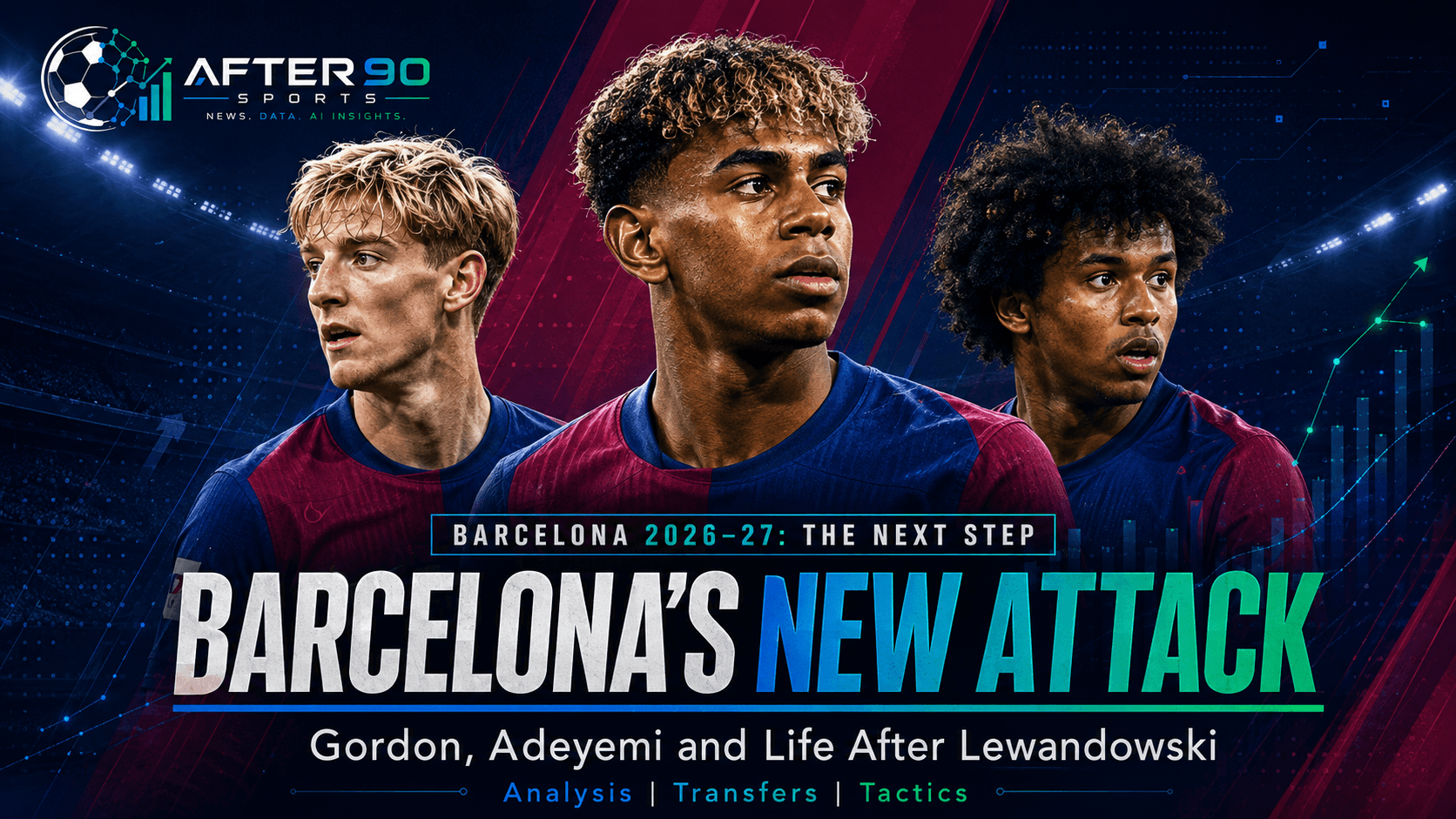
## Report 3 — Barcelona 2026–27: The Next Step
For the first time since 2022, Barcelona are preparing for a season without Robert Lewandowski leading the attack.
The Polish striker leaves after four seasons, 119 goals in 191 appearances and seven trophies, including three LaLiga titles.
More importantly, he leaves behind something that cannot be measured only through goals:
For four years, Barcelona always knew who their reference point in the penalty area was.
That certainty has disappeared.
But Barcelona have not responded by signing another traditional No. 9.
Instead, they have built something completely different.
Anthony Gordon has arrived from Newcastle United on a contract until 2031.
Karim Adeyemi has joined from Borussia Dortmund, also until 2031.
Gordon has spent most of his career on the wing but has experience through the centre, while Adeyemi can play on either flank or as a central forward.
Barcelona have also added 18-year-old Belgian winger Jesse Bisiwu, further increasing the speed and one-against-one ability available to Hansi Flick.
Barcelona have therefore answered the departure of one elite goalscorer with:
More speed. More movement. More versatility. More competition.
But potentially:
Less certainty inside the penalty area.
And that creates one of the biggest tactical questions of Barcelona’s new season.
1. You Cannot Simply Replace 119 Goals
Lewandowski was not merely Barcelona’s centre-forward.
He was the point around which large parts of the attack were organised.
When Barcelona reached the final third, there was always an obvious destination.
Cross from wide?
Lewandowski attacks the box.
Cut-back?
Lewandowski searches for space between the centre-backs.
Possession around the penalty area?
Lewandowski pins the defence.
Direct ball?
Lewandowski provides a central target.
Even when he did not score, his positioning influenced defenders.
That type of striker gives an attack clarity.
Barcelona will now need to replace that clarity collectively.
Because Gordon is not Lewandowski.
Adeyemi is not Lewandowski.
Ferran Torres is not Lewandowski.
And they should not be asked to become him.
2. Barcelona Have Chosen a Different Direction
The most revealing part of Barcelona’s transfer activity is what they did not do.
They did not immediately sign another classic penalty-box striker.
Instead, they added two forwards whose biggest qualities are:
- Pace.
- Movement.
- Versatility.
- Pressing.
- Carrying the ball.
- Attacking space.
- Playing in multiple positions.
Gordon’s profile is built around work rate and the ability to operate as a centre-forward despite spending most of his career on the wing.
Adeyemi is similarly capable of playing on either side or through the middle.
This suggests something important.
Barcelona may not be replacing Lewandowski with a player.
They may be replacing him with a system.
3. Anthony Gordon: A Very Different Type of Barcelona Forward
Gordon’s signing is particularly interesting because his style appears almost designed for Flick’s football.
At Newcastle, he developed into a high-intensity winger capable of:
- Pressing aggressively.
- Running behind the defence.
- Carrying the ball at speed.
- Attacking from the left.
- Moving centrally.
- Playing without needing constant touches.
He also brings defensive work rate and experience as a centre-forward.
That European output matters.
But his tactical profile may matter even more.
Gordon does not need Barcelona to slow the game down before he becomes dangerous.
He wants space.
He wants transition.
He wants defenders turning toward their own goal.
That gives Flick something Barcelona sometimes lacked:
A forward who can make open space feel more dangerous than possession itself.
4. Gordon Can Change Barcelona’s Left Side
Barcelona’s right flank already contains one of football’s biggest creative threats in Lamine Yamal.
That naturally attracts defensive attention.
Opponents frequently shift toward his side.
They double-team.
They bring the midfielder across.
They protect the inside channel.
That creates a question:
What happens on the opposite side?
This is where Gordon could become extremely valuable.
If Barcelona switch the ball quickly from Lamine’s side to Gordon, the Englishman may receive against:
- One defender instead of two.
- A defence moving laterally.
- An exposed full-back.
- Large space behind the line.
Barcelona suddenly become capable of attacking both wings with genuine one-against-one threat.
That can make defensive overloads against Lamine much more expensive.
5. Karim Adeyemi Adds Something Even More Extreme: Speed
If Gordon is fast, Adeyemi is explosive.
His profile is built around:
- Acceleration.
- Powerful running.
- Direct attacking.
- A strong left foot.
- Positional versatility.
That gives Flick another tactical weapon.
Imagine a Champions League opponent pressing Barcelona high.
Pedri escapes the first line.
Lamine receives inside.
Adeyemi immediately attacks the space behind the centre-back.
The opponent now has a problem.
Step forward?
Barcelona can play through the press.
Drop back?
Barcelona gain space for Pedri and Lamine.
Adeyemi therefore changes the geometry of the attack before he even touches the ball.
Sometimes speed itself creates space.
6. Adeyemi Could Also Be Used Through the Middle
This may become one of Flick’s most interesting experiments.
Adeyemi has played centrally before and is capable of operating as a centre-forward.
But that would create a completely different No. 9 from Lewandowski.
Lewandowski often wanted defenders close to him.
Adeyemi wants defenders chasing him.
Lewandowski could pin the centre-backs.
Adeyemi may try to separate them.
Lewandowski provided a target.
Adeyemi provides depth.
That could produce a front three such as:
Gordon — Adeyemi — Lamine Yamal
Few defensive lines would want to defend large spaces against that trio.
The obvious problem?
Against a team defending with ten players behind the ball, there may be almost no space to attack.
And that is where the debate becomes much more complicated.
7. Ferran Torres May Be More Important Than Ever
Barcelona already possess another solution.
Ferran Torres.
His role can sometimes be underestimated because he does not arrive with the attention surrounding a major new signing.
But his numbers deserve attention.
Ferran and Lamine Yamal both scored 16 LaLiga goals in 2025–26, sharing the Zarra Trophy as the league’s highest-scoring Spanish players.
Ferran is also capable of operating anywhere across the attack, including centre-forward.
And that makes him a serious candidate to start centrally.
A possible front three:
Gordon — Ferran — Lamine
would offer something relatively balanced.
Gordon provides verticality.
Lamine provides creation.
Ferran attacks the penalty area.
And the midfield can provide the control behind them.
8. Ferran Does Not Need to Become Lewandowski Either
This distinction matters.
If Ferran becomes the main central forward, success should not be measured by asking:
Can he score 35 or 40 goals?
The better question is:
Can Barcelona collectively replace Lewandowski’s goals?
The goal burden can now be distributed among:
- Lamine Yamal.
- Ferran Torres.
- Raphinha.
- Anthony Gordon.
- Karim Adeyemi.
- Dani Olmo.
- Fermín López.
- The midfield.
Lamine finished the previous LaLiga campaign with 16 goals and 11 assists and was named the league’s Player of the Season.
Barcelona already possess several players capable of producing goals.
The challenge is not necessarily finding one player who scores 40.
It may be creating five players who score between 10 and 20.
9. This Could Make Barcelona Less Predictable
There was an advantage to having Lewandowski.
Everyone knew where the striker would usually be.
There was also a disadvantage.
Everyone knew where the striker would usually be.
The new Barcelona attack could become much harder to map.
Imagine these rotations:
Gordon begins left.
Adeyemi begins centrally.
Lamine stays right.
Then:
Adeyemi moves left.
Gordon attacks the centre.
Lamine enters the half-space.
Pedri overlaps the movement from midfield.
Thirty seconds later:
Gordon returns wide.
Adeyemi attacks behind.
Lamine receives between the lines.
For defenders, the reference points keep changing.
That could become extremely difficult to control.
10. Raphinha Is Still Central to the Project
The arrival of Gordon and Adeyemi does not automatically reduce Raphinha to a secondary role.
His greatest value under Flick has never been purely positional.
Raphinha can:
- Play left.
- Play right.
- Move inside.
- Attack the box.
- Press aggressively.
- Make runs without the ball.
- Help establish the intensity Flick wants.
His continued presence gives Barcelona another experienced attacking profile alongside a younger, faster group.
The interesting question therefore is not simply:
Who starts?
It is:
Which combination works best against each opponent?
11. Barcelona Could Have Several Completely Different Front Threes
That may become one of the greatest strengths of the squad.
Balanced
Gordon — Ferran — Lamine
Width, box presence and creativity.
Maximum Speed
Gordon — Adeyemi — Lamine
Designed to punish high defensive lines.
Flick Intensity
Raphinha — Ferran — Lamine
Continuity, pressing and established relationships.
Transition Attack
Adeyemi — Gordon — Lamine
A nightmare for opponents defending large spaces.
Possession Heavy
Raphinha — Ferran — Lamine
With Olmo and Pedri behind them to overload central areas.
Rotation / Development
Roony Bardghji and Jesse Bisiwu give Flick further wide options.
The depth is impressive.
The challenge will be turning depth into hierarchy.
12. The Biggest Question Remains the Penalty Area
Barcelona have added speed.
They have added dribbling.
They have added pressing.
They have added versatility.
But have they replaced:
Penalty-box dominance?
This is where Lewandowski’s absence may become most visible.
Against Real Madrid, Liverpool or Bayern, speed can be devastating.
But Barcelona will also play many matches against teams defending in a low block.
There may be:
- Ten players behind the ball.
- No space behind the defence.
- Crowded central areas.
- Repeated crosses.
- Very few transition opportunities.
In those matches, Barcelona need someone attacking:
- The near post.
- The far post.
- The six-yard box.
- Second balls.
- Cut-backs.
- Crosses under pressure.
Ferran may provide part of that.
But this remains the biggest unanswered attacking question.
13. Who Occupies the Centre-Backs?
One of a classic striker’s most underrated jobs is simply occupying defenders.
Lewandowski could stand between two centre-backs and force both of them to constantly monitor him.
That created room elsewhere.
Without a permanent central reference, Barcelona must ensure their movement does not accidentally make defending easier.
If Gordon moves left...
Adeyemi drops...
Lamine receives wide...
and nobody attacks the centre...
the opposing centre-backs can step forward.
Beautiful movement becomes harmless movement.
The new attack therefore needs one basic rule:
Someone must always threaten the goal.
Rotation does not mean abandonment of the penalty area.
14. Lamine Yamal Could Benefit More Than Anyone
Perhaps the biggest beneficiary of Barcelona’s new speed is Lamine.
He already forces opponents to dedicate extra defensive resources to his side.
Now imagine what happens if the players around him are constantly attacking space.
Lamine receives.
The left-sided centre-back steps toward the ball.
Adeyemi runs behind.
Gordon attacks the opposite side.
Ferran enters the box.
Pedri offers underneath.
Suddenly Lamine has multiple solutions.
Pass.
Dribble.
Switch.
Combine.
Shoot.
The objective should not be asking Lamine to do more.
It should be:
Giving him more dangerous options.
15. Gordon Could Also Help Solve the Pressing Problem
Report 2 identified one of Flick’s biggest Year-Three priorities:
Making the press more coordinated.
Gordon’s profile could help.
A forward line featuring players willing to sprint aggressively without the ball could make Barcelona’s first defensive line much stronger.
The effect is important.
Better attacking pressing can produce:
- More high recoveries.
- Shorter distances to goal.
- Fewer exposed transitions.
- Better protection for the high defensive line.
Once again, attack and defence are connected.
16. Adeyemi Gives Barcelona a Counterattacking Threat They Rarely Had
Barcelona will usually dominate possession.
But that does not mean they should reject counterattacking football.
There will be Champions League matches where the opponent pushes forward.
There will be Clásicos where Madrid leave space.
There will be moments after defending set pieces.
There will be matches where Barcelona spend five minutes deeper than usual.
With Adeyemi, Gordon and Lamine available, Flick could suddenly possess one of Europe’s fastest transition attacks.
That is important because Barcelona should not become dependent on only one method of scoring.
Possession should remain the foundation.
But transition can become another weapon.
17. The Attack Could Finally Match Flick’s Tactical Evolution
There is an interesting relationship between Reports 2 and 3.
If Flick wants Barcelona to become more adaptable, his new attack gives him the personnel to do it.
Want to dominate possession?
Use Ferran centrally and surround him with creators.
Want maximum pressing?
Use Raphinha and Gordon.
Want to attack space?
Use Adeyemi.
Want one-against-one dominance?
Use Lamine and Gordon.
Want late-game speed against tired defenders?
Bring Adeyemi from the bench.
Want more control?
Move Raphinha inside and involve Pedri and Olmo.
The squad now offers solutions.
That means Flick has fewer excuses for tactical predictability.
18. Competition Could Become a Strength — or a Problem
There is another side to having so many forwards.
Minutes.
Lamine will expect to play.
Raphinha will expect to play.
Gordon has not joined Barcelona to watch from the bench.
Adeyemi will expect opportunities.
Ferran has earned a major role.
Roony needs development.
Bisiwu needs development.
That is a lot of players for three attacking positions.
Flick must create a hierarchy without destroying competition.
That requires:
- Clear communication.
- Tactical rotation.
- Workload management.
- Opponent-specific selections.
- Rewarding form.
- Using substitutions aggressively.
If managed correctly, Barcelona could remain dangerous throughout the season.
If managed poorly, attacking depth can become dressing-room frustration.
19. The World Cup Makes Rotation Even More Important
The 2026–27 season follows a World Cup summer.
That matters.
Several Barcelona stars have carried significant international workloads into preseason.
Barcelona cannot expect the same front three to play every major match from August to May.
The new attacking depth therefore serves two purposes:
Tactical flexibility.
and
Physical protection.
For a club trying to compete deep into every tournament, both are essential.
20. Barcelona May Be Building an Attack for Europe
There is another interpretation of the transfer strategy.
Perhaps Gordon and Adeyemi are not primarily responses to LaLiga.
Perhaps they are responses to the Champions League.
European football increasingly punishes teams that cannot attack space quickly.
Barcelona’s possession will always matter.
But against elite opponents, opportunities may last only seconds.
Win the ball.
One pass.
Run behind.
Attack.
Gordon and Adeyemi are built for those moments.
And that could be Barcelona’s biggest offensive evolution under Flick.
21. But Do Barcelona Still Need a True No. 9?
This question should remain open.
There is a strong argument that Barcelona already have enough.
Ferran can play centrally.
Adeyemi can play centrally.
Gordon has experience centrally.
Goals can be distributed.
The attack can rotate.
But there is an equally reasonable counterargument.
When Barcelona face a Champions League opponent defending deep with 15 minutes remaining and need one goal...
Would they benefit from an elite penalty-box striker?
Almost certainly.
The question is not whether such a player would improve Barcelona.
The question is whether the improvement would justify:
- The transfer cost.
- The salary.
- Reduced minutes for existing forwards.
- A possible reduction in tactical flexibility.
This may remain one of the biggest squad-building debates of the season.
22. The Real Replacement for Lewandowski May Be Collective Goals
Perhaps Barcelona’s solution is simpler than searching for another superstar.
Consider a hypothetical attacking distribution:
| Player | Possible Role |
|---|---|
| Lamine Yamal | Primary creator + major scorer |
| Ferran Torres | Central box attacker |
| Raphinha | Pressing + goals + movement |
| Anthony Gordon | Left-side scorer and transition threat |
| Karim Adeyemi | Vertical runner and flexible forward |
| Dani Olmo | Goals from between the lines |
| Fermín López | Late runs into the box |
| Roony / Bisiwu | Rotation and development |
Barcelona do not necessarily need one player to reproduce Lewandowski’s total.
They need the collective attack to reproduce — and ideally exceed — his contribution.
23. The Biggest Potential Upgrade Is Unpredictability
Last season’s Barcelona were extremely dangerous.
The new Barcelona could become harder to prepare for.
One week:
Ferran plays No. 9.
Next week:
Adeyemi.
Then Gordon moves centrally during the match.
Raphinha switches sides.
Lamine comes inside.
Olmo moves beyond the striker.
Opponents may know Barcelona’s philosophy.
But they may not know the exact attacking structure they will face.
That connects directly with Flick’s Year-Three challenge:
Keep the principles. Change the solutions.
24. What Must Go Right?
For this new attack to succeed, several things need to happen.
1. Gordon Must Adapt to Barcelona’s Positional Game
Running into space is only part of the job.
He must also learn when to remain wide and when to attack inside.
2. Adeyemi Must Become More Than a Transition Weapon
Barcelona will frequently face opponents who give him very little space.
3. Ferran Must Continue Scoring
His movement inside the box may become even more valuable after Lewandowski’s departure.
4. Lamine Cannot Carry the Entire Creative Burden
The new signings need to reduce his workload, not increase it.
5. Flick Must Establish Combinations
Seven forwards do not automatically create a better attack.
Relationships matter.
6. Someone Must Consistently Occupy the Penalty Area
Fluidity cannot become emptiness.
7. Competition Must Remain Healthy
Depth only becomes an advantage when players accept the structure.
25. Is the New Attack Better?
That depends on what we mean by “better.”
Is Barcelona losing one of the best goalscorers of his generation?
Yes.
Lewandowski’s 119 goals in 191 Barcelona appearances cannot simply be dismissed.
But is the new attack younger?
Yes.
Faster?
Definitely.
More versatile?
Almost certainly.
Better suited to aggressive pressing?
Potentially.
More dangerous in transitions?
Yes.
More unpredictable?
Potentially much more.
More reliable inside the penalty area?
That remains to be proven.
And that final question may define the entire experiment.
Final Assessment
| Area | 2025–26 Barcelona | 2026–27 Attack |
|---|---|---|
| Central reference | Lewandowski | Shared / flexible |
| Penalty-box presence | Excellent | Question mark |
| Pace | Good | Elite potential |
| Width | Strong | Very strong |
| One-v-one threat | Excellent through Lamine | Threat on both sides |
| Pressing options | Strong | Potentially stronger |
| Transition threat | Good | Major upgrade |
| Tactical flexibility | Good | Excellent potential |
| Goalscoring responsibility | Partly concentrated | More distributed |
| Squad depth | Strong | Very deep |
| Low-block solution | Lewandowski reference | Still to be proven |
| European potential | High | Potentially higher |
Conclusion
Barcelona have not replaced Robert Lewandowski.
And perhaps that is exactly the point.
They have replaced certainty with possibility.
A traditional No. 9 with multiple mobile forwards.
Penalty-box dominance with speed.
A fixed reference with rotation.
A player opponents could locate with an attack they may struggle to predict.
Anthony Gordon brings intensity, movement and direct running.
Karim Adeyemi brings extraordinary speed and positional flexibility.
Ferran Torres offers goals and penalty-area movement.
Raphinha provides aggression and tactical discipline.
And Lamine Yamal remains the creative centrepiece.
On paper, Barcelona now possess one of the most varied attacking groups in Europe.
But variety alone does not score goals.
The biggest challenge for Flick is turning all that movement into structure.
All that speed into chances.
All that depth into hierarchy.
And all those different forwards into enough goals to replace one of the greatest strikers of his generation.
The old Barcelona knew exactly who would finish the attack.
The new Barcelona may not care.
Because the objective is to create an attack where:
Anyone can finish it.
Barcelona 2026–27: The Next Step
Lewandowski was the reference.
Now the entire attack must become the reference.