Hansi Flick, Year Three: Evolution or Reinvention?
 After90
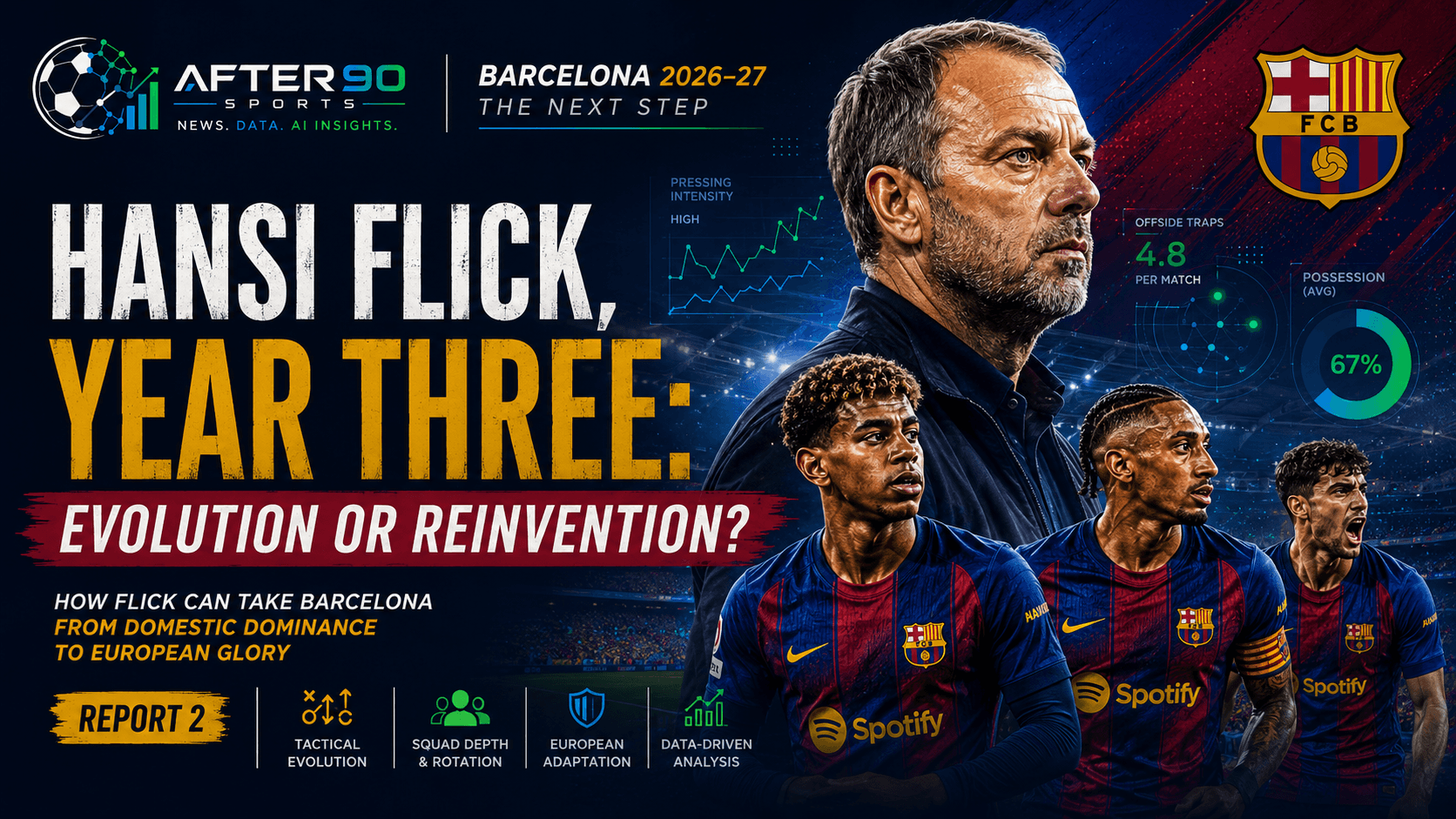
Report 2 — Barcelona 2026–27: The Next Step
Hansi Flick enters his third season at Barcelona in a very different position from the one he occupied when he arrived in 2024.
Back then, he had to convince the club, the players and the supporters that his ideas could work at Barcelona.
He no longer needs to do that.
Two consecutive LaLiga titles, two Spanish Super Cups and a Copa del Rey have transformed the discussion completely.
Across his first 116 matches, Flick recorded 88 victories — a 75.9% win rate, the second-highest percentage in Barcelona’s history at that stage.
The club has also extended his contract through June 2028, with an option for an additional season.
Flick has already built a successful Barcelona.
The question now is more difficult:
Does he need to perfect what he has already created — or reinvent parts of it?
Barcelona’s domestic results suggest evolution.
Their European disappointments suggest adaptation.
And that tension may define Flick’s third season.
1. Flick No Longer Has to Build an Identity
Perhaps the biggest difference between 2024 and 2026 is that Barcelona already know what they are supposed to look like.
When Flick arrived, he was associated with:
- High pressing.
- Intensity.
- Direct attacking football.
- A high defensive line.
- Aggressive counter-pressing.
- Quick vertical progression.
Two years later, those ideas have become recognisable characteristics of his Barcelona.
His team want to:
- Press high.
- Recover possession quickly.
- Maintain a high defensive line.
- Attack vertically when space appears.
- Control territory through possession.
- Commit numbers into attacking positions.
- Keep the distance between the lines short.
- Force opponents to make decisions under pressure.
This is not a team searching for an identity.
It has one.
And that is important because Flick’s third season should not begin with a complete tactical reset.
Barcelona do not need a new philosophy.
They need:
A more complete version of the existing one.
2. Five Trophies Mean the Philosophy Has Already Worked
There is an important danger when analysing Barcelona’s weaknesses.
European disappointment can make it tempting to focus only on what went wrong.
But Flick’s approach has already produced extraordinary results.
In his first two seasons, Barcelona won five of the eight trophies available to them:
- Two LaLiga titles.
- Two Spanish Super Cups.
- One Copa del Rey.
His team also developed a habit of sustained attacking production.
Barcelona scored in 55 consecutive LaLiga matches between December 2024 and May 2026.
The 2025–26 campaign also included an 11-match winning run.
This matters.
You do not dismantle a system that produces those results.
The objective should be:
Preserve what makes Barcelona dangerous while fixing what makes them vulnerable.
3. Flick’s Most Important Principle: Intensity
When discussing Flick, formations can sometimes become a distraction.
4-2-3-1.
4-3-3.
A high defensive line.
Inverted midfield positions.
Different attacking structures.
All of these matter.
But Flick’s most important idea is simpler:
Barcelona should play with intensity both with and without the ball.
That intensity appears in several forms.
With the Ball
Barcelona try to move opponents quickly.
They do not want possession simply for possession’s sake.
The objective is to:
- Draw pressure.
- Find the free player.
- Accelerate through midfield.
- Isolate a winger.
- Attack the defensive line.
Without the Ball
The first reaction after losing possession is usually aggressive.
Players step forward rather than immediately retreating.
The objective is to win the ball before the opponent can organise a counterattack.
When it works, Barcelona can suffocate teams.
When it fails, however, the consequences can be severe.
And that is where Year Three must evolve.
4. The High Line Is Not Going Away
One thing seems extremely unlikely:
Hansi Flick abandoning his high defensive line.
Flick sees the high line not as a defensive gamble, but as part of the entire structure.
It allows Barcelona to:
- Keep the team compact.
- Press closer to the opponent’s goal.
- Recover second balls.
- Maintain territorial dominance.
- Prevent opponents from building comfortably.
- Catch forwards offside.
Across Flick’s first 50 league matches, Barcelona forced 240 opposition offsides — 4.8 per match.
That is not an accidental statistic.
It is a structural weapon.
So the question for 2026–27 should not be:
Should Flick abandon the high line?
The better question is:
Can he make the high line more adaptable?
5. Adaptation Does Not Mean Betraying the Philosophy
This may be the most important distinction of Flick’s third season.
Barcelona do not need to become defensive.
They need to become:
Situationally intelligent.
There may be moments when the defensive line should remain extremely high.
There may also be moments when it should drop five metres.
Or ten.
Consider an opponent with:
- Two elite sprinters.
- A midfielder capable of playing first-time vertical passes.
- A goalkeeper comfortable bypassing the press.
- A centre-back capable of breaking lines.
Using exactly the same defensive height against that opponent as against a deep, low-possession LaLiga side is not necessarily courage.
Sometimes it is predictability.
The elite version of Flick’s Barcelona should still play aggressively.
But it should be capable of understanding:
When the risk is worth taking.
That is tactical evolution.
Not tactical surrender.
6. The Biggest Upgrade Must Come Before the Defensive Line
Barcelona’s defensive problems are often discussed as if they begin with the centre-backs.
That is too simplistic.
The high line only works when the player on the ball is uncomfortable.
If an opponent receives possession with:
- Time.
- Space.
- His head up.
Then even the fastest defenders can become vulnerable.
The protection must therefore begin much higher.
Barcelona need:
Better pressure on the ball carrier.
Faster closing of central passing lanes.
More coordinated pressing angles.
Stronger counter-pressing immediately after turnovers.
Better positioning from the midfield when the full-backs advance.
The objective should not simply be:
Defend the space behind better.
It should be:
Give opponents fewer opportunities to attack that space cleanly.
7. Year Three Should Introduce More Than One Pressing Mode
One of the ways Flick can evolve without changing Barcelona’s identity is through different levels of pressing.
Barcelona do not need to hunt the ball at maximum intensity every minute.
That becomes physically expensive and tactically predictable.
Instead, they could develop several pressing modes.
Mode 1: Full High Press
Used when:
- The opponent plays short from the goalkeeper.
- Barcelona sense technical insecurity.
- The match requires immediate pressure.
- The team wants to create momentum.
The front line pushes high.
The midfield follows.
The defence squeezes the pitch.
This is classic Flick football.
Mode 2: Controlled Mid-Block
Instead of chasing the centre-backs, Barcelona allow the opponent to advance slightly.
The objective is to close the central spaces and wait for a trigger.
For example:
- A pass toward the touchline.
- A poor first touch.
- A backwards pass.
- A receiver with his back to goal.
Then Barcelona accelerate the press.
This reduces running while potentially creating better pressing situations.
Mode 3: Protect the Lead
There will be moments — especially in Europe — when Barcelona do not need to recover the ball within three seconds.
They need to:
- Stay compact.
- Force the opponent outside.
- Protect the centre.
- Reduce transition opportunities.
- Manage the clock.
A team capable of switching between these modes becomes far harder to exploit.
8. The Next Evolution: Control Without Losing Verticality
Flick’s Barcelona are enjoyable partly because they are not slow.
They can dominate possession but still attack quickly.
That should remain.
But one of the lessons from last season is that there are moments when attacking quickly is not the correct decision.
Imagine Barcelona are leading 2–1 away from home in a Champions League knockout match with 15 minutes remaining.
The ball is recovered in midfield.
There is a possible forward pass.
But five Barcelona players are already ahead of the ball.
Should the pass still be attempted?
Sometimes, yes.
Sometimes the better decision is:
Keep the ball.
Move the opponent.
Allow teammates to recover their positions.
Take 20 seconds out of the match.
Then attack.
The next version of Barcelona needs to understand the difference.
9. Pedri Becomes Even More Important in This Evolution
If Flick wants Barcelona to control different match rhythms, Pedri becomes fundamental.
His greatest value is not simply creativity.
It is:
Decision-making.
Pedri can recognise:
- When to accelerate.
- When to recycle possession.
- When to move the ball to the opposite side.
- When to receive between the lines.
- When to stay deeper.
- When to delay the final pass.
That makes him one of the players capable of transforming Barcelona from:
an aggressive team
into:
an aggressive team that controls when to be aggressive.
Those are two very different things.
The second is much harder to play against.
10. Flick Must Protect Pedri From Becoming Irreplaceable
There is a problem, however.
The more important Pedri becomes, the more dangerous Barcelona’s dependence on him becomes.
Over a season that includes domestic competitions, Champions League football and the physical consequences of a World Cup summer, the team cannot function only when one midfielder is available.
Flick needs alternative methods of controlling games.
That could come through:
- Frenkie de Jong when available.
- Gavi.
- Marc Bernal.
- Marc Casadó.
- Dani Olmo in certain structures.
- A new midfield profile.
- Different build-up patterns involving the defenders.
The system must remain recognisable even when the personnel changes.
That is one of the differences between a strong starting XI and a championship squad.
11. The Full-Back Roles May Need to Become More Asymmetrical
Another area where Flick can evolve is the use of the full-backs.
Barcelona do not need both sides to behave identically.
One full-back can advance.
The other can remain deeper.
One can move inside.
The other can provide width.
This asymmetry could improve Barcelona’s protection after losing possession.
For example:
If the left-back pushes very high to support the attack, the right-back could remain more conservative.
Barcelona would then preserve three players behind the main attacking structure.
Or the opposite could occur depending on:
- The opponent.
- The winger combination.
- The midfield.
- The game state.
The important idea is:
Structure should dictate movement.
Not habit.
12. Barcelona Must Develop a Stronger Rest-Defence Structure
This concept may become one of the defining tactical discussions of the season.
“Rest defence” describes how a team positions the players who are not directly involved in the attack so they can stop the opponent’s counterattack.
Flick’s Barcelona naturally commit numbers forward.
That creates attacking power.
But it also increases the importance of the players left behind.
An ideal attacking structure should contain protection.
For example, if Barcelona have five players occupying advanced attacking lanes, the players behind them should already be positioned to:
- Contest the first clearance.
- Stop the first forward pass.
- Cover both wings.
- Protect the central corridor.
- Delay the counterattack if recovery fails.
The better this structure becomes, the more aggressively Barcelona can attack.
That is the interesting paradox:
Better defensive organisation can actually create more attacking freedom.
13. Lamine Yamal Needs Freedom — Inside a Stronger Structure
There is no reason to reduce Lamine Yamal’s freedom.
He is one of the players Barcelona should build around.
But freedom works best when the other ten players provide structure around it.
If Lamine receives wide on the right, he should know:
- Where the right-back is.
- Where the nearest midfielder is.
- Who is attacking the penalty area.
- Who is covering behind him.
- Where the switch of play is available.
That allows him to improvise.
Without that structure, freedom becomes isolation.
The goal should be to create situations where Lamine receives the ball already holding an advantage.
Then his talent can decide what happens next.
14. Raphinha’s Pressing Role Shows What Flick Values
One reason Raphinha has become so important under Flick is that his influence is not limited to possession.
He brings:
- Intensity.
- Vertical movement.
- Pressing.
- Aggression.
- Runs into scoring areas.
- Tactical discipline.
This tells us something important about Flick’s priorities.
An attacker does not only need to:
- Score.
- Assist.
- Dribble.
He must contribute to the structure.
That standard will become particularly important as Barcelona’s attack changes.
New attackers entering Flick’s system will have to understand that pressing is not an optional extra.
It is part of the position.
15. Flick Must Solve the Difference Between “Pressing” and “Running”
This is one of the most important details.
High-intensity football can easily become wasted energy if the press is not coordinated.
One player jumps forward.
Another arrives late.
The midfielder hesitates.
The defence remains too deep.
The opponent escapes.
Now four Barcelona players are running backwards.
That is not effective pressing.
The objective must be collective movement.
One trigger.
One reaction.
One compact team.
For Flick, Year Three must turn effort into greater efficiency.
16. European Football Requires a Second Personality
Barcelona’s domestic dominance proves that their primary personality works.
The Champions League asks another question.
Can they become something slightly different when required?
Not a different team.
A second version of the same team.
European knockout football contains moments when Barcelona may need to:
- Defend lower.
- Slow possession.
- Protect a draw.
- Accept 10 minutes without the ball.
- Stop chasing a third goal.
- Commit fewer players forward.
- Take fewer risks during one phase of a tie.
These situations should not feel uncomfortable.
They should become part of the tactical vocabulary.
The best possession teams in Europe do not control every match by having the ball for 70% of the time.
Sometimes they control a match by controlling:
What the opponent is allowed to do.
17. Flick’s Biggest Challenge Is Not Tactical Pride — It Is Tactical Predictability
Flick’s refusal to abandon his principles is a strength.
Players know what he believes.
They understand the identity.
The club knows what kind of football it wants.
But there is a danger if opponents know exactly what Barcelona will do in every situation.
Elite coaches study patterns.
They look for:
- Where the press can be bypassed.
- Which centre-back can be isolated.
- Which full-back leaves space.
- Where the defensive line moves.
- What happens after the first pressing line is beaten.
If Barcelona respond to every opponent in exactly the same way, elite opposition will eventually build solutions.
The evolution must therefore be:
Principles stay stable, details become unpredictable.
18. The Third Season Should Be About Tactical Maturity
Flick’s first season was about transformation.
The second was about confirmation.
The third should be about:
Maturity.
That means Barcelona becoming capable of answering several questions during the same match.
Can we press high?
Yes.
Can we defend a mid-block?
Yes.
Can we attack immediately?
Yes.
Can we keep the ball for 90 seconds?
Yes.
Can we use a high line?
Yes.
Can we drop temporarily?
Yes.
Can we win 4–0?
Yes.
Can we also protect a difficult 1–0?
That last question may be the one that matters most in Europe.
19. Flick Has Earned the Right to Evolve the Project
There is another important element.
Flick now has authority.
His contract has been extended through 2028 with an option for a further season.
His first two years delivered:
- Five trophies.
- Two consecutive league titles.
- A 75.9% win rate.
That gives him something he did not possess in 2024:
Institutional credibility.
If Flick decides the team needs to change a certain behaviour, the players already have evidence that his ideas can produce success.
He is no longer asking them to believe in a hypothetical project.
They have won inside that project.
This should make tactical evolution easier.
20. The Champions League Is Now the Objective
After two successful domestic seasons, the standard has changed.
Barcelona no longer need to prove that Flick can win LaLiga.
He has done it twice.
The third season is about proving that the same ideas can survive the most demanding European situations.
That means the main ambition becomes:
Winning the Champions League.
Another strong domestic season would still have value.
But the project is increasingly being judged against Europe.
21. Preseason Offers the First Signs of a More Established Project
Barcelona have entered their third preseason under Flick with a much more established identity than in his first summer.
The results of preseason friendlies are not especially important.
The interesting part is what Flick can use these weeks for:
- Testing new relationships.
- Integrating new players.
- Evaluating young talent.
- Adjusting pressing distances.
- Building physical condition.
- Experimenting with midfield combinations.
- Developing alternative structures.
The priority should not be arriving at Gameweek One with every tactical variation completed.
It should be arriving with:
The foundations clear.
22. What Should Flick Keep Exactly the Same?
Not everything needs improvement.
Several principles should remain almost untouched.
The Ambition to Dominate Territory
Barcelona should still push opponents backwards.
The Courage to Defend High
The high line remains central to the identity.
The Counter-Press
Immediate pressure after losing possession should remain one of the team’s greatest weapons.
Trust in Young Players
Flick’s willingness to give responsibility to youth has become one of the strengths of the project.
Attacking Width
Barcelona are most dangerous when they force opponents to defend the entire pitch.
Verticality
Possession should continue to have purpose.
Barcelona should not return to slow circulation without penetration.
The new version must preserve these qualities.
23. What Must Change?
The changes are more subtle — but important.
1. Pressing Must Become More Selective
Maximum intensity cannot be the only setting.
2. The Defensive Line Must Understand Context
High by default does not have to mean high in every second of every match.
3. Rest Defence Must Improve
Barcelona need better protection before turnovers happen.
4. Possession Must Become a Defensive Tool When Necessary
Sometimes keeping the ball is the best form of defending.
5. Match-State Management Must Improve
The correct tactical choice at 0–0 is not always the correct choice at 2–1.
6. The Team Needs More Than One Rhythm
Fast football is dangerous.
Changing speed is even more dangerous.
7. Europe Must Influence the Evolution
Barcelona’s domestic success should remain the foundation, but the Champions League weaknesses must shape the next phase.
24. Evolution or Reinvention?
So we return to the original question.
Does Hansi Flick need to evolve his Barcelona?
Or reinvent it?
The answer should be:
Evolution.
A reinvention would make little sense.
This team already wins.
The philosophy already suits Barcelona.
The players believe in it.
The supporters recognise it.
The results justify it.
But evolution is no longer optional.
The Champions League has shown that opponents can hurt Barcelona when they escape the first press, attack the space behind the line and turn the match into repeated transitions.
The system therefore needs another layer.
Not fewer principles.
More solutions.
25. What Would the Ideal Year-Three Barcelona Look Like?
The best version would still look unmistakably like Hansi Flick’s team.
It would:
Press high.
Defend aggressively.
Attack with width.
Move the ball quickly.
Allow Lamine freedom.
Use Pedri to control rhythm.
Commit numbers forward.
But it would also know how to:
Drop temporarily.
Close the centre.
Protect a lead.
Keep possession without forcing an attack.
Slow the match.
Survive a difficult 15-minute period.
Recognise when the opponent has tactical momentum.
That combination would represent the real next step.
Final Assessment
| Area | Flick’s Current Barcelona | Year-Three Evolution |
|---|---|---|
| Identity | Very clear | Preserve |
| High pressing | Major strength | Add selective pressing modes |
| High defensive line | Central principle | Make opponent-specific adjustments |
| Possession | Dominant and vertical | Improve game-state control |
| Counter-press | Aggressive | Improve coordination |
| Rest defence | Can be exposed | Major priority |
| Attacking freedom | Excellent | Maintain within stronger structure |
| Match management | Inconsistent at times | Major priority |
| Tactical flexibility | Good | Expand |
| Domestic performance | Elite | Maintain |
| European maturity | Still incomplete | Main objective |
| Coaching position | Extremely strong | Use stability to evolve |
Conclusion
Hansi Flick does not enter the 2026–27 season needing to save Barcelona.
He has already transformed it.
Two league titles.
Two Spanish Super Cups.
A Copa del Rey.
Five trophies in two seasons.
A style the supporters recognise.
Young players who have developed into major contributors.
And a team that once again expects to win every competition it enters.
But success changes the question.
The first challenge was:
Can Flick make Barcelona winners again?
Answered.
The second was:
Can he make the success sustainable?
Two consecutive league titles suggest yes.
Now comes the hardest question:
Can Flick evolve his football enough to win Europe without destroying what made Barcelona successful?
He should not abandon the high line.
He should refine it.
He should not abandon pressing.
He should make it smarter.
He should not slow Barcelona down.
He should teach them when to slow themselves down.
He should not make the team less courageous.
He should make courage more calculated.
That is the difference between changing an identity and maturing one.
And after two seasons of domestic success, that may be exactly what Barcelona need.
Barcelona 2026–27: The Next Step
The philosophy is already there.
Now Flick must make it complete.