Hull City stun Manchester United 2–0: sterile domination, set-piece failures and a historic opening-day defeat
 After90
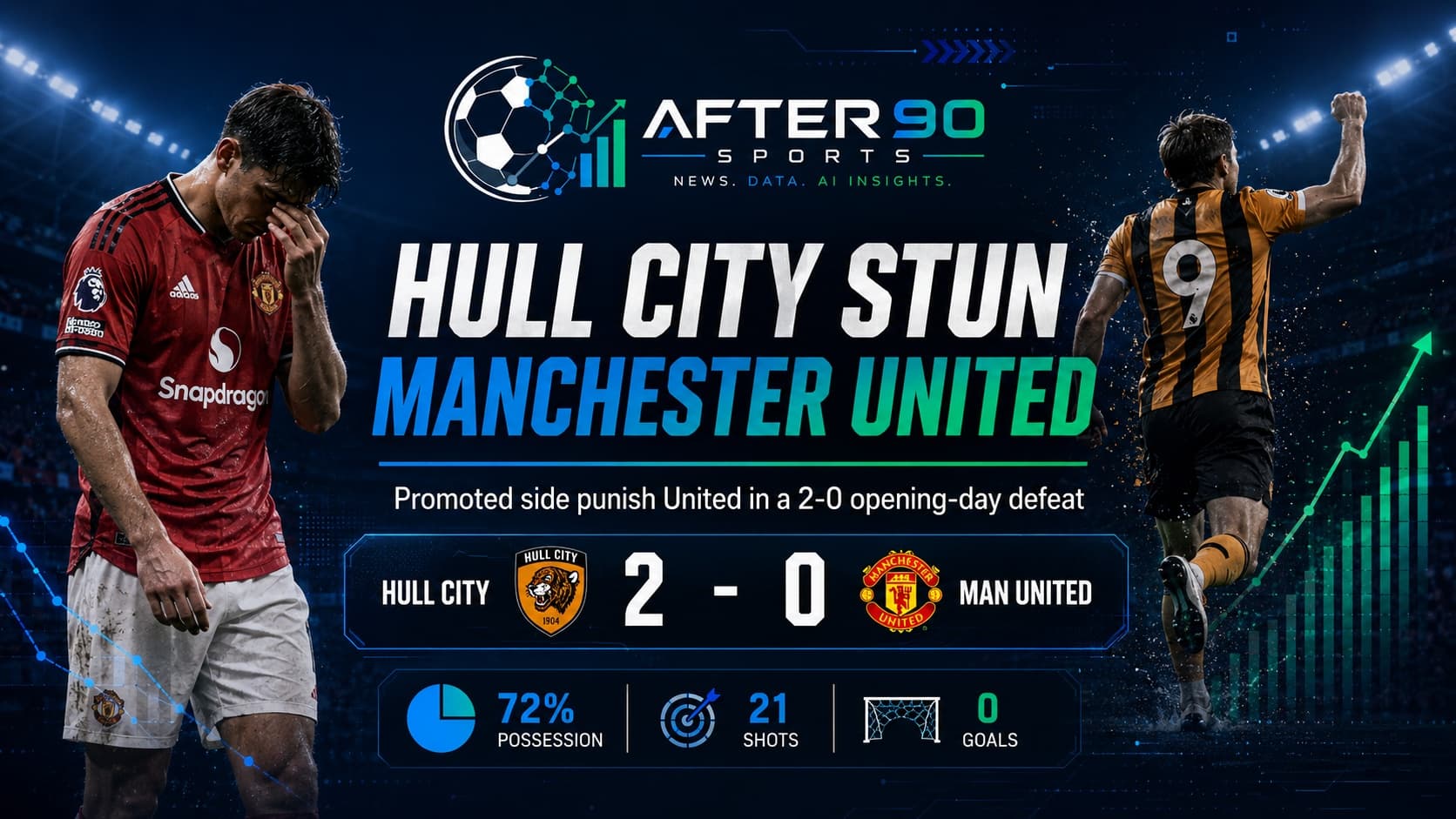
Manchester United could hardly have imagined a worse beginning to the 2026/27 Premier League season.
Michael Carrick's side travelled to the MKM Stadium to face newly promoted Hull City as clear favourites, but returned empty-handed after a deserved 2–0 defeat, with Semi Ajayi and Nobel Mendy scoring the goals that gave Hull a remarkable victory on their return to the Premier League.
For United, however, the concern goes far beyond the scoreline.
They controlled 72% of possession, attempted 21 shots and took six corners — yet finished the afternoon without a goal and rarely looked capable of turning their territorial dominance into genuine attacking control.
Hull needed only 28% of the ball to expose United's weaknesses.
Hull punish United twice from set pieces
The warning signs appeared early.
In the 17th minute, Regan Slater's corner caused problems inside the Manchester United penalty area. Oli McBurnie's effort was pushed onto the post by Senne Lammens, but United failed to react quickly enough to the rebound and Semi Ajayi converted to put Hull 1–0 ahead.
Things became even worse for Carrick's team before half-time.
In the 38th minute, another Slater delivery — this time from a free kick — found Nobel Mendy, who attacked the ball aggressively and headed beyond Lammens.
Two goals.
Two set-piece situations.
And a Manchester United defence repeatedly beaten not by complicated attacking combinations, but by organisation, physicality and reactions inside its own penalty area.
Hull went into half-time with a deserved 2–0 lead. Contemporary match reporting described the promoted side as more aggressive and effective in the decisive moments, while United struggled to create clear opportunities despite seeing far more of the ball.
72% possession, 21 shots... zero goals
The final numbers underline just how ineffective Manchester United's domination became.
| Statistic | Hull City | Manchester United |
|---|---|---|
| Possession | 28% | 72% |
| Total shots | 8 | 21 |
| Shots on target | 4 | 5 |
| Corners | 1 | 6 |
| Goals | 2 | 0 |
United therefore put only 5 of their 21 attempts on target — 23.8%.
Hull, by comparison, scored twice from eight attempts overall and twice from four efforts on target.
In other words, United produced almost three times as many shots and had more than two-and-a-half times as much possession, yet Hull were overwhelmingly more efficient where it mattered.
This was possession without penetration.
United moved the ball, occupied Hull's half and accumulated attempts, but too much of their attacking play took place in front of an organised defensive block rather than through it.
Carrick's changes could not change the game
Carrick reacted at half-time by introducing Marcus Rashford, replacing Patrick Dorgu.
It was Rashford's first Premier League appearance for Manchester United since December 2024.
Later, Kobbie Mainoo and Benjamin Sesko were also introduced as United searched for a route back into the contest.
The substitutions gave United even greater territorial control, but Hull remained compact and disciplined.
Konstantinos Tzolakis dealt confidently with the efforts that did reach his goal, while United were unable to create the sustained pressure normally expected from a team chasing a two-goal deficit against newly promoted opposition.
Where Manchester United lost the match
The biggest concern for Carrick will be that this defeat cannot simply be explained by bad luck.
Set-piece defending was poor. Both Hull goals came from dead-ball situations, with United losing crucial first and second contacts.
Possession was largely sterile. Seventy-two per cent of the ball and 21 attempts sounds dominant statistically, but five shots on target tells a very different story.
Hull won the physical battle. The promoted side competed aggressively for second balls, attacked crosses with conviction and made United uncomfortable whenever the game became direct.
And perhaps most worryingly, United lacked attacking cohesion. Bruno Fernandes struggled to influence the match decisively, while the midfield containing new arrivals Youri Tielemans and Andrey Santos failed to give United the control and progression that their possession percentage might suggest.
Hull's first Premier League victory over Manchester United
This is where today's result becomes genuinely historic.
Before Saturday, Hull City had faced Manchester United 10 times in the Premier League without winning once:
Manchester United wins: 8 Draws: 2 Hull City wins: 0
That was tied for the most times Hull had faced any Premier League opponent without recording a victory.
The sequence is now over.
Hull City 2–0 Manchester United on August 22, 2026 is officially Hull's first Premier League victory over Manchester United.
But it should not be described as Hull's first-ever victory over United.
The clubs have a much longer history. Before today's game, Hull had already recorded six competitive victories against Manchester United.
Their previous league victory came on November 23, 1974, when Hull also defeated United 2–0 in the old Second Division.
Remarkably, almost 52 years later, the scoreline is exactly the same.
Hull also defeated Manchester United 2–1 in the League Cup semi-final second leg in January 2017, although United progressed on aggregate.
So the accurate historical headline is:
Hull City's first Premier League win over Manchester United — and their first league win against them since 1974.
Manchester United also suffer an unwanted club first
There is another record that arguably makes the result even more damaging for United.
Before travelling to Hull, Manchester United had played 12 top-flight opening matches against teams that had just been promoted from the second tier.
Their record was:
9 wins 3 draws 0 defeats
They had never lost one.
The previous occasion came in 2010/11, when United opened against newly promoted Newcastle United and won 3–0 at Old Trafford.
Hull have therefore become the first newly promoted club ever to defeat Manchester United in their opening top-flight fixture of a season.
That makes this more than simply an opening-day upset.
It is a result without precedent in Manchester United's top-flight history.
United's uncomfortable history against newly promoted teams
Losing to promoted opposition itself is certainly not unprecedented.
Manchester United have suffered several famous Premier League defeats against clubs in their first season after promotion.
Burnley beat United 1–0 in August 2009. Leicester City produced the extraordinary 5–3 comeback in September 2014. Bournemouth beat United 2–1 in December 2015, and newly promoted Norwich won by the same score at Old Trafford only a week later.
Huddersfield Town defeated José Mourinho's United 2–1 in October 2017, a result that Opta/Sky Sports at the time identified as United's 15th Premier League defeat against newly promoted opposition.
There were more to follow.
Newly promoted Wolves beat United 2–1 in April 2019, while Cardiff City — already relegated — won 2–0 at Old Trafford on the final day of the same season.
Perhaps the most damaging modern example came in November 2021, when newly promoted Watford demolished United 4–1. It was United's heaviest league defeat against a promoted side since the 5–1 loss to Manchester City in 1989 and proved to be Ole Gunnar Solskjær's final match in charge.
And only last season, newly promoted Leeds United won 2–1 at Old Trafford on April 13, 2026.
Hull can now add their name to that list.
The difference is that none of those clubs had previously beaten Manchester United in the opening match of a top-flight campaign immediately after promotion.
A result Carrick cannot dismiss as an opening-day accident
One match does not determine a Premier League season.
But the manner of this defeat should concern Manchester United considerably more than simply dropping three points in August.
United were facing a club that had just arrived from the Championship. They had 72% possession. They produced 21 attempts. They had the stronger squad on paper.
Yet Hull looked better organised, more aggressive around both penalty areas and vastly more efficient.
For Michael Carrick, the immediate problem is therefore not possession or volume.
It is what Manchester United actually do with that possession — and how vulnerable they remain when opponents challenge them physically, defend compactly and attack set pieces aggressively.
For Hull City, meanwhile, it could hardly have been a better return to the Premier League.
Hull City 2–0 Manchester United.
Their first Premier League victory over United.
Their first league victory against United since 1974.
And the first time in Manchester United's history that a newly promoted club has beaten them in their opening top-flight match of a season.
For Hull, history.
For Manchester United, an opening-day warning that will be very difficult to ignore.