Is Real Madrid Ready to Return to the Top? Expectations, Targets and the Final Verdict for 2026–27
 After90
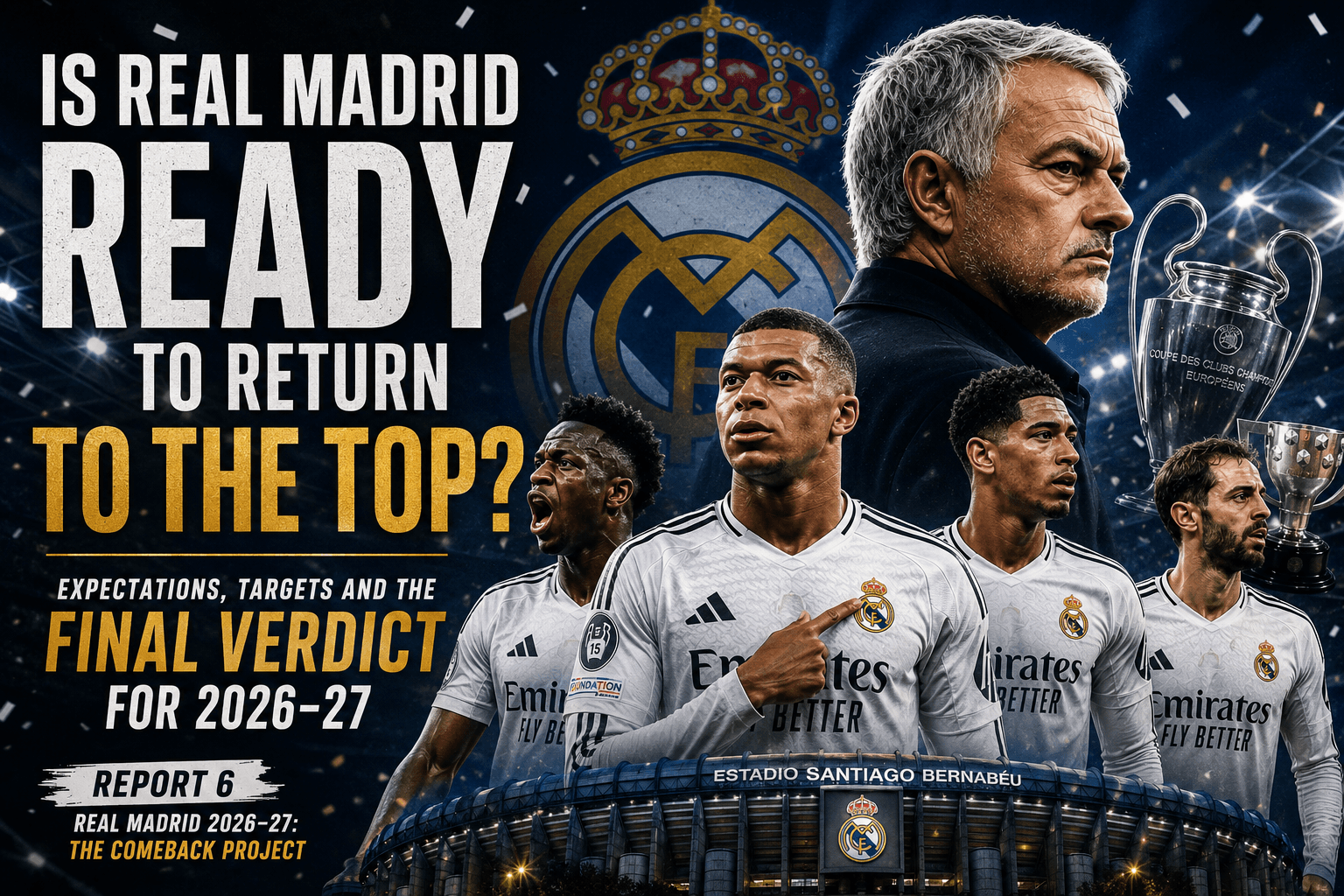
Report 6 — Real Madrid 2026–27: The Comeback Project
Over the previous five reports, we have examined almost every part of Real Madrid’s rebuild.
We looked at why last season failed.
We analysed the return of José Mourinho.
We examined the new signings and the problems each of them could solve.
We explored how the new Madrid may play tactically.
And we identified what the squad still needs before competitive football begins.
Now there is only one question left.
Is Real Madrid actually ready to return to the top?
The answer is not as simple as looking at the names on the squad list.
On paper, Madrid have almost everything.
Elite goalscorers.
Explosive wingers.
Creative midfielders.
Physical midfielders.
Attacking full-backs.
Ball-playing defenders.
Recovery defenders.
Multiple tactical systems.
Depth across almost every position.
And one of the most experienced managers in elite football.
The ingredients are there.
But great squads do not automatically become great teams.
The final stage of the project is the hardest:
turning potential into results.
1. What Does “Returning to the Top” Actually Mean?
For most clubs, finishing second in the league and reaching the latter stages of the Champions League could be considered a successful season.
For Real Madrid, expectations are different.
A successful 2026–27 season cannot simply mean:
- Playing better football.
- Improving statistically.
- Looking more organised.
- Competing until the final weeks.
Those things matter.
But at Real Madrid, eventually the project has to produce trophies.
The minimum standard should therefore be:
Real Madrid must seriously compete for every major competition.
That does not mean they have to win everything.
No team can guarantee that.
But Madrid should enter April and May with realistic opportunities to win both LaLiga and the Champions League.
If the team is effectively eliminated from the title race months earlier, the project has not worked.
If Madrid repeatedly collapse against Europe’s elite, the project has not worked.
Progress must ultimately become competitive success.
2. LaLiga Must Become the Foundation of the Project
The league should be one of Mourinho’s biggest priorities.
Why?
Because a league season exposes structural weaknesses more clearly than almost any other competition.
You cannot hide behind one great night.
You cannot survive an entire season through individual moments.
To win LaLiga, Madrid need to perform consistently against:
- Elite opponents.
- Mid-table teams.
- Low defensive blocks.
- Aggressive pressing sides.
- Difficult away grounds.
- Matches immediately after Champions League games.
- Opponents who offer almost no attacking space.
That is exactly why the tactical improvements discussed throughout this series matter.
Madrid need to become a team capable of winning in different ways.
Sometimes through Mbappé’s speed.
Sometimes through Vinícius in isolation.
Sometimes through Bernardo’s control.
Sometimes through a set piece.
Sometimes through a late Bellingham run.
Sometimes through Carlos Espí occupying the box.
Sometimes through a defensive 1–0 victory.
A champion cannot depend on one type of match.
3. The League Target Should Be 90+ Points
A simple performance target for the season should be:
90 points or more.
This does not guarantee the title.
But it normally means the team has produced the consistency expected from a championship contender.
To reach that level, Madrid cannot afford repeated unnecessary draws or defeats against opponents they are expected to beat.
The biggest improvement must come from turning difficult matches into wins.
Last season, the difference between Madrid and the strongest domestic rival was not necessarily that Madrid were incapable of competing in individual major matches.
The issue was consistency across the entire calendar.
The new team has to convert:
draws into wins
and
unstable matches into controlled victories.
That is where league titles are won.
4. Madrid Should Aim for at Least 85 League Goals
Real Madrid possess too much attacking quality to produce an average offensive season.
A reasonable minimum target should be:
85+ LaLiga goals.
Why does this matter?
Because Madrid cannot build the new project entirely around defensive improvement.
The squad contains:
- Mbappé.
- Vinícius.
- Bellingham.
- Diomande.
- Bernardo Silva.
- Güler.
- Rodrygo.
- Brahim.
- Endrick.
- Espí.
- Mastantuono.
The attacking ceiling is enormous.
The objective should therefore not simply be to score more goals.
It should be to distribute the goals more effectively.
Madrid cannot depend on Mbappé and Vinícius alone.
Bellingham should contribute.
Diomande should contribute.
Midfielders should arrive into the box.
Defenders should become dangerous from set pieces.
The more distributed the scoring becomes, the harder Madrid become to stop.
5. Mbappé Should Lead the Scoring — but Not Carry the Attack Alone
Kylian Mbappé should naturally remain Madrid’s primary goalscorer.
The entire tactical structure discussed in Report 4 should help him.
Starting centrally.
Attacking the space between centre-backs.
Receiving from both wings.
Benefiting from Bellingham’s movement.
Receiving cut-backs from Vinícius and Diomande.
Attacking crosses from Trent and Dumfries.
A successful Madrid should create an environment where Mbappé does not have to manufacture every goal himself.
His job should become simpler:
arrive in dangerous areas and finish.
If Madrid build the system properly, Mbappé could score more efficiently while actually touching the ball less in irrelevant areas.
That would be a sign of tactical improvement.
6. The Vinícius–Mbappé Partnership Will Define the Attacking Ceiling
This remains one of the most important relationships in the entire project.
Madrid do not simply need both players to produce individually.
They need them to improve each other.
A successful partnership should look like this:
Vinícius stretches the left side.
Mbappé occupies the centre.
Vinícius attacks inside when the defence moves.
Mbappé drifts left only when the structure allows it.
Bellingham attacks the spaces created between them.
If this relationship works, Madrid possess perhaps the most dangerous left-central attacking combination in world football.
If it fails, Madrid risk returning to the same problem:
too many stars occupying the same spaces.
The difference between those two outcomes could determine the entire season.
7. Diomande Could Become the Player Who Changes the Geometry of Madrid’s Attack
The most interesting new variable may be Yan Diomande.
Not necessarily because he must become Madrid’s second or third highest scorer immediately.
His tactical importance comes from something else.
He can force opponents to defend the right side seriously.
That matters enormously.
If defenders cannot overload toward Vinícius, the entire pitch opens.
Suddenly:
- Vinícius receives more one-on-one situations.
- Mbappé gets more room centrally.
- Bellingham finds larger spaces between the lines.
- Bernardo receives more time.
- Trent has more passing angles.
Diomande therefore does not need to produce extraordinary numbers immediately to influence Madrid.
If opponents respect his threat, he is already changing matches.
8. Bellingham Must Become Decisive Again
Jude Bellingham may be one of the players who benefits most from a clearer tactical structure.
Madrid should not ask him to solve every midfield problem.
He should not constantly be required to:
- Build from the defensive line.
- Cover full-backs.
- Create every attack.
- Lead the press.
- Score goals.
- Defend the box.
His best version appears when he can arrive.
When other players create the structure, Bellingham can attack it.
His targets should include:
- Regular goals from midfield.
- More touches between the lines.
- Late runs into the box.
- Strong pressing contributions.
- Better connections with Mbappé.
A more specialised Bellingham could actually become a more dangerous Bellingham.
9. Bernardo Silva May Be the Player Who Wins Madrid the “Boring” Matches
Every championship team needs players who dominate the glamorous matches.
But they also need players who solve games nobody remembers.
A difficult away match.
A 0–0 against a low block.
A match three days after the Champions League.
A game where the opponent refuses to leave its own penalty area.
This is where Bernardo Silva may become invaluable.
His contribution may not always appear in goals and assists.
It may appear in:
- Keeping possession.
- Escaping pressure.
- Drawing opponents out of position.
- Slowing the match after Madrid take the lead.
- Creating the pass before the assist.
- Helping Madrid remain in the opponent’s half.
Those actions can turn unstable matches into controlled ones.
Over 38 league matches, that can be worth many points.
10. The Defence Should Target Fewer Than 32 League Goals Conceded
Real Madrid do not need to become the most defensive team in Europe.
But they do need to become harder to destabilise.
A reasonable target would be:
fewer than 32 goals conceded in LaLiga.
More important than the number itself is how those goals are conceded.
Madrid should reduce:
- Open-field counterattacks.
- Goals after simple turnovers.
- Situations where centre-backs defend huge spaces.
- Late goals caused by game-state chaos.
- Unnecessary transitions after taking the lead.
If Mourinho improves those areas, the defensive numbers should improve naturally.
11. Konaté + Huijsen Could Become the Defensive Foundation
If healthy and given enough time together, the Konaté–Huijsen partnership could become one of Madrid’s most important developments.
Their profiles make sense together.
Huijsen provides:
- Build-up.
- Passing.
- Composure.
Konaté provides:
- Recovery pace.
- Strength.
- Aggression.
- Protection in space.
The partnership should allow Madrid to defend higher while still protecting themselves against direct attacks.
But the biggest requirement is continuity.
Mourinho cannot change the central-defensive pairing every week without necessity.
Great defences depend on relationships.
12. Courtois Remains One of Madrid’s Biggest Competitive Advantages
Tactical systems matter.
But championship teams also need players who save them when the system fails.
Thibaut Courtois remains one of those players.
Madrid should aim to reduce the number of difficult situations he faces.
But in the Champions League, there will always be moments when the goalkeeper must win the team a match.
A great goalkeeper can turn:
a tactical mistake into a save,
a defensive breakdown into a corner,
and sometimes an elimination into qualification.
Madrid already possess that advantage.
They should not take it for granted.
13. The Champions League Target: Top Eight First
Madrid’s first Champions League objective should be simple:
finish the league phase inside the top eight.
This matters for more than prestige.
Avoiding the additional knockout playoff means:
- Two fewer high-intensity matches.
- Lower injury risk.
- More recovery time.
- Better preparation for domestic fixtures.
- Greater control over the calendar.
For a squad coming off a World Cup summer and managing several physical situations, those two matches could matter enormously.
Madrid should treat the league phase seriously from the beginning.
Not assume they can repair everything later.
14. In Europe, Mourinho’s Experience Could Become a Major Advantage
This may be where Mourinho’s return becomes particularly interesting.
Champions League knockout football is not only about playing well.
It is about:
- Understanding game states.
- Managing two-legged ties.
- Knowing when to attack.
- Knowing when to slow down.
- Managing emotional momentum.
- Protecting advantages.
- Recognising when the opponent is vulnerable.
Madrid have historically possessed extraordinary Champions League experience as a club.
Mourinho adds another layer of competitive experience.
If he can combine that mentality with the attacking quality of this squad, Madrid should be capable of reaching the latter stages.
The minimum objective should be:
Champions League semi-finals.
Once a team reaches that point, small moments can decide everything.
15. Copa del Rey Must Be Taken Seriously
One of Madrid’s biggest mistakes in previous seasons has sometimes been allowing the Copa del Rey to become secondary until it is too late.
With the current squad depth, there should be no excuse.
Rotation does not have to mean surrendering quality.
Madrid can rest major starters while still fielding extremely competitive teams.
The Copa should therefore be treated as:
- An opportunity for squad players.
- A development platform for younger talent.
- A realistic trophy target.
- A chance to maintain competitive rhythm.
A club with this level of depth should not accept an early exit lightly.
16. Mourinho’s Biggest Test Will Be Squad Management
Perhaps no tactical decision will matter more than how Mourinho manages minutes.
The squad contains too many players to keep everyone satisfied through promises.
The only sustainable solution is clarity.
Every player needs to understand his category.
Core starter.
Tactical starter.
Rotation option.
Specialist.
Development player.
Problems begin when a player believes he is a guaranteed starter while the coach sees him as a rotation option.
Mourinho must establish expectations early.
This is especially important in areas such as:
- Right-back.
- Right wing.
- Central midfield.
- Centre-back.
- Secondary attacking roles.
A deep squad can win a treble.
A badly managed deep squad can divide a dressing room.
17. Rodrygo May Become the Biggest Squad-Management Test
Rodrygo remains particularly interesting.
He is too talented to be treated like an ordinary substitute.
But the squad now contains significant competition in every role he can play.
His season could therefore develop in several ways.
Scenario 1: Tactical utility player
He becomes the high-quality option Mourinho uses across multiple positions.
Scenario 2: Wins a starting role
Excellent performances force Mourinho to adjust the structure.
Scenario 3: Struggles for continuity
He becomes caught between several positions without owning one.
How Mourinho handles Rodrygo could tell us a lot about the hierarchy of the new Madrid.
18. Güler and Mastantuono Must Continue Developing
Madrid cannot allow the rebuild to become entirely focused on established stars.
Young players still need pathways.
Arda Güler should continue receiving meaningful responsibility.
Not only late substitute appearances.
He needs matches where he is expected to:
- Control possession.
- Create chances.
- Take set pieces.
- Make decisions under pressure.
Mastantuono also needs a clear development plan.
The objective should not be to force every young player into the starting XI immediately.
It should be to ensure that, by the end of the season, they are better players than they were at the beginning.
Madrid’s future depends on that.
19. Set Pieces Could Quietly Add 10–15 Important Goals
Real Madrid possess enough quality to make set pieces a major weapon.
Delivery from:
- Trent.
- Bernardo.
- Güler.
Targets including:
- Konaté.
- Rüdiger.
- Bellingham.
- Tchouaméni.
- Dumfries.
Even a modest improvement in attacking set pieces could produce several additional league goals.
And not ordinary goals.
Often decisive goals.
Set-piece goals frequently arrive in exactly the matches where open play is difficult.
If Madrid add even 10 goals across all competitions through well-designed dead-ball situations, the impact could be significant.
20. The Bernabéu Must Become a Major Advantage Again
Championship teams make their stadium uncomfortable for opponents.
Madrid should aim to dominate at home.
A realistic target:
no more than one home league defeat.
The mentality at the Bernabéu should be simple:
even when Madrid are not playing well, the opponent should feel that surviving 90 minutes will be difficult.
That requires:
- Strong opening periods.
- Aggressive pressing.
- Sustained territorial pressure.
- Quick reactions after conceding.
- Better control after taking the lead.
A home stadium should provide points before it provides entertainment.
Ideally, Madrid produce both.
21. The Clásicos and Madrid Derbies Will Be Major Tests
League titles are not won only in major matches.
But major matches often reveal how close a team is to championship level.
Madrid should aim to perform significantly better against their primary domestic rivals.
A reasonable objective would be:
at least 7 points from the 12 available against Barcelona and Atlético Madrid.
More important than the exact number will be the performances.
Do Madrid control periods of the match?
Can they survive pressure?
Can they defend transitions?
Can Mourinho tactically adjust during the game?
Those matches will provide some of the clearest evidence of the project’s progress.
22. The First 10 League Matches Will Tell Us a Lot
It will be too early to judge the entire Mourinho project after ten matches.
But several important trends should already be visible.
We should know:
Is Mbappé consistently playing centrally?
Is Vinícius receiving more one-on-one situations?
Is the right wing contributing?
Is Bellingham operating between the lines?
Is the team protected after losing possession?
Has Mourinho established a defensive partnership?
Is Bernardo helping control difficult games?
Are the new signings integrated?
If the answers are mostly yes, the project is moving in the right direction.
If the same structural problems from last season remain visible, concern would be justified.
23. Three Possible Scenarios for the Season
It is useful to imagine three broad outcomes.
Scenario A — The Best-Case Version
Everything clicks quickly.
Mbappé and Vinícius establish a complementary relationship.
Diomande becomes a major right-sided threat.
Bellingham thrives behind Mbappé.
Bernardo controls possession.
Konaté and Huijsen stabilise the defence.
Trent and Dumfries give Mourinho different tactical solutions.
The injury situation improves.
Madrid become extremely difficult to counterattack against.
Possible outcome:
- LaLiga champions.
- Champions League finalists or winners.
- Strong Copa run.
- One of Europe’s most complete teams.
This is the ceiling.
And with the quality available, it is not unrealistic.
Scenario B — The Realistic Successful Version
The team takes time to develop.
There are periods of inconsistency.
Some new signings need months to adapt.
Mourinho changes the system several times.
But by the second half of the season, Madrid are clearly stronger.
Possible outcome:
- 90+ league points.
- Genuine LaLiga title challenge.
- Champions League semi-final or better.
- At least one major trophy.
- Clear tactical identity established.
This would represent a successful first season of the new project.
Scenario C — The Warning Scenario
The attacking hierarchy remains unclear.
Vinícius and Mbappé continue occupying similar spaces.
The right side remains unstable.
Too many players become unhappy with minutes.
Injuries continue.
The team becomes overly dependent on individual moments.
Mourinho reacts by becoming increasingly conservative.
Possible outcome:
- League inconsistency.
- Excessive draws against low blocks.
- Champions League vulnerability.
- Dressing-room tension.
- Questions about the direction of the project.
This is the scenario Madrid must avoid.
24. What Would Count as a Successful Season?
Not every trophy has the same weight.
Winning the Spanish Super Cup alone would not make the season successful.
Nor would reaching the Champions League semi-final while finishing far behind the league champion.
My minimum criteria for a successful season would be:
At least one major trophy
LaLiga, Champions League or Copa del Rey.
And:
Genuine contention for another major competition.
For example:
Winning LaLiga + Champions League quarter-final/semifinal
Successful.
Winning Champions League + second in LaLiga
Clearly successful.
Winning Copa del Rey + fighting for LaLiga until the final weeks + deep Champions League run
Successful.
No major trophy + another distant second-place finish
Not successful.
At Real Madrid, progress matters.
But trophies remain the final measurement.
25. Recommended Performance Targets
| Area | 2026–27 Target |
|---|---|
| LaLiga points | 90+ |
| League goals | 85+ |
| League goals conceded | Under 32 |
| Home league defeats | Maximum 1 |
| Points vs Barcelona + Atlético | 7+/12 |
| Champions League league phase | Top 8 |
| Champions League minimum | Semi-finals |
| Copa del Rey | Serious title challenge |
| Major trophies | At least 1 |
| Tactical objective | Stable rest defence |
| Attacking objective | Balanced threat from both wings |
| Squad objective | Clear hierarchy without losing depth |
| Physical objective | Reduce recurring muscle injuries |
These targets are ambitious.
They should be.
This is Real Madrid.
26. The Most Important Target Cannot Be Measured in a Table
There is one objective more important than 90 points or 85 goals.
Real Madrid need to become recognisable again.
After watching ten minutes of a match, it should be obvious what the team wants to do.
How they build.
How they press.
How they protect the ball.
How they attack space.
How they defend transitions.
Great teams have an identity even before you see the lineup.
That is what Mourinho must build.
The team cannot depend on one system forever.
But every system should follow the same principles.
27. What Would Mourinho’s Successful Madrid Look Like?
The ideal version would combine qualities that are usually difficult to put together.
Disciplined — but not passive.
Direct — but capable of controlling possession.
Physical — but technically sophisticated.
Fast in transition — but patient against low blocks.
Structured — but still allowing individual creativity.
That is the challenge.
Madrid should not become a copy of Mourinho’s teams from 2010 or 2012.
Football has changed.
The squad has changed.
Mourinho must also adapt.
The most successful version of this project will not recreate the past.
It will take Mourinho’s strongest principles and apply them to modern football.
28. The Biggest Reason for Optimism: Madrid Now Have Different Ways to Win
This may be the strongest argument in favour of the project.
Last season, Madrid often looked dependent on individual attacking brilliance.
The new squad offers more possibilities.
They can win through:
Transition
Mbappé + Vinícius + Diomande.
Positional control
Bernardo + Trent + Bellingham.
Physical dominance
Valverde + Tchouaméni + Konaté.
Wide overloads
Cucurella or Dumfries.
Penalty-box football
Carlos Espí.
Set pieces
Trent/Güler delivery + aerial power.
Defensive game management
Mourinho’s structure + Courtois.
Champions are difficult to stop because there is no single solution against them.
Madrid are moving toward that kind of squad.
29. The Biggest Reason for Caution: Too Many Pieces Still Need to Connect
The same depth that creates optimism also creates risk.
The team includes many players who expect major roles.
The tactical relationships are new.
The coach is new.
Several players have had interrupted preparation.
Young players still require development.
And the expectations are immediate.
Madrid could become extraordinary.
But there is no guarantee the process will be smooth.
The biggest mistake would be assuming that an expensive and talented squad automatically produces elite football.
It does not.
The details still have to be built.
30. Final Verdict: Is Real Madrid Ready?
Yes — but not finished.
Real Madrid appear ready to compete for every major trophy.
The squad quality is sufficient.
The tactical options are sufficient.
The attacking talent is exceptional.
The defensive profiles are improved.
The depth is extraordinary.
The contract uncertainty around Vinícius has been removed.
And Mourinho has been given enough tools to build the type of team he wants.
There are no obvious excuses left.
But Madrid are not yet a finished team.
They still need:
- Tactical automatisms.
- Fitness.
- Defensive partnerships.
- Role clarity.
- Midfield control.
- Emotional stability.
- Time together.
That is why the first months will be so important.
The Final Conclusion of “The Comeback Project”
This series began with a simple question:
How did a squad with so much talent finish another season without a major trophy?
The answer was never just one player.
And it was never just one manager.
Real Madrid lacked balance.
They lacked continuity.
They lacked clear spacing.
They lacked control.
They depended too heavily on individual solutions.
The response this summer has been significant.
A new coach.
New defenders.
New full-backs.
More control in midfield.
A different striker profile.
Another explosive winger.
Greater tactical flexibility.
And a clearer long-term commitment to the core stars.
Now the transfer window can only do so much.
The next stage belongs to Mourinho and the players.
The question is no longer:
Does Real Madrid have enough talent?
It clearly does.
The question is:
Can Real Madrid turn all that talent into one team?
If Mourinho succeeds, Madrid have the quality to win LaLiga.
They have the quality to win the Champions League.
And they have the depth to compete across every competition.
But the most important transformation would be deeper than any trophy.
It would be the return of a Real Madrid team that knows exactly:
who it is.
how it wants to play.
how it wants to win.
And what to do when a match becomes difficult.
That is the final step.
Real Madrid 2026–27: The Comeback Project
The rebuilding phase is almost over.
Now comes the part that matters.