








£3.46 Billion: How the Premier League Changed the Rules of the Transfer Market
 After90
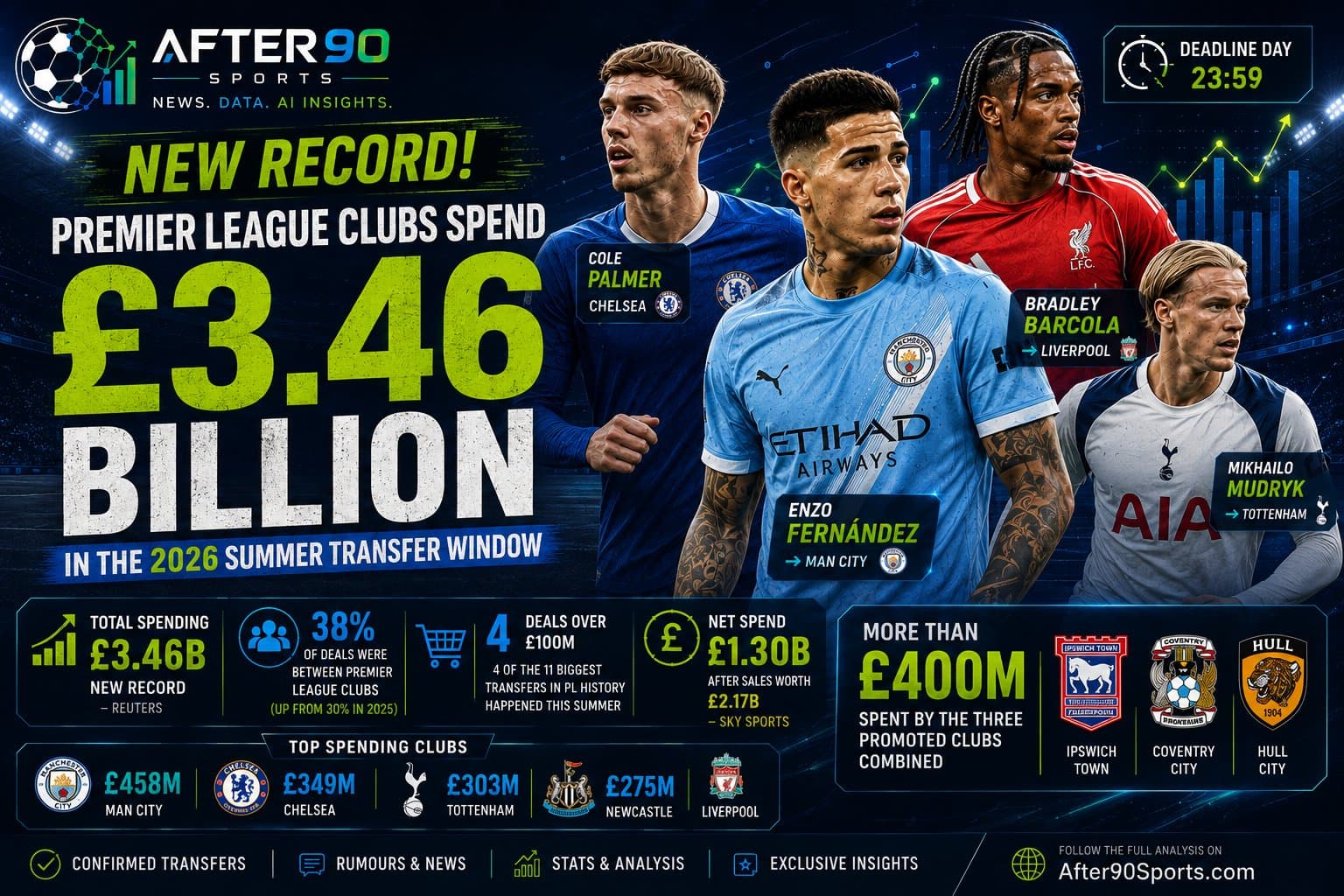
Premier League clubs have shattered the summer transfer spending record with approximately £3.46bn invested in 2026. After an extraordinary window of £100m-plus deals, we examine where the money went and who actually spent it best.
The summer transfer window is closed, but the number it left behind in the Premier League tells the story of an extraordinary market.
£3.46 billion.
That is approximately how much Premier League clubs spent during the summer of 2026 — a new record that further demonstrates the financial power of English football.
But the size of the spending raises a more important question:
Who actually spent well — and will those billions produce better teams on the pitch?
According to Reuters, Premier League clubs spent approximately £3.46bn during the summer window.
For comparison, only five years ago, summer spending stood at approximately £1.13bn.
Premier League summer spending has therefore more than tripled in five years.
From £1.13bn to £3.46bn: A Remarkable Five-Year Rise
The numbers illustrate how quickly the transfer market has changed.
Five years ago:
£1.13 billion
Summer 2026:
approximately £3.46 billion
Premier League clubs have also spent more than £2bn in each of the last five summer transfer windows.
Sky Sports calculates the 2026 total slightly higher at approximately £3.48bn, when potential add-ons are included.
According to its calculations, Premier League clubs generated approximately £2.17bn from player sales, leaving a combined net spend of around:
£1.30 billion.
The small difference between the Reuters and Sky Sports totals reflects different methodologies for calculating transfer fees and potential add-ons.
But the overall conclusion is the same:
The Premier League has just completed the biggest summer transfer window in its history.
Manchester City Lead the Spending — and the Scale Is Extraordinary
Manchester City were at the centre of the spending surge.
According to Reuters, City spent approximately:
£458 million
during the summer window — the highest total of any Premier League club.
Sky Sports, using a slightly different methodology for transfer fees and add-ons, places City's expenditure at approximately £440.3m.
Either way, the message is clear.
Manchester City did not enter the market simply looking for one or two additions.
They effectively rebuilt a significant part of the squad under new manager Enzo Maresca.
And the biggest move arrived on Deadline Day.
Enzo Fernández — £125m
Manchester City signed Argentina midfielder Enzo Fernández from Chelsea for £125m, matching the British transfer record.
But Fernández was not City's only huge midfield investment.
They also signed:
- Elliot Anderson from Nottingham Forest for £116m
- Ayyoub Bouaddi from Lille for £86m
That means City's investment in those three midfielders alone reached approximately:
£327 million.
This is not ordinary squad reinforcement.
It represents an almost complete reconstruction of the midfield.
Four £100m+ Transfers in One Summer
Perhaps nothing illustrates the scale of this transfer window better than the number of deals crossing the £100m threshold.
Four transfers did so this summer:
| Player | Transfer | Reported Fee |
|---|---|---|
| Enzo Fernández | Chelsea → Manchester City | £125m |
| Morgan Rogers | Aston Villa → Chelsea | £117m |
| Elliot Anderson | Nottingham Forest → Manchester City | £116m |
| Bradley Barcola | Paris Saint-Germain → Liverpool | £107m + add-ons |
Barcola's Liverpool transfer could eventually reach approximately £123m if all add-ons are activated.
Even more remarkably:
Four of the 11 most expensive transfers in Premier League history happened during this summer window alone.
That is an indication not merely of increased spending, but of how quickly the upper end of the English transfer market is being redefined.
Chelsea and Tottenham Join the £300m Club
Manchester City were not alone.
According to Reuters, Chelsea spent approximately:
£349 million
as the club reshaped its squad under new manager Xabi Alonso.
Tottenham's spending reached approximately:
£303 million
as Spurs attempted another major reconstruction following two difficult seasons.
One of Tottenham's biggest moves was the signing of Sandro Tonali from Newcastle United, in a deal potentially worth £100m.
Sky Sports' calculations produce slightly different totals, but tell essentially the same story:
- Manchester City — £440.3m
- Chelsea — £342.4m
- Tottenham — £334m
- Newcastle United — £275.2m
Whatever methodology is used, several Premier League clubs operated at spending levels that would have seemed extraordinary only a few years ago.
Even the Promoted Clubs Spent More Than £400m
This might be the most revealing number of the entire window.
The Premier League's three promoted clubs — Ipswich Town, Coventry City and Hull City — collectively spent more than:
£400 million.
That demonstrates just how powerful the financial incentive of Premier League survival has become.
Promoted clubs are no longer necessarily entering the division with a handful of relatively inexpensive additions.
For some, promotion now triggers an immediate squad reconstruction designed to compete from day one.
And when three newly promoted clubs can collectively invest more than £400m, the financial gap between the Premier League and many of Europe's other domestic competitions becomes increasingly difficult to ignore.
The Premier League Is Buying From Itself
Another number deserves particular attention.
Approximately 38% of Premier League transfer deals were conducted between Premier League clubs themselves, compared with around 30% last summer.
That means an increasing percentage of the league's enormous transfer spending is circulating within England.
Deals such as:
- Enzo Fernández: Chelsea → Manchester City
- Elliot Anderson: Nottingham Forest → Manchester City
- Morgan Rogers: Aston Villa → Chelsea
- Sandro Tonali: Newcastle → Tottenham
illustrate the trend.
Premier League clubs are not simply using their financial strength to recruit talent from Spain, Italy, Germany and France.
Increasingly, they are prepared to pay enormous fees to take established players directly from domestic rivals.
That creates a different transfer economy.
A Premier League club receiving an offer from another English club knows exactly how much financial power exists on the other side of the negotiating table.
And that inevitably affects valuations.
Spending Doesn't Tell the Whole Story
The £3.46bn headline is extraordinary.
But net spending provides another perspective.
According to Sky Sports' calculations, Premier League clubs recovered approximately:
£2.17 billion
through player sales.
That leaves combined net expenditure of approximately:
£1.30 billion.
And this is where the strategies of individual clubs begin to look very different.
Liverpool, for example, finished the window with the highest net spend according to Sky Sports:
£219.4m
They were followed by:
- Ipswich Town — £190.7m
- Tottenham — £176m
- Arsenal — £136.6m
Chelsea provide perhaps the most striking contrast.
Despite spending more than £340m, Chelsea ended the window with an approximate:
£67.3m transfer surplus
after generating around £409.7m from player sales, according to Sky Sports.
That makes judging a transfer window purely by gross expenditure increasingly misleading.
Chelsea: More Than £300m Spent — Yet Still a Transfer Profit
Chelsea might be the best example of how unusual the modern transfer market has become.
The club spent more than £340m.
Yet it sold players for even more.
Enzo Fernández's £125m move to Manchester City was a major component of those revenues, but Chelsea's broader squad turnover allowed the club to finish the window in a dramatically different financial position from what its gross spending suggests.
It raises an important question:
How should we actually judge a club's transfer window?
By gross spending?
By net spending?
By resale value?
Or simply by the quality of the squad that remains when the window closes?
Ultimately, football provides the answer.
The Premier League Isn't Just Spending More — It's Repricing Players
One of the most significant consequences of Premier League wealth cannot be measured purely through total expenditure.
It can also be seen in the price clubs are willing to pay for proven Premier League players.
When midfielders command fees of £116m and £125m, and transfers worth £60m or £70m become increasingly normal for major clubs, valuations across the market inevitably rise.
Selling clubs know their Premier League rivals have enormous resources.
There is little incentive to accept discounted offers.
The cycle becomes increasingly powerful:
Higher revenues → greater purchasing power → higher valuations → bigger transfers.
And because so much money now circulates between Premier League clubs themselves, that effect can reinforce itself.
The Real Question: Who Bought Better?
This is where the more important story begins.
Manchester City spent hundreds of millions rebuilding their squad.
Chelsea conducted another enormous cycle of buying and selling.
Liverpool invested more than £100m in Bradley Barcola.
Tottenham broke new ground with their spending.
Arsenal strengthened a squad already competing at the top.
Even the promoted clubs invested hundreds of millions.
But the Premier League does not award points for transfer expenditure.
There is no trophy for winning Deadline Day.
The true value of these billions will eventually be measured in three areas:
results, performance and the impact of the new players.
Who Actually Won the Transfer Window?
It is far too early to deliver a definitive verdict only days after the market closed.
But we can already identify the questions that will determine whether these transfer strategies succeed.
Can Manchester City's rebuilt midfield launch another successful cycle?
Can Chelsea convert enormous player trading into a more balanced team under Xabi Alonso?
Does Bradley Barcola provide Liverpool with the attacking dimension they were missing?
Can Tottenham turn major investment into a genuine improvement in results?
And was spending more than £400m collectively a necessary survival strategy for the promoted clubs — or an enormous financial gamble?
The transfer market cannot answer those questions.
The numbers on the pitch will.
Beyond £3.46 Billion
The summer of 2026 was not simply another record-breaking transfer window.
When Premier League summer spending moves from approximately £1.13bn five years ago to £3.46bn today, it points to a fundamental shift in the economics of the competition.
Major clubs can rebuild significant portions of their squads in a single window.
Mid-table clubs possess enough financial power to reject offers that would once have been impossible to refuse.
Promoted clubs arrive with transfer budgets capable of competing with established teams elsewhere in Europe.
And Premier League clubs increasingly use that wealth to buy from one another.
But behind all those extraordinary numbers remains the simplest measure of success.
£3.46 billion has been spent.
Now comes the difficult part:
proving that the money built better football teams.
Sources
- Reuters — Premier League clubs smash summer transfer spending record, September 2026.
- Sky Sports — Summer transfer spending: Premier League and European league breakdowns, September 2026.
- Sky Sports — Premier League summer 2026 transfers: confirmed ins and outs, September 2026.