









Ipswich 0–2 Liverpool: Isak Strikes Early as Liverpool Finally Win Without the Chaos
 After90
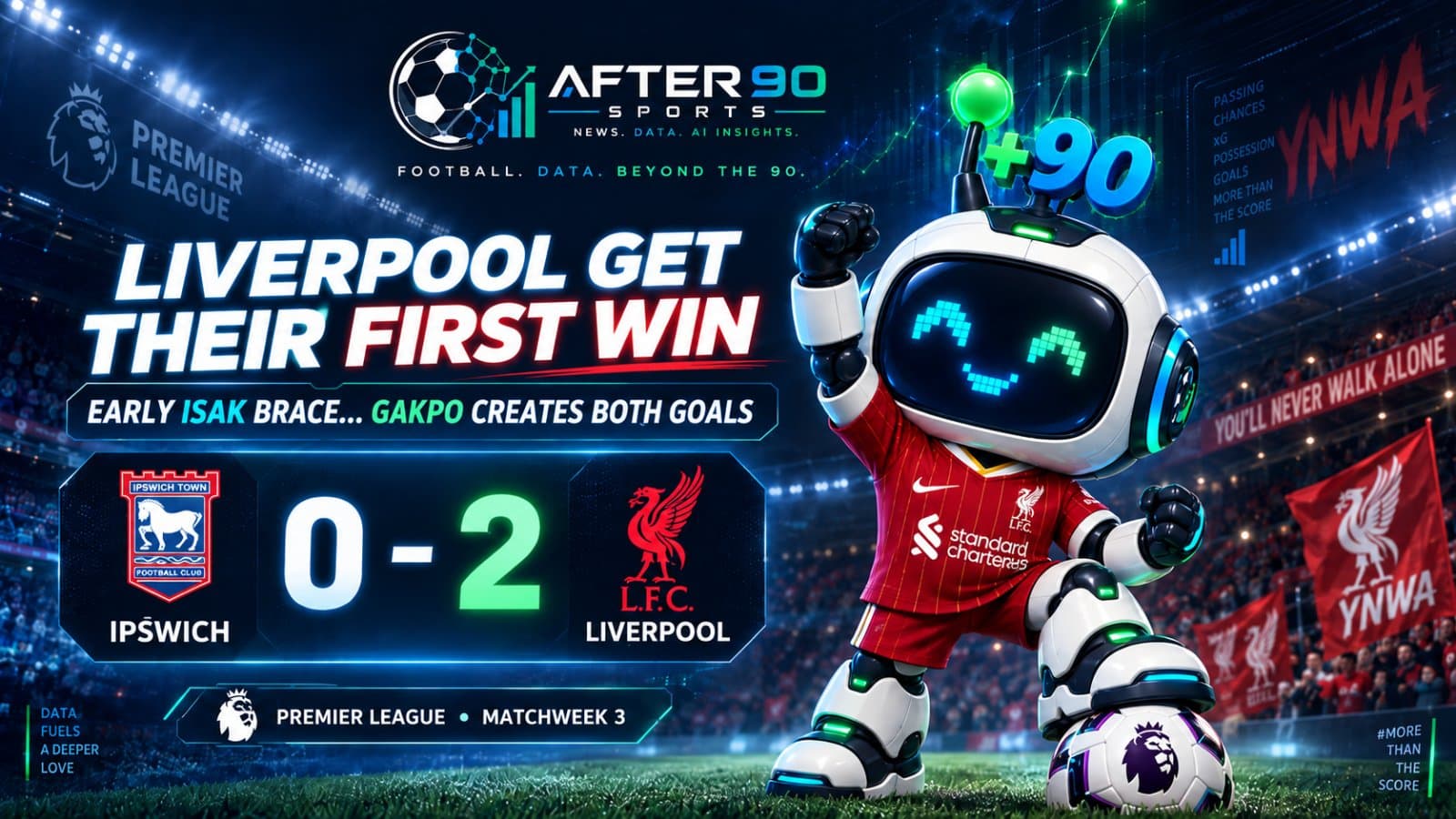
Liverpool secured their first Premier League win of the season with a 2-0 victory over Ipswich. Alexander Isak struck twice early, while Cody Gakpo created both goals in a more controlled Reds performance.
Liverpool needed only nine minutes to put the match against Ipswich exactly where they wanted it.
Alexander Isak scored twice in the 6th and 9th minutes, with Cody Gakpo providing both assists, before Liverpool protected their advantage and left Ipswich with a 2–0 victory.
The result gave Liverpool their first Premier League win of the season after two consecutive draws, taking them to 5 points from 3 matches and fifth place.
But for After90, the most important story is not simply that Liverpool won.
Before the match, we asked:
Does Liverpool need more attack — or more control?
This match gave us part of the answer.
Liverpool scored early, avoided another chaotic contest, and finished with a clean sheet.
But one number still demands attention:
Ipswich took more shots than Liverpool.
So it is still too early to say Liverpool's control problem has completely disappeared.
Isak kills the contest in three minutes
Liverpool started exactly as they needed to.
In the sixth minute, Cody Gakpo created the opening goal for Alexander Isak.
Three minutes later, the same combination struck again:
Gakpo → Isak → goal.
Before the match had even reached ten minutes, Liverpool were already two goals ahead.
That completely changed the nature of the contest.
Instead of being forced to chase the match and increase the tempo, Liverpool put Ipswich in the position of having to take risks.
Isak said after the match that Liverpool had spoken beforehand about starting games better, adding that the team is beginning to understand more clearly how it wants to attack.
He also explained that when Liverpool regain possession, the idea is to move forward quickly before the opposition can reset defensively.
That was exactly what happened during the opening nine minutes.
Cody Gakpo — the real man of the match?
Isak scored both goals.
But if we are looking for the player who had the greatest influence on how the result was created, Cody Gakpo deserves special attention.
Cody Gakpo vs Ipswich
| Metric | Value |
|---|---|
| Assists | 2 |
| Touches | 58 |
| Passes | 38 |
| Pass accuracy | 89% |
| Duels won | 7/10 |
| Rating | 8.05 |
Gakpo did not simply create both goals.
He also won 7 of his 10 duels and recorded the highest rating among the Liverpool players for whom impact data was available.
Isak also spoke after the match about Gakpo's passing quality and ability to find him in the areas where he prefers to receive the ball.
Virgil van Dijk also praised Gakpo's performance and his importance to Liverpool's direct start.
After90 Player Impact
Isak finished the moves.
Gakpo created the conditions that decided the match.
The numbers tell a slightly different story from the scoreline
The result says:
Ipswich 0–2 Liverpool
But the match statistics show that Liverpool's control was not absolute.
| Statistic | Ipswich | Liverpool |
|---|---|---|
| Possession | 45% | 55% |
| Shots | 14 | 10 |
| Shots on target | 5 | 7 |
| Corners | 4 | 3 |
| Fouls | 6 | 13 |
| Yellow cards | 1 | 3 |
Liverpool had more possession and put more efforts on target.
But Ipswich finished the match with 14 shots compared with Liverpool's 10.
And that gives us the key analytical point:
Liverpool controlled the scoreline more than they controlled the volume of shots.
The difference was that Liverpool were far more efficient during the moments that decided the match.
Ipswich reached more shooting situations, but none of them became a goal.
That makes Liverpool's win important.
It does not necessarily mean every underlying problem has disappeared.
From an early 2–0 lead to match management
Once Liverpool scored the second goal, the nature of the test changed.
The question was no longer:
Can Liverpool score?
It became:
Can Liverpool stop the match from becoming chaotic again?
The final score says yes.
But Ipswich's shot volume prevents us from describing the performance as complete defensive control.
Ipswich managed:
- 14 shots
- 5 shots on target
So the more accurate reading is:
🟢 Better game management
But:
🟡 Defensive control still needs more evidence
Liverpool's back line — Van Dijk as the build-up hub
The player-impact data clearly shows how important Virgil van Dijk was in circulating possession from the back.
Virgil van Dijk
- 97 touches
- 90 passes
- 91% pass accuracy
- 4/4 duels won
- 7.31 rating
Among the Liverpool players with available impact data, Van Dijk had the most touches and completed the most passes.
That reflects how Liverpool managed the match after taking the lead.
Not necessarily by attacking constantly, but by keeping possession and recycling the ball through the defensive line.
Jérémy Jacquet — extremely clean on the ball
Alongside Van Dijk, Jérémy Jacquet produced strong numbers in possession:
| Metric | Jacquet |
|---|---|
| Touches | 81 |
| Passes | 67 |
| Pass accuracy | 96% |
| Duels | 5/11 |
| Rating | 7.15 |
His 96% passing accuracy was the highest among the Liverpool players with available data.
But the 5 of 11 duels won also shows that the match still presented physical and defensive challenges.
Szoboszlai — the stabilising presence in midfield
Dominik Szoboszlai delivered a very balanced midfield performance.
- 76 touches
- 61 passes
- 90% pass accuracy
- 2/4 duels won
- 7.58 rating
His rating was the second highest among Liverpool's available impact data, behind Gakpo.
A midfielder capable of retaining the ball at that level of accuracy was particularly valuable once Liverpool were already two goals ahead.
Liverpool did not need to force every attack forward.
They needed to stop Ipswich from turning the game into a constant exchange of transitions.
Florian Wirtz — heavily involved, but tested physically
Florian Wirtz was involved throughout the match:
76 touches
He finished with:
- 48 passes
- 81% pass accuracy
- 5/14 duels won
- 6.96 rating
Compared with Szoboszlai or Gakpo, the duel numbers were clearly more difficult for him.
That gives us one point worth monitoring over the coming matches:
How does Wirtz handle the physical side when games become more aggressive?
One game is not enough to make a judgment.
But it is a useful early signal to track.
Ipswich — they found the shots, but not the finish
A 0–2 result can make it look as though Ipswich were completely out of the contest.
The numbers suggest something slightly different.
Ipswich recorded:
- 45% possession
- 14 shots
- 5 shots on target
- 4 corners
So the problem was not simply reaching shooting positions.
The problem was turning those attempts into goals.
Saša Lukić — Ipswich's passing hub
Saša Lukić was the most active Ipswich player on the ball among those with available data.
He recorded:
- 75 touches
- 65 passes
- 94% pass accuracy
- 2/4 duels won
- 6.77 rating
That passing accuracy helps explain why Ipswich were still able to enjoy decent periods of possession despite going two goals down so early.
The defence kept the ball — but the damage had already been done
Issa Diop completed:
53 passes at 89% accuracy
and won:
3 of 3 duels
Jacob Greaves completed:
52 passes at 88% accuracy
But Liverpool no longer needed to press relentlessly for the rest of the game.
The damage had already been done in the opening nine minutes.
From that point on, Liverpool could defend the result rather than having to recreate the match.
Barcola makes his Liverpool debut
In the 64th minute, Bradley Barcola came on for Víctor Muñoz.
It was his first appearance in a Liverpool shirt.
But the game state did not require him to immediately become the attacking hero.
Liverpool were already two goals ahead, and protecting the score became the priority.
For that reason, it would be better to wait for a larger sample before making any conclusions about his role in the new system.
After90 Trend Check
Before the match, we asked:
Does Liverpool need more attack or more control?
After the match, we can give our first verdict.
🟢 Attack is not the primary problem
Two goals inside nine minutes, with two assists from Gakpo, showed that Liverpool can still create decisive attacking moments.
🟢 Match management improved
After going 2–0 up, Liverpool did not allow the game to become another open shootout and finished with a clean sheet.
🟡 Defensive control is still under examination
Ipswich finished with 14 shots, more than Liverpool.
So it would be premature to say Liverpool have completely solved the issue of allowing opponents opportunities.
Verdict
🟡 Clear improvement — but we need more matches
That may be the best description of the entire performance.
What changed from the first two rounds?
Liverpool entered Matchweek 3 after two draws.
This time:
They scored first.
They doubled the lead quickly.
And they never needed to chase the game.
That matters.
A team that starts well gets to choose the type of match it wants.
A team that falls behind is forced to take risks.
Isak said after the game that the stronger start had been something Liverpool discussed before kick-off.
That makes the opening nine minutes more significant than simply two goals.
They changed the entire scenario Liverpool played in for the rest of the match.
Head-to-head — Liverpool's dominance continues
This was the third meeting listed in the After90 dataset between the two teams.
Liverpool have won all three:
- Ipswich 0–2 Liverpool
- Liverpool 4–1 Ipswich
- Ipswich 0–2 Liverpool
Ipswich are still looking for their first point against Liverpool across those meetings.
Beyond the 90
Liverpool got what they needed.
A win.
A clean sheet.
And two early goals that removed the need for another chaotic match.
Alexander Isak was the finisher.
Cody Gakpo was the architect.
Van Dijk and Szoboszlai helped Liverpool manage what came afterwards.
But After90 should not allow the scoreline to become bigger than the performance.
Ipswich attempted 14 shots compared with Liverpool's 10.
That means the question we asked before kick-off remains partially open:
Have Liverpool become better at controlling matches?
After Matchweek 3, the answer is:
Yes, in managing the scoreline.
But:
There is still not enough evidence to say that the problem of conceding opportunities has disappeared.
That is the trend to monitor next.
Because the first win matters.
But for a team aiming to return to the top, the goal cannot simply be to win once.
The goal is to make winning repeatable.
Match Data — After90
| Metric | Ipswich | Liverpool |
|---|---|---|
| Score | 0 | 2 |
| Possession | 45% | 55% |
| Shots | 14 | 10 |
| Shots on target | 5 | 7 |
| Corners | 4 | 3 |
| Fouls | 6 | 13 |
| Yellow cards | 1 | 3 |
Goals
- 6' Alexander Isak — assist Cody Gakpo
- 9' Alexander Isak — assist Cody Gakpo
Sources
- Match statistics and player-impact data: After90Sports database
- Liverpool FC — Alexander Isak's post-match reaction regarding the strong start and his connection with Cody Gakpo
- Reuters — Match report, Virgil van Dijk reaction and Bradley Barcola's debut
After90 Note: All numerical match statistics in this analysis come exclusively from the verified After90Sports dataset supplied for this report. External sources are used only for context, quotes and reactions.